Dogecoin Nears Cycle Base Near $0.063 as Spot ETFs Log a Month of Zero Net Flows
Key Takeaways
- •Dogecoin dropped 2.66% over 24 hours to roughly $0.0631 on November 14, moving in line with Bitcoin's 2.63% fall amid a wider cryptocurrency selloff, with no token-specific catalyst identified.
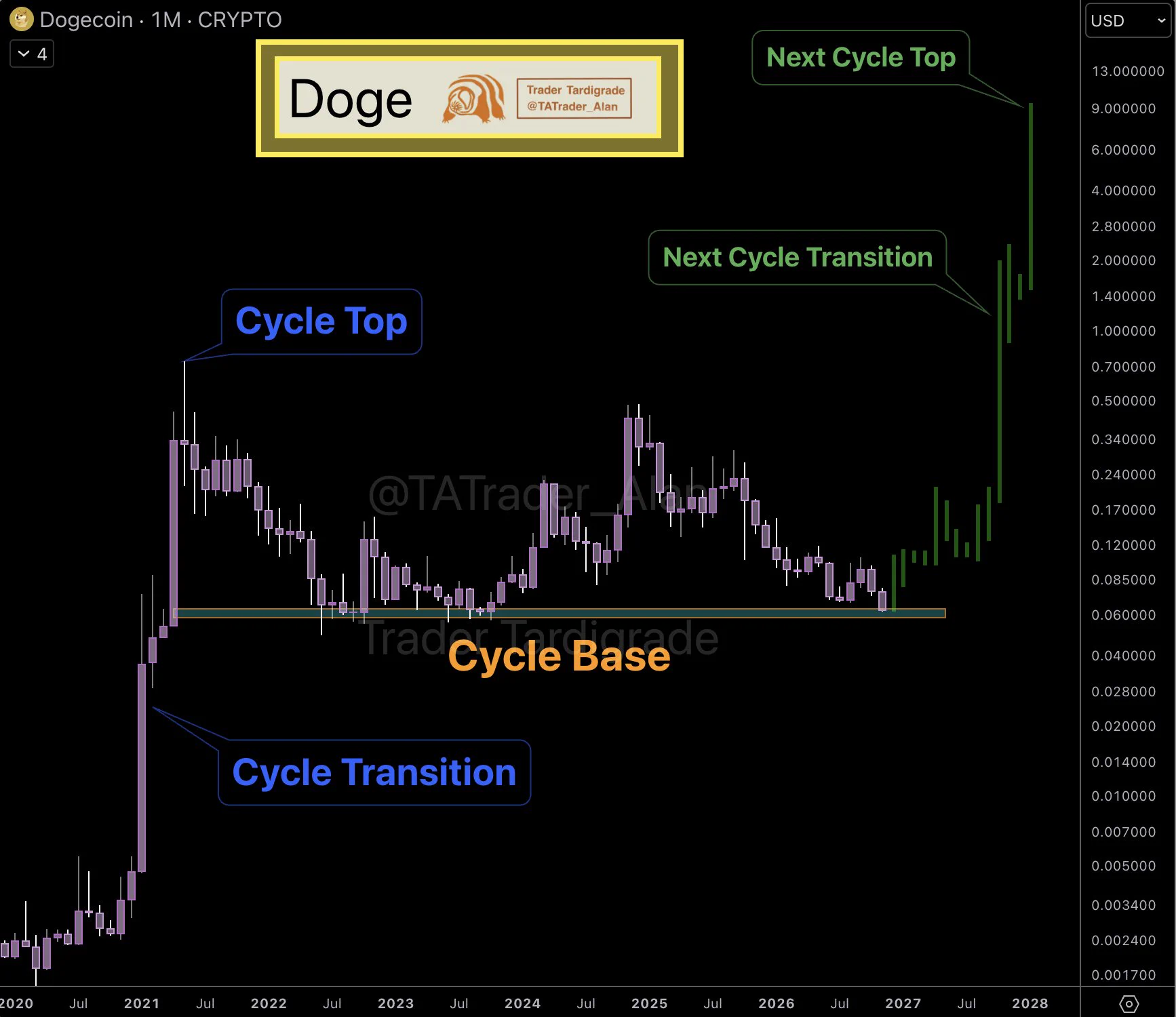
- •Analyst Trader Tardigrade identified the current area on Dogecoin's monthly chart as a zone that produced bounces in previous cycles, meaning a rebound could trigger a transition into the next phase of the market cycle.
- •If the $0.062 support holds and Bitcoin remains above $67,000, Dogecoin could target $0.067, while a break below that support could bring $0.060 into focus.
- •Neither Grayscale's GDOG nor 21Shares' TDOG reported a daily net inflow or outflow from October 14 through November 13, though zero net flows do not prevent investors from trading existing ETF shares on exchanges.
- •The two funds reported combined net assets of roughly $10.74 million, with Grayscale's $9.15 million representing about 85% of the total, underscoring how early-stage the Dogecoin ETF category remains.
Dogecoin traded around $0.0631 on November 14 after slipping 2.66% in 24 hours, a decline that closely tracked Bitcoin's 2.63% drop during a broader cryptocurrency selloff, according to market data. The move pushed the meme coin toward $0.062, a level traders are watching for signs of support, and coincided with a month of zero daily net flows across the two tracked US spot Dogecoin ETFs.
Despite the weakness, crypto analyst Trader Tardigrade argues that Dogecoin has reached a potential cycle base and expects a bounce could lead into the next phase of its market cycle. The combination of sliding prices and dormant ETF flows now frames the near-term picture for the token.
Analyst Sees Cycle Base on the Monthly Chart
In a November 14 post on X, the analyst pointed to Dogecoin's monthly chart and described the current area as a zone where the price bounced in previous cycles. He expects another rebound could move DOGE into what he calls a cycle transition.
His view rests on the token repeating earlier price behavior, although past rebounds do not guarantee another recovery. The monthly chart offers a longer view than daily price swings, which also means a possible cycle shift could take time to develop, and a lasting bottom remains unconfirmed.
Key Levels in Focus
The near-term outlook centers on $0.062 support. CoinGlass data showed the Dogecoin price touched $0.06210 on November 14 before trading around $0.0631. If that support holds and Bitcoin stays above $67,000, DOGE could attempt a move toward $0.067, a target sitting about 6.2% above the quoted price. A break below $0.062 could instead bring $0.060 into focus, roughly 4.9% below current levels.
The Dogecoin price has moved alongside Bitcoin during the latest decline, and no verified Dogecoin-specific event has emerged as the clear cause of the selloff.
Trading figures also show a slight slowdown on Binance. CoinGlass recorded $38.76 million in DOGE trading volume on November 13, down from $39.12 million the previous day. Those figures cover one exchange and do not capture the entire market.
DOGE closed at $0.06751 on November 11, before falling to $0.06454 on November 13. Reclaiming $0.067 would bring the token back near that earlier closing price.
Dogecoin ETFs Record a Month Without Daily Net Flows
The price decline has unfolded alongside a quiet period for the two US spot funds tracked by SoSoValue. Neither Grayscale's GDOG nor 21Shares' TDOG reported a daily net inflow or outflow from October 14 through November 13.
According to SoSoValue, the last reported daily outflow totaled $138,570 on October 13. Another tracker attributes that withdrawal to Bitwise's fund rather than to the two products still trading. Bitwise's DOGE ETF had its final trading day on October 14 and was liquidated on October 22, with remaining shareholders receiving cash.
Zero net flows do not mean ETF shares stopped trading. The figure measures net creations and redemptions, while investors can still buy and sell existing shares on an exchange. The data also cannot show whether institutions alone bought or sold shares, since retail investors can trade these funds too, and matched buyers and sellers need not trigger a net flow.
Grayscale's product began trading in November 2025, while 21Shares launched its ETF in January 2026. Both give investors exposure to Dogecoin through a brokerage account without requiring them to hold the coin directly. As spot funds, they hold the underlying coin rather than derivative contracts. Dogecoin itself dates to 2013, when it launched as a lighthearted token and grew into the sector's best-known meme coin, and its ETF listings extend a US spot-fund structure already available for Bitcoin and Ethereum.
Grayscale reported $9.15 million in net assets as of November 13. The latest available figure from 21Shares showed about $1.59 million as of November 12. Together, those reported figures amount to roughly $10.74 million, with Grayscale representing about 85% of the combined total, although the two figures reflect different dates. Less than $11 million across two young funds, the figures underline how early in its life this product category remains.
ETF assets can fall when the Dogecoin price declines, even without withdrawals. Conversely, a price recovery could lift those assets without attracting new money. Any renewed creations or redemptions at either fund would appear in SoSoValue's daily flow data, giving readers a trackable signal to follow alongside the price levels above.
Originally reported by Blockonomi.

