Dogecoin falls below $0.083 as muted ETF demand and bearish positioning constrain recovery
Key Takeaways
- •US spot Dogecoin ETFs have shown little activity since last week, suggesting institutional demand remains subdued.
- •Long-to-short ratios below 1, reported at 0.66 and 0.84, indicate that short positions outnumber long positions.
- •Dogecoin’s open interest-weighted funding rate was slightly positive at 0.0010% on Tuesday, showing limited demand for leveraged long positions.
- •DOGE is above its 50-day and 100-day EMAs but remains below the 200-day EMA, leaving its broader technical structure neutral to bearish.
- •A break above $0.088 could target $0.092 and $0.102, while a daily close below $0.070 could lead to a deeper retracement.
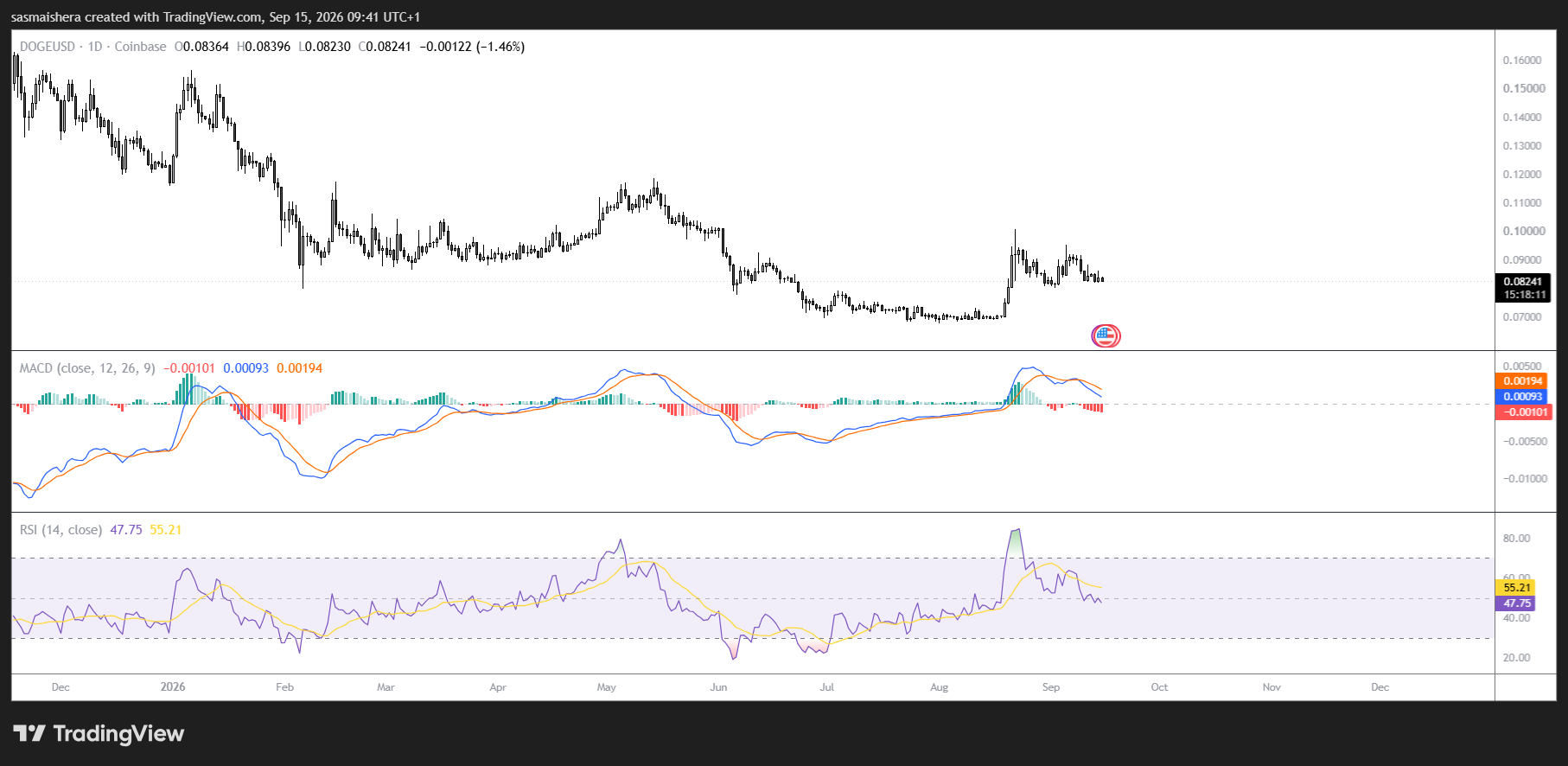
Dogecoin (DOGE) traded below $0.083 on Tuesday after finding support around a key technical zone during the previous session. The meme coin remains above its 50-day and 100-day exponential moving averages, creating a potential base for recovery. However, subdued institutional demand, bearish derivatives positioning and cautious on-chain indicators suggest that buyers have not yet regained strong conviction.
DOGE is at a critical level. Holding above its nearby moving averages could support another advance, while a breakdown could expose the token to a deeper correction.
Dogecoin ETF demand remains subdued
Data from SoSoValue shows that US spot Dogecoin exchange-traded funds have recorded little activity since last week. The lack of meaningful inflows suggests institutional investors remain hesitant to increase exposure despite DOGE’s recovery from approximately $0.070.
Continued stagnation would deprive the token of an important source of demand. If ETF flows turn negative, selling pressure could increase and undermine Dogecoin’s attempt to establish a short-term bottom.
Dogecoin’s derivatives market is sending conflicting signals about trader positioning. The article’s key takeaways identify DOGE’s long-to-short ratio as having fallen to a one-month low of 0.66. Separately, CoinGlass data shows the ratio at 0.84 on Tuesday, its lowest level in more than a month. In either case, a reading below 1 means short positions outnumber longs, indicating that more traders expect the price to decline.
Funding rates offer a slightly more positive indication. Dogecoin’s open interest-weighted funding rate turned positive on September 9 and stood at 0.0010% on Tuesday. A positive funding rate means that holders of long positions are paying short sellers, reflecting some demand for bullish leveraged positions. However, the rate remains modest and does not fully offset the bearish signal from the long-to-short ratio.
CryptoQuant’s market summary also indicates a mildly bearish outlook. Large whale orders are appearing in Dogecoin’s futures market, but sell-side activity remains dominant. Spot-market conditions are becoming more active, while several other indicators remain neutral.
Taken together, these readings suggest that larger traders are active but are not necessarily accumulating DOGE aggressively. The market remains vulnerable to further weakness unless buying pressure strengthens.
DOGE remains above short-term moving averages
Dogecoin is trading above its 50-day EMA at $0.081 and its 100-day EMA at $0.082. This moving-average cluster forms the token’s immediate support zone.
DOGE remains below the 200-day EMA at $0.092, however, leaving its broader technical structure neutral to bearish. The Relative Strength Index is near 47, indicating balanced momentum between buyers and sellers. Meanwhile, the Moving Average Convergence Divergence line remains slightly below zero, showing that bullish momentum is still limited.
DOGE’s first notable resistance is near $0.088. A breakout above that level could allow buyers to challenge the 200-day EMA at $0.092. If that barrier is cleared, the next significant supply zone would be around $0.102.
On the downside, a loss of the $0.081–$0.082 EMA cluster would weaken the short-term recovery. The next major support is at $0.070, and a daily close below that level could trigger a more substantial retracement.

