Poverty Gains, Fiscal Misses: A Mixed Verdict on Marcos Jr.'s Economic Promises
Key Takeaways
- •Poverty incidence among individuals fell to 9.7% in 2025 from 15.5% in 2023, placing the administration ahead of its poverty target.
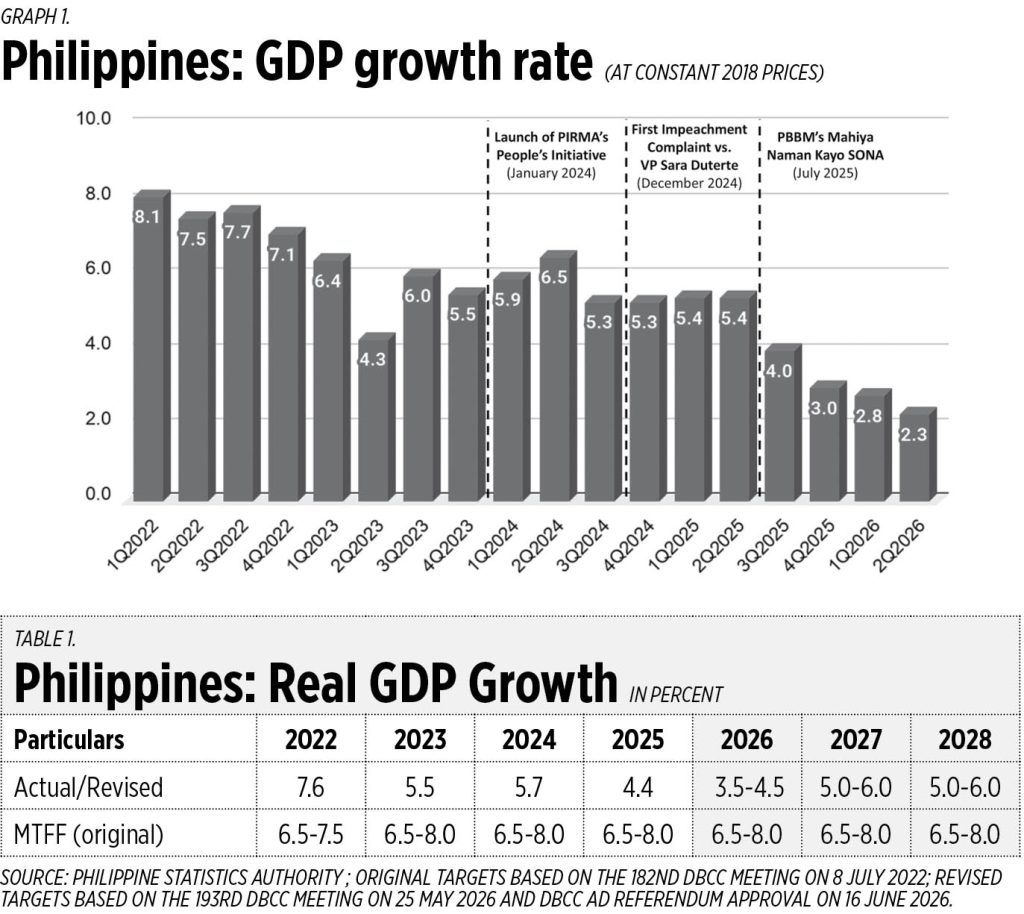
- •Economic growth weakened over time, dropping from 8.1% in the first quarter of 2022 to 2.3% in the second quarter of 2026.
- •The administration missed its fiscal consolidation targets, with debt, deficits, and interest payments all moving worse than planned.
- •National government debt reached a record P19.07 trillion at the end of June 2026, and interest payments are projected to absorb 22.4% of revenue by 2028.
- •Infrastructure spending met the 5% to 6% GDP target in the first half of the term, but Diokno said poor execution and corruption concerns have weakened the quality of spending.
In an opinion column for BusinessWorld, economist Benjamin E. Diokno graded the administration of President Ferdinand Marcos, Jr. against five economic pledges — and found the record mixed.
In Philippine politics, presidential candidates promise abundance with ease. Governing, by contrast, tests how much of that abundance can survive contact with fiscal arithmetic. The promises that matter most are therefore not campaign flourishes, but commitments made after a president-elect has seen the books, assembled a Cabinet, and begun to govern from inherited conditions rather than applause lines.
The Five Economic Promises
Taking office after the pandemic and the fiscal damage it left behind, President Marcos made five economic pledges against which his administration can now be judged:
- The Philippine economy would grow at a sustainable and rapid rate of 6.5% to 8% from 2023 to 2028.
- Poverty incidence would be reduced to single digits by the end of his term, specifically 9% or lower by 2028.
- The National Government debt-to-GDP ratio would fall to 51.1% by 2028 from 61.8% in 2022, and the fiscal deficit-to-GDP ratio would narrow from -7.6% in 2022 to -3% by 2028. The debt-to-GDP ratio was 39.6% before the COVID-19 pandemic. These twin goals underpin the fiscal consolidation program.
- High-quality public spending would be ensured by investing 5% to 6% of GDP in public infrastructure — the essence of the Build Better More program, a continuation of the previous administration's Build, Build, Build program.
- The unemployment rate would be brought down to around 4% to 5% from 2022 to 2028, with one million jobs generated per year.
The Verdict: Mixed
Economic Growth
The administration started out strong, with output exceeding the target in Mr. Marcos' first year. Growth then slowed markedly over time, falling from 8.1% in the first quarter of 2022 to 2.3% in the second quarter of 2026. That slowdown matters because growth is the base that supports jobs, revenues, and the room government has to fund services without leaning more heavily on borrowing. The government's forecast of 3.5% to 4.5% annual growth in 2026, and 5% to 6% annually in 2027-28, now looks hopeful rather than hard-headed. Rating: 3.0 (Passed).
Poverty Alleviation
Reducing poverty is the administration's strongest claim. Mr. Marcos promised to lower poverty incidence to single digits, possibly to 9% or less by 2028, and on this measure he is ahead of schedule. According to the Philippine Statistics Authority's Family Income and Expenditure Survey, poverty incidence among individuals fell to 9.7% in 2025 from 15.5% in 2023.
That decline reduced the number of Filipinos below the poverty threshold from 17.5 million in 2023 to 11.1 million in 2025. The national poverty threshold in 2025 was P14,634 a month for a family of five, or about P97 per person per day. Rating: 1.0 (Excellent).
Fiscal Consolidation
Fiscal consolidation tells a gloomier story. The administration promised to lower both the debt-to-GDP ratio and the fiscal deficit-to-GDP ratio, and it has missed both. The original target was to bring debt down to 51.1% of GDP by 2028; the revised target is now 64.2%. Since 2024, the actual path has trailed steadily behind the Medium-Term Fiscal Framework.
The deficit has followed the same pattern. It was close to plan in 2023, but from 2024 onward the actual deficit moved progressively above the target path.
National government debt reached a record P19.07 trillion at the end of June 2026, of which P12.84 trillion was domestic and P6.23 trillion was external. This does not signal a crisis, but it is an increasingly costly constraint. In the proposed 2027 budget, P1.1 trillion — or 15.5% of total spending — is earmarked for the debt burden, money that could otherwise have been spent on infrastructure, health, education, and social protection.
Interest payments make the warning clearer. They are rising as a share of revenues just as slower growth threatens collections and global uncertainty risks keeping borrowing costs high. By 2028, interest payments are projected to absorb 22.4% of revenue, almost twice the planned 12.5%. Fiscal consolidation therefore needs more urgency, not further postponement.
Across the three tests of fiscal discipline — debt, deficits, and interest payments — the administration is off course. There is still time to correct the slippage, but the adjustment will become more painful the longer it is delayed. Rating: 4.0 (Conditional Failure).
Quality of Public Spending
The infrastructure case is straightforward. The Philippines still trails its ASEAN-5 peers — Indonesia, Malaysia, Thailand, and Singapore — after decades of underinvestment. Over the past half-century, the country spent only about 2% of GDP on public infrastructure, far too little for an economy that wants to grow faster and compete regionally. Spending 5% to 6% of GDP was therefore a sensible goal, first under Build, Build, Build and now under Build Better More.
Roads, bridges, railways, and airports are not mere ornaments; they are the plumbing of commerce. The administration did meet its 5% to 6% spending goal in the first half of its term. The problem is quality. Too much of the capital budget appears to have been misallocated, mismanaged, or lost to corruption.
The response has been to shrink the public construction budget to 4.03% of GDP in 2027 and 3.96% in 2028. That is the wrong cure, Diokno argues. Corruption should be met with better procurement, stronger implementation, greater transparency, and credible punishment, not with less investment. The Philippines needs cleaner infrastructure spending, not a smaller ambition.
Actual infrastructure spending as a percent of GDP was within target during the first three years of the Marcos Jr. administration. How much became real construction remains unclear. Planned spending for 2026-28 is disappointingly low, though still above the historical average. Rating: 3.0 (Passed).
Employment Generation
Employment remains the most defensible part of the record after poverty reduction. The target of a 4% to 5% unemployment rate is attainable, and creating one million jobs a year remains possible. But the risks are accumulating: weaker growth could squeeze micro, small and medium enterprises; wage increases above inflation and productivity could slow hiring; and global uncertainty, from wars to trade tensions, could reduce the deployment of overseas Filipino workers.
The jobs market ultimately depends on economic growth. As output slowed in 2025, unemployment rose. Sustained job creation therefore requires not only labor-market programs but a stronger economy. Rating: 2.0 (Good).
Final Words
The record is uneven. President Marcos can claim real progress on poverty reduction and a broadly defensible performance on employment, but growth has weakened, fiscal consolidation has continued to miss the mark, and infrastructure policy has been pulled down by poor execution and corruption concerns. The lesson is not that the original economic promises were misplaced, but that they now require harder choices: faster growth, cleaner public spending, and a more credible return to fiscal discipline.
Benjamin E. Diokno is an economist, professor emeritus of Economics, and monetary board member of the Bangko Sentral ng Pilipinas. He was secretary of Budget and Management under three administrations (Corazon Aquino, Joseph Estrada, and Rodrigo Duterte), served as chairman of the Monetary Board and BSP governor from 2019 to 2022, and was secretary of Finance under Ferdinand Marcos, Jr. from 2022 to 2024.
Source: BusinessWorld

