Din Tai Fung CEO Says Training Has Eased Dumpling-Folding Bottleneck as Chinese Restaurants Scale
Key Takeaways
- •Din Tai Fung's U.S. restaurants averaged $27.4 million in sales in 2024, nearly double the figure of the next-closest chain, according to Technomic data.
- •The chain addressed its dumpling-folding labor bottleneck by formalizing the skill into a career track with a 12-week training program and a dumpling training manager at every U.S. restaurant.
- •Chinese restaurants in the 20 largest U.S. metropolitan areas declined by roughly 1,200 locations between 2014 and 2019 as the family labor pool weakened and owners' college-educated children pursued other careers.
- •Standardized processes enabled large-scale growth, exemplified by Panda Express, which now operates more than 2,600 U.S. locations with annual sales exceeding $6 billion.
- •Din Tai Fung opened three U.S. restaurants this year and has signed for a 20,000-square-foot space in Downtown Brooklyn scheduled to open in 2027.
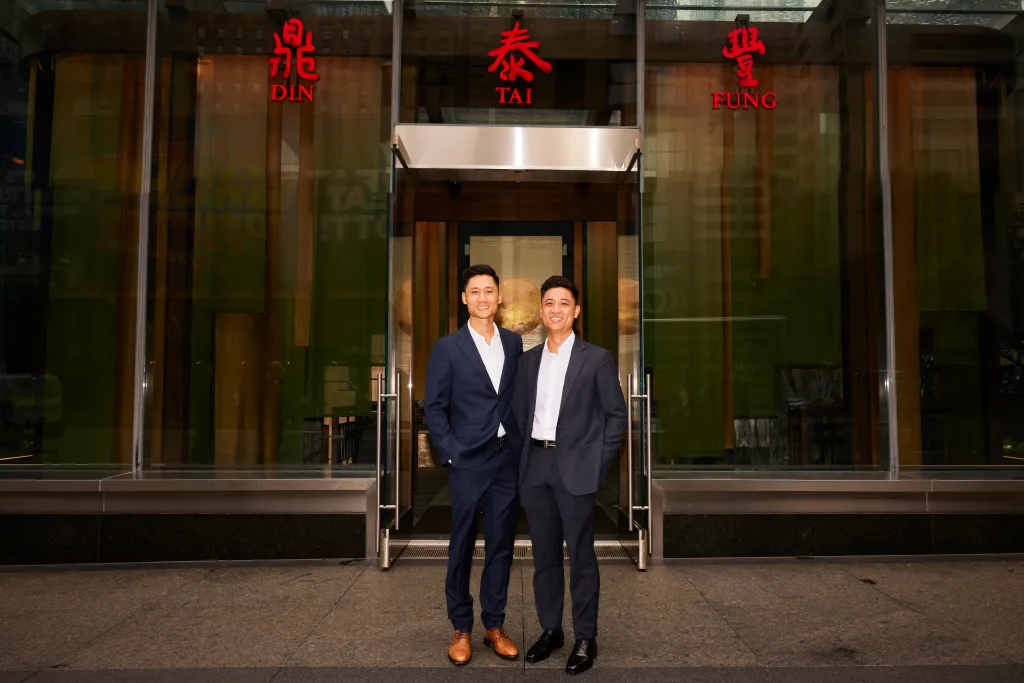
The restaurant chain with the highest per-store sales in the United States says the factor that once limited its growth was a highly specific labor shortage: people capable of folding its soup dumplings to exacting standards.
Anyone who has eaten at Din Tai Fung may have seen the lab-coated technicians working behind glass windows. “The bottleneck used to be dumpling-folding talent,” Albert Yang, CEO of Din Tai Fung North America, told Fortune by email. “But through continuous improvements to our training programs, we’ve largely overcome that challenge.”
The idea of “dumpling-folding talent” reflects a broader shift in the Chinese-American restaurant industry. For much of the time Chinese food has been sold in the United States, family members supplied the labor: owners, spouses, children and extended relatives. Lucas Sin, a chef at New York-based Junzi Kitchen, described the pattern at a 2020 Fortune roundtable as “a cousin of a cousin of a cousin from Fujian.”
At Din Tai Fung, folding dumplings is now a formal corporate career track. The company has a 12-week training program and a dumpling training manager at every U.S. restaurant, Yang told the Los Angeles Times in 2023.
The transition from family labor to standardized systems is helping reshape Chinese food businesses in America. Din Tai Fung’s U.S. restaurants averaged $27.4 million in sales in 2024, nearly twice the figure of the next-closest chain, according to Technomic data reported by Restaurant Business. Panda Express, which was co-run by an engineer who built her own point-of-sale system in the 1980s, now generates more than $6 billion a year.
When family labor was the business model
The traditional Chinese-American restaurant model, according to people who operated such businesses, relied on inexpensive labor at the beginning and a ready customer base at the end.
“You could always hand it off to the next wave of immigrants. Toisan to Hong Kong to Taiwan to Fujian,” Jennifer 8. Lee, author of The Fortune Cookie Chronicles, said during the 2020 Fortune roundtable about New York’s Chinese restaurants. “But now it’s pretty good in China. Why go into debt coming to America and buying a restaurant?”
Foreign Policy reported in 2019 that migration from rural Fujian, which had supplied workers for American takeout kitchens in the 1980s and 1990s, had slowed as living conditions in China improved. Monthly wages for takeout cooks had risen from about $1,500 in the 1980s to nearly $4,000.
The family labor pool also weakened. A 2019 New York Times analysis of Yelp data found that Chinese restaurants accounted for 7.3% of all restaurants across the 20 largest U.S. metropolitan areas five years earlier, compared with 6.5% in 2019—a decline of about 1,200 locations. The analysis attributed the drop in part to owners retiring while their college-educated children pursued other careers.
“There was no succession plan, because success was seen as not having to do it anymore,” Jason Wang, cofounder of Xi’an Famous Foods, said at the Fortune roundtable.
The pressure on restaurant operators has continued. In 2025, chain restaurant sales grew at their slowest pace outside the pandemic era since the Great Recession. In its coverage of the Technomic Top 500, Restaurant Business listed an immigration crackdown among the contributing factors, alongside weak consumer confidence, weight-loss drugs and bad weather.
Yang described the demand side through his own childhood. Many Americans, he said, first encountered Chinese food at inexpensive fast-food and fast-casual restaurants opened by immigrants who could not afford elaborate dining rooms.
“They were focused on surviving, supporting their families, and building a future for the next generation,” Yang said.
The food offered by his family’s company now occupies a more aspirational position, he said. “I remember growing up, my mom would pack me Chinese food for lunch, and other kids would sometimes make fun of me for it,” he said. “Now, I hear from parents that their kids actually think it’s cool when someone brings leftover Din Tai Fung to school for lunch.”
Din Tai Fung was inducted into the Asian Hall of Fame this month as a “Global Family Legacy” honoree. Albert and Aaron Yang accepted the honor on behalf of the family at the Nov. 5 ceremony in Los Angeles.
Systems help Chinese food chains scale
The Chinese food businesses that have expanded across the United States are generally those that replaced family labor with standardized processes early in their development.
Panda Express is a prominent example. Andrew Cherng’s family opened Panda Inn in Pasadena in 1973. Business was initially so slow that his mother would sprinkle salt on the threshold to ward off evil spirits, he said at Nation’s Restaurant News’ CREATE conference in July. His wife, Peggy Cherng, was trained as an engineer. When point-of-sale systems were barely available in the mid-1980s, she built one for the company.
“We had to develop it ourselves,” she said at the conference, according to Nation’s Restaurant News. Panda Express now has more than 2,600 U.S. locations, annual sales of more than $6 billion and its own Panda University for employees. It ranks 11th among U.S. chains.
Industry observers anticipated the shift toward centralized systems years ago. “Automation and central kitchens will take over,” Wong of the culinary federation told Foreign Policy in 2019. Zhao predicted that takeout restaurants would be consolidated under new brands able to keep prices low through automation.
Some of the newest entrants to the U.S. market already arrive with those systems in place. Chinese chains including HeyTea, Chagee, Luckin Coffee, Wallace and Haidilao—some of which have thousands of stores in China—have expanded into U.S. cities while seeking alternatives to a price war in a saturated domestic market, The New York Times reported in December 2025.
“China’s food service industry is suffering from severe oversupply,” Bob Qing, founder of restaurant investor Tomato Capital, told the newspaper. Limited-service Asian and noodle chains increased their U.S. sales by 7.8% in 2025, more than any other segment, according to Technomic data reported by Restaurant Business.
Turning dumpling-making into a job description
Din Tai Fung offers a particularly clear example because its core product is also the part of its operation that is most difficult to systematize. Each restaurant produces about 10,000 dumplings a day with roughly 30 chefs working in rotation. Each dumpling is expected to have 18 folds and weigh 21 grams, according to the Los Angeles Times.
Kan Kuang-Ming, the chain’s head chef in Taiwan, told the paper: “You have to fail about 1,400 times before you can make one that is beautiful.”
In Taiwan, new chefs learn by shadowing a senior chef. In the United States, they instead complete a formal training program. “Our current training program is 12 weeks, though it still takes six months and up to a year to get up to speed,” Albert Yang told the Times in 2023. At the time, he said entry-level hourly positions started at $20 an hour, while managers earned $100,000.
The family business itself began through a more traditional path. Founder Bing-Yi Yang opened a cooking-oil shop in Taipei in 1958, according to Restaurant Business, and later hired a Shanghai-born chef to make soup dumplings, the Los Angeles Times reported. When Bing-Yi’s son Frank opened the first U.S. location in Arcadia, California, in 2000, the founder’s grandsons worked at the register.
“We were running credit cards when we could barely even see over the counter,” Aaron Yang told the newspaper.
Albert Yang now says Din Tai Fung’s systems are sufficiently developed to support faster expansion. The company opened three U.S. restaurants this year—in Irvine and Brea, California, and Scottsdale, Arizona. Yang credited years of investment in the company’s employees, leadership development, training programs, operational systems and production capabilities.
Asked by Fortune whether the company faced a ceiling, Yang said: “I don’t believe in setting an arbitrary limit.”
He identified the company’s own standards as its current constraint. “Today, our bottleneck isn’t necessarily a physical or operational constraint,” he said. “It’s a self-imposed one driven by the quality standards we’re unwilling to compromise.”
Real estate is another limitation. A typical Din Tai Fung requires 10,000 to 20,000 square feet, which Yang described as “incredibly challenging” to find in a prime location in Manhattan or Brooklyn.
For New Yorkers who waited years for the chain’s first location, which opened in the Broadway district in the former Mars 2112 space, a second location is planned. Din Tai Fung has signed for 20,000 square feet at The Brook, a 52-story tower at 567 Fulton St. in Downtown Brooklyn. The restaurant is scheduled to open in 2027, according to the Brooklyn Paper.

