Diesel Sits Just Below Prior Peak as Brent Futures Hold at $92.38
Key Takeaways
- •Diesel prices are running only slightly below their previous peak even though Brent crude is trading lower than it did in March or June, according to Econbrowser's update based on EIA data.
- •Front-month Brent futures on the New York Mercantile Exchange were quoted at $92.38 as of 3:23 PM CT at the time of the report.
- •The update's author stated he sees no reason for Brent to fall on a sustained basis and therefore no particular reason for diesel to drop.
- •The crack spread—the margin between refined product prices and crude—moves with refinery utilization, refining capacity, and product inventories, which is why diesel and Brent can diverge for months at a time.
- •Diesel price shifts feed into freight and agricultural operating costs, and heating oil draws on the same distillate supply stream, meaning cold-weather demand taps that same supply.
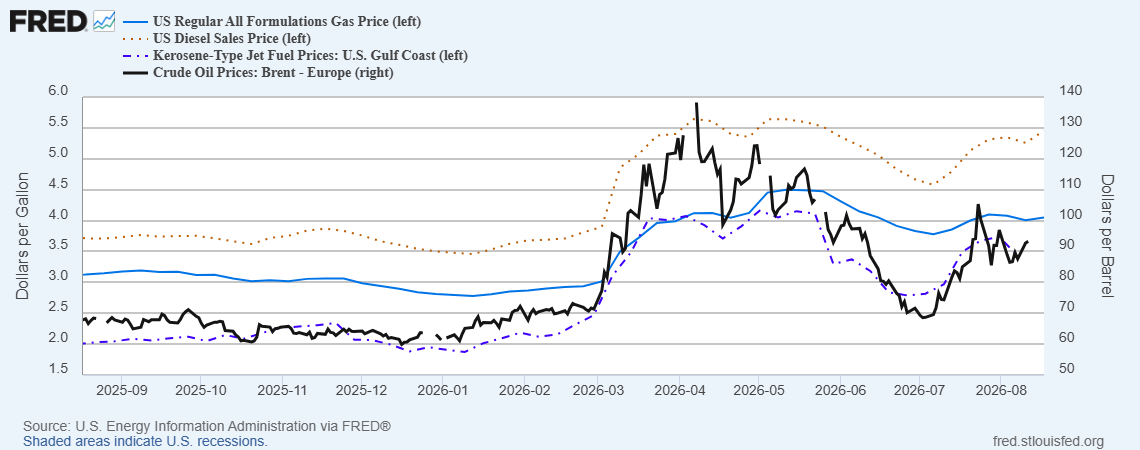
Diesel prices are running only slightly below their previous peak, even though Brent crude has been trading lower than it did earlier this year in March or June, according to Econbrowser's latest Gasoline and Diesel update, which draws on data from the U.S. Energy Information Administration (EIA).
Front-month Brent futures on the New York Mercantile Exchange (NYMEX) were quoted at $92.38 as of 3:23 PM CT at the time of the report.
The author of the update wrote: "I don't see a reason for Brent to go down on a sustained basis, so no particular reason for a drop in diesel."
Divergences of this kind — a refined product holding near its previous peak while crude trades below its earlier levels — generally reflect conditions in refining as much as in crude markets. The margin between refined product prices and crude, known in the industry as the crack spread, moves with refinery utilization, refining capacity, and product inventories, which is why diesel and Brent can track each other over the long run yet part ways for months at a time.
Brent is one of the primary global benchmarks for crude oil pricing, alongside West Texas Intermediate (WTI) in the United States. Front-month futures contracts represent the nearest delivery month and are widely followed as a near-real-time indicator of spot-market price levels. NYMEX, part of CME Group, is the exchange where key energy futures contracts, including the Brent contract referenced in the update, are traded.
Diesel is a distillate fuel refined from crude oil and used primarily in trucking, agriculture, construction, and industry, as well as for heating in some markets. Because trucking fleets and farm equipment run on diesel, price shifts feed through to freight and agricultural operating costs, one reason economists track it alongside gasoline. Because crude oil is the principal input in diesel production, diesel prices generally move in line with crude benchmarks such as Brent. Heating oil, used widely in the U.S. Northeast during winter, comes from the same distillate refining stream, so cold-weather demand draws on the same supply. The EIA, the statistical agency of the U.S. Department of Energy, publishes weekly and monthly data on U.S. refinery output, inventories, and prices for gasoline, diesel, and other petroleum products, which analysts use to track conditions in fuel markets; among the most closely followed diesel series are the weekly U.S. on-highway retail diesel price and the distillate inventory and refinery utilization figures in the agency's Weekly Petroleum Status Report.
Source: Econbrowser

