DHL says heavy air freight drove 30% operating profit growth
Key Takeaways
- •DHL Express operating income rose 64% as heavier shipments, disciplined pricing and cost control lifted performance.
- •Temporary air cargo capacity shortages, especially around the Middle East conflict area, added about $172.6 million to earnings.
- •DHL raised its full-year EBIT guidance to $7.43 billion after reporting stronger quarterly earnings momentum.
- •Cross-border freight management operating profit increased 22% on higher air and ocean volumes and better freight rates.
- •Capital expenditures in the first half were 25% higher than a year earlier at $1.5 billion as DHL invested in its 2030 growth strategy.
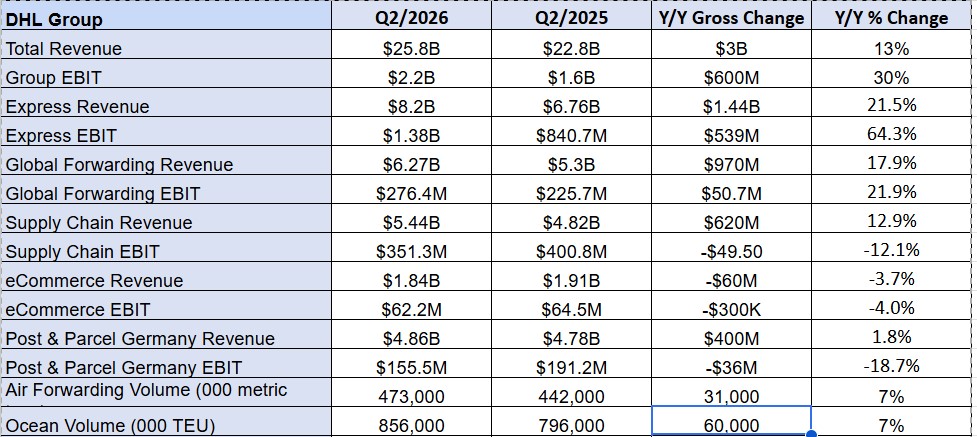
Heavier shipments at DHL Express, tighter air freight capacity and the pass-through of higher fuel costs through surcharge mechanisms helped drive a 30% increase in operating profit for DHL Group amid volatile market conditions.
The latest quarter compared favorably with the same three-month period in 2025, when international shipments weakened after the United States sparked a wave of new tariffs and other restrictive trade policies.
DHL (FRA: DHL) on Wednesday reported net profit rose 24%. Revenue increased 13% to 22.4 million euros, equivalent to $25.8 billion, while earnings before interest and taxes reached $2.2 billion. The operating profit margin improved by 1 percentage point to 8.3%. Reflecting the stronger earnings momentum, DHL raised its full-year forecast last month, guiding to EBIT of $7.43 billion.
Cash flow increased 73% to $655 million, partly because of U.S. tariff refunds that the Supreme Court ruled were illegally applied under emergency powers. DHL said it is passing those refunds on to customers as quickly as possible.
DHL Express operating income jumped 64% as the business continued to benefit from higher weight per shipment, a core measure of asset utilization and customer pricing, along with disciplined yield and cost management. Weight per day for time-definite international shipments is up six points from the first quarter as the company targets more industrial customers. Temporary capacity shortages in the air cargo market, especially around the Middle East conflict area, added about $172.6 million to earnings as volume that would normally have gone to forwarders was moved on overnight DHL flights.
DHL Express, alongside FedEx and UPS, continues to take a larger share of the general air freight market as the companies reallocate capacity on their in-house airlines toward heavier freight and away from low-priced, light parcels as the post-Covid e-commerce boom normalizes. DHL said express carriers now handle more than half of all international air cargo tonnage. According to long-range forecasts from Boeing and Airbus, express air business is expected to grow faster than general air cargo over the next 20 years.
CEO Tobias Meyer told analysts that DHL Express is positioned to gain significant market share in air freight because the network’s scale, design and fuel-efficient freighters allow it to offer logistics companies better speed at affordable prices compared with regular commercial airlines.
“It’s the reliability, the speed and the predictability of the integrator model which is superior to the general air freight product. That is attractive not only for small spare parts, but also for bigger parts like turbines used in aviation or for power generation, and other complex, high-value products,” he said.
DHL Express recently helped a manufacturer of racing-grade motorcycles ship units from China and distribute them across Europe, using Express air assets to move the heavier shipments with greater speed, control and visibility.
CFO Melani Kries said express heavy freight “is not a cheap forwarding product in our premium network. It is a heavier shipment in an express network with express pricing where you take into consideration the cost to produce,” and revenue drops quickly to the bottom line.
DHL, FedEx and UPS have all put greater strategic emphasis on serving the B2B sector and industrial verticals that require specialized logistics and support higher rates, while gradually stepping back from many low-margin last-mile delivery relationships with online retailers.
DHL is also expanding capabilities in premium logistics categories such as life sciences and healthcare, next-generation energy — including electric vehicles, wind and battery storage — and data centers, using a cross-divisional approach to support customers. The company is expanding its healthcare logistics network in the United States, the United Kingdom, Singapore and South Korea.
DHL said it saw a significant increase in AI-related projects, including warehousing, international transportation of parts and components for data centers, inbound logistics to construction sites and material staging.
“There’s obviously high urgency to bring such sites into operation, and that urgency then translates into goods that need interim storage and sequencing to alleviate bottleneck capacities at the construction, and us also taking over even certain installation services on site. That’s the two areas. We also expect significant spare parts business to follow as those installations mature,” Meyer said on the earnings call. He added that data center logistics revenue is expected to grow indefinitely.
Other divisions
DHL’s cross-border freight management business posted a 22% increase in operating profit, supported by growing air and ocean volumes and higher freight rates. Air freight volumes rose mainly in Asia and Latin America, while gross profit per unit of air freight increased 28%.
DHL Supply Chain, which provides warehousing and distribution services, grew revenue by 13%. The unit posted a loss because of a one-time organizational change that substantially boosted earnings in the second quarter of 2025, making the comparison unusually difficult, DHL said. During the first half, more than 700 artificial intelligence and robotics projects went live, accelerating digitalization and automation across operations.
DHL eCommerce continues to be affected by the accounting impact of the 2025 merger of DHL parcel and mail units into British parcel delivery company Evri, in exchange for a minority stake, as well as the resulting loss of revenue contribution from the United Kingdom. Excluding consolidation and currency effects, the division recorded strong revenue growth, supported by the continued structural trend toward e-commerce. On July 27, DHL announced plans to acquire Lithuania-based Venipak to boost competitiveness in the Baltic states.
At Post & Parcel Germany, growing domestic and international parcel business helped offset declining mail volumes, but higher transportation and personnel costs weighed on profits. DHL said it remains focused on improving productivity, maintaining cost discipline and enhancing its processes.
Management said DHL’s cost-management program, Fit for Growth, has delivered $1.2 billion in planned savings six months ahead of schedule, including through digitization and process improvements.
“We are not single-minded about cost,” Meyer said. “We are a service organization and particularly in Global Forwarding it is extremely important to have great people and have great capabilities. We see ourselves having that balanced view and not being single-mindedly obsessed about cost.”
CapEx
Capital expenditures were 25% higher in the first half than in 2025, at $1.5 billion, as DHL continued to invest in its network and new capabilities in line with its 2030 growth strategy.
FedEx Corp. and UPS, by comparison, have reduced capital spending in recent quarters as they work through excess capacity in their freight networks, although they still invest at comparable levels to DHL after starting from a higher base. At FedEx, capital spending for the fiscal year ended May 31 totaled $3.8 billion, down $246 million, or 6%, from fiscal 2025. Capital spending as a percentage of revenue fell to 4%, the lowest annual level in FedEx history.
Meyer said DHL is balancing investment in growth with returns to shareholders.
“We are very mindful not to increase the capital intensity in our existing business, but we want to fuel growth where CapEx is required to realize such growth. That is the case in Express, but also in Supply Chain where we have a significant demand and a very good success track record to enable new real estate and new buildings for our customers and also increasingly automate and deploy robotics in those solutions,” he said.
RELATED STORIES:
DHL eCommerce to acquire Baltic parcel carrier Venipak
DHL Forwarding charters 777 cargo jets to beef up Transpacific capacity
UPS shift away from Amazon shows bigger payoff
New UPS tool helps online shoppers calculate import fees before buying

