DEX-to-CEX Spot Volume Ratio Reaches Record 24.16% in July as Both Sides of the Market Contract
Key Takeaways
- •The DEX-to-CEX spot volume ratio reached 24.16% in July, marking the highest level since The Block's data series began in January 2019.
- •Both decentralized and centralized exchanges saw volume declines in July, but Tier-1 CEX spot volume contracted more sharply, falling to its lowest monthly total since October 2023.
- •The 24.16% figure measures onchain volume against a filtered basket of vetted centralized exchanges and should not be interpreted as a global market share percentage.
- •DEX aggregators now routinely match or beat centralized exchange pricing on spot trades up to several million dollars, narrowing a slippage gap that previously favored centralized venues.
- •The durability of the record will be tested when retail participation and liquidity recover, as sustained ratio strength under high-activity conditions would signal genuine trader migration rather than a seasonal effect.
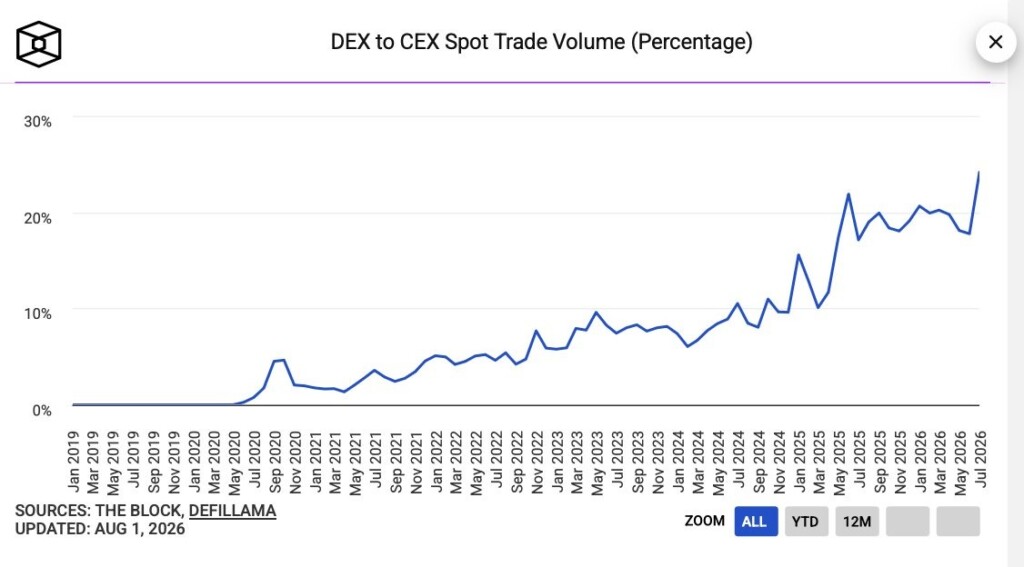
Decentralized exchanges have been steadily eroding centralized platform volume for some time. Since April of last year, the DEX-to-CEX ratio has remained consistently in double-digit territory. In July, onchain trading took its largest proportional share of centralized exchange volume to date.
According to The Block's DEX to CEX spot trade volume, the ratio reached 24.16% in July — the highest reading since the data series began in January 2019.
At first glance, the figure appears to signal a decisive win for decentralized exchanges. However, the underlying volume data tells a more nuanced story.
Both Sides of the Market Contracted — One Faster Than the Other
Spot DEX volume fell to $124.82 billion in July, representing a 6% decline from the previous month. This marked the weakest month for onchain trading since September 2024.
Centralized exchanges fared worse. Data from Artemis shows that Tier-1 centralized exchange monthly spot volume totaled $375 billion in July — the lowest monthly figure since October 2023. The ratio reached its new high because centralized spot volume contracted at a faster pace than its decentralized counterpart.
Trading activity broadly declined. Onchain platforms retained slightly more of a shrinking pool than centralized venues. Summer volume downturns are not unusual in cryptocurrency markets; what has changed is which side of the market absorbs the impact more heavily.
The 24.16% Reading Is a Ratio, Not a Market Share Figure
The Block calculates the ratio by dividing monthly DEX volume by the volume from a filtered basket of major centralized exchanges with reliable reporting. Flash trades are excluded before the computation is performed, and venues outside that basket do not enter the denominator.
The 24.16% reading does not mean that a quarter of all global spot cryptocurrency trading settled onchain in July. Rather, onchain volume equaled approximately one-quarter of what the vetted centralized venues cleared during the same period. The series is useful for tracking directional trends across months, but it is not a market share metric and should not be cited as one.
Execution Quality and Structural Shifts Have Closed a Previously Wide Gap
The ratio has been climbing for reasons that extend beyond July's specific conditions. DEX aggregators now routinely match or beat centralized exchange pricing on spot pairs up to several million dollars in notional value. Two years ago, this was not the case — slippage was the primary argument for executing large orders on centralized order books.
Listing speed further reinforces the trend. New assets frequently trade onchain from the first block, often reaching centralized venues weeks later, if at all. Traders seeking early access to new tokens often have no centralized alternative. Robinhood Chain contributed additional July activity in this category, capturing trading flow that had limited alternative venues.
The aftermath of FTX's collapse in November 2022 and subsequent enforcement actions against major centralized venues — including Binance's $4.3 billion settlement with the U.S. Department of Justice in November 2023 and the SEC's ongoing case against Coinbase — have contributed to a broader shift toward self-custody among a segment of market participants. While difficult to quantify precisely, this sentiment backdrop compounds the structural advantages DEXs now hold in execution and listing speed.
These structural factors do not explain a record set during the quietest trading month in nearly two years. They do, however, explain why the baseline floor beneath the ratio continues to rise.
The Real Test Comes With the Next Risk-On Period
The decisive test will arrive when retail participation returns and liquidity sees a noticeable recovery across the market. If the ratio holds steady under such conditions, it would point to a more genuine migration of traders from centralized platforms to decentralized ones. Conversely, if centralized venues recapture proportional flow during a high-activity period, the July record would look more like a seasonal artifact than a structural turning point. Indicators to monitor include monthly Tier-1 CEX spot volume, DEX aggregator trade counts, and stablecoin inflows to onchain venues — all of which would need to move in a sustained direction to confirm either outcome.

