Deutsche Bank to Launch Bitcoin and Ethereum Custody Service in Europe
Key Takeaways
- •Deutsche Bank's planned custody service will initially support Bitcoin, Ethereum, and selected stablecoins and e-money tokens, including USDC, EURC, and EURAU.
- •The service will operate through the bank's Corporate Bank and Investment Bank divisions, serving corporates, asset managers, hedge funds, custodians, brokers, and sovereign institutions.
- •Deutsche Bank will manage wallets and private keys end to end, using safeguards such as hardware-based key protection, separate warm and cold storage environments, and multi-person approval processes.
- •The launch timing depends on completion of the applicable regulatory process, with the EU's MiCA framework establishing a common authorization regime for crypto-asset services, including custody, since the end of 2024.
- •The bank may expand the supported asset list after launch based on client demand, internal approvals, and regulatory requirements, and also plans to add tokenized financial instruments to its roadmap.
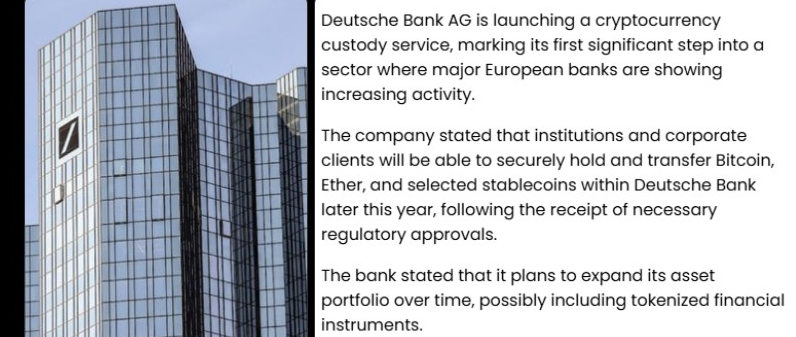
Deutsche Bank plans to launch a digital asset custody service for institutional and corporate clients in Europe this year, with the initial offering set to cover Bitcoin, Ethereum, and a selection of stablecoins and e-money tokens, subject to regulatory clearance.
The service will support selected cryptocurrencies and stablecoins while allowing clients to transfer assets to third parties. The German lender said the launch remains subject to completion of the applicable regulatory process, and that supported assets, geographical availability, and service features could still change before go-live.
Deutsche Bank Expands Digital Asset Services
Deutsche Bank will offer the custody service through its Corporate Bank and Investment Bank divisions. The bank plans to serve corporates, asset managers, hedge funds, custodians, brokers, and sovereign institutions.
Crypto news | Source: X
According to Deutsche Bank's official announcement, clients will be able to store supported digital assets and transfer them to third parties. The bank will manage the technical custody process end to end, including wallet management and private key management, removing the need for clients to build and operate their own digital asset custody systems.
Custody has long been viewed as a foundational building block for institutional participation in digital assets, since regulated storage and transfer of private keys is a precondition for funds, corporates, and sovereign institutions that want exposure to tokens through familiar channels. Deutsche Bank's move fits into a broader effort among global banks to add digital asset custody capabilities, a market historically served by specialized crypto infrastructure firms.
Gerald Podobnik, Co-Head of Corporate Bank at Deutsche Bank, described digital assets as a complement to existing financial infrastructure, noting that regulated financial institutions can provide security, trust, and safeguards as digital asset markets develop.
“Digital assets are not a replacement for the traditional financial system but an important complement to it,” Podobnik said. “We see them as new rails that can coexist with existing market infrastructures while benefiting from the trust, security, and safeguards that regulated financial institutions provide. Our aim is to offer clients a secure and regulated gateway to this evolving market.”
Bitcoin and Ethereum Lead Initial Asset List
Bitcoin and Ethereum will form part of Deutsche Bank's initial supported asset range. The service will also cover selected stablecoins and e-money tokens, including USDC, EURC, and EURAU. USDC and EURC are issued by Circle, while EURAU is a euro-denominated stablecoin issued by AllUnity, a joint venture involving DWS, Deutsche Bank's asset management arm.
Deutsche Bank may add more digital assets after launch. Any expansion will depend on client demand, internal product approval, risk controls, and regulatory requirements. The bank also plans to add tokenized financial instruments to its product roadmap.
The custody plan gives institutional clients another regulated route for holding Bitcoin and Ethereum in Europe. Instead of requiring clients to manage cryptographic keys directly, Deutsche Bank will control the private-key infrastructure itself.
The German bank has worked on digital asset custody services for several years. In 2023, it announced a partnership with Taurus, a Swiss digital asset infrastructure firm.
Institutional-Grade Security Controls
Deutsche Bank designed the custody platform with multiple layers of operational and technical controls. The system uses secure key generation and hardware-based protection for client assets, and the bank will operate separate warm and storage environments.
Multi-person approval processes will govern selected transactions, while segregation of duties will divide responsibilities across teams. The planned service also includes backup and recovery processes, with a redundant technical setup supporting system availability and operational continuity. Controls such as cold storage, hardware-based key protection, and multi-person approvals are standard safeguards across the digital asset custody industry, where preventing key compromise and unauthorized transfers is the core security task.
Selected external technology and infrastructure companies will supply specific technical components, although Deutsche Bank did not identify every provider in its latest announcement. The bank will retain its own governance, client checks, and risk controls around the service.
European Launch Still Depends on Regulation
Deutsche Bank expects the first clients to begin using the digital asset custody service this year, but the launch schedule depends on completion of the applicable regulatory process. The bank said geographical availability, supported assets, and service features could change, and that regulators, internal approvals, market conditions, and client demand could shape the final launch structure.
The timing of that regulatory work will determine when clients can onboard, making the final asset list, the geographic footprint, and the first client onboardings the milestones to watch. The broader backdrop has also become clearer: the EU's Markets in Crypto-Assets Regulation (MiCA) introduced a common authorization regime for crypto-asset services, including custody, alongside dedicated rules for stablecoins and e-money tokens, with its provisions on crypto-asset services applying since the end of 2024.
Before accepting clients, Deutsche Bank will apply its due-diligence requirements, and each institution must meet the bank's onboarding criteria and risk standards.
The bank also warned that digital assets carry risks linked to price volatility, fraud, cyber incidents, and failures among market participants. Crypto assets also lack deposit-guarantee protection comparable to eligible traditional bank deposits.
This article is for informational purposes only and does not constitute financial or investment advice. Digital assets involve risks including price volatility, fraud, cyber incidents, and market-participant failures.

