Democrats' Midterm Sweep May Put Supreme Court's Conservative Majority on Borrowed Time, Analyst Argues
Key Takeaways
- •Tom Schaller argues that Democrats' Nov. 3 midterm victory in the Senate gives the party power to shape the federal judiciary because the chamber confirms judicial nominees by simple majority.
- •Schaller called on Chuck Schumer to block Donald Trump's Supreme Court and virtually all appeals court nominees, replicating Mitch McConnell's 2016 refusal to act on Merrick Garland's nomination.
- •The Supreme Court's 6-3 conservative majority could become a 5-4 liberal majority if a Democratic president and Senate replace Justice Clarence Thomas, 78, or Justice Samuel Alito, 76, whose tenures could extend to 2028.
- •Schaller views the 2028 Senate map as favorable to Democrats, citing narrow 2022 wins by Republicans Ted Budd and Ron Johnson, while the 2030 map offers fewer pickup opportunities.
- •Reform proposals beyond blocking nominees include adding four justices backed by Rep. Jim Clyburn, 18-year term limits championed by Sen. Cory Booker, and stricter ethics rules targeting Justices Thomas and Alito, whose 2023 code of conduct lacks an enforcement mechanism.
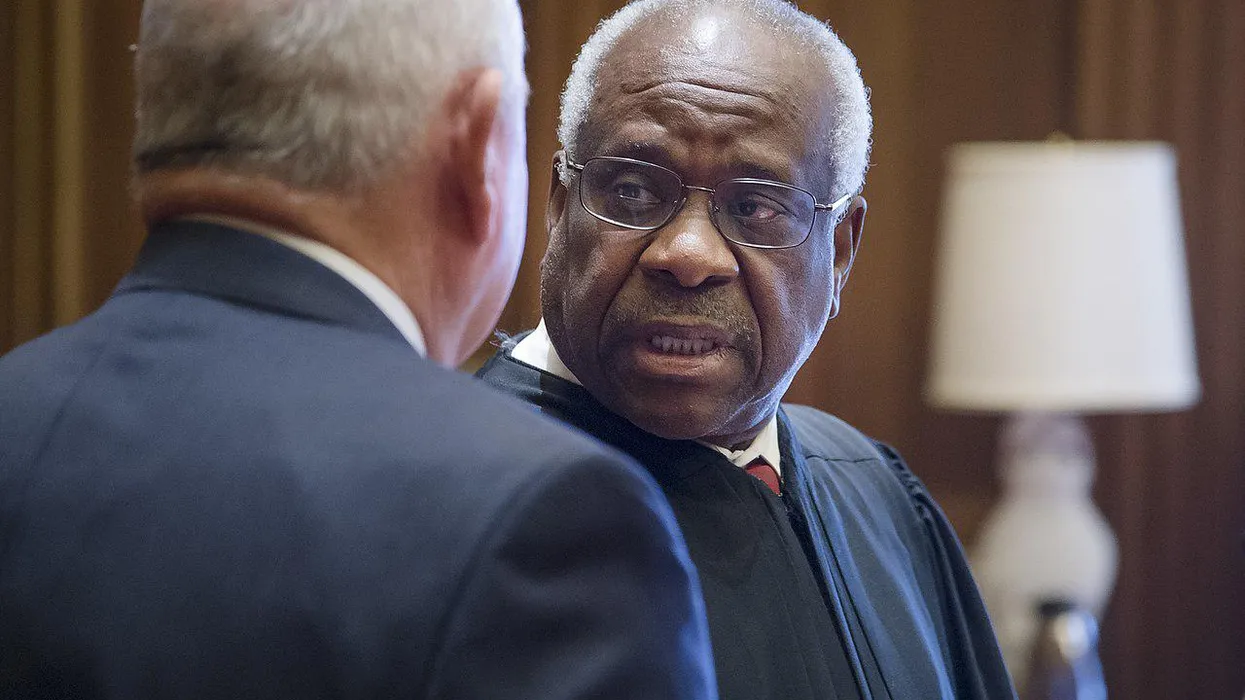
Democrats' midterm rout may have just put the Supreme Court's conservative supermajority on borrowed time — and the fallout could last a generation, according to political analyst Tom Schaller.
Writing in the Public Notice newsletter on Substack, Schaller argues that the most consequential thing Democrats won on Nov. 3, at least as far as the courts are concerned, is the Senate, which confirms judicial nominees. Under the Constitution, federal judicial appointments require the Senate's advice and consent, and since a 2017 rules change Supreme Court nominees can be confirmed by a simple majority. "Generational victories, after all, should beget generational consequences," he wrote.
Schaller's opening move is modeled directly on a strategy pioneered by Mitch McConnell. He called on Senate Democratic leader Chuck Schumer to stonewall Donald Trump's judicial nominations for the remainder of Trump's term, blocking confirmation of any Supreme Court nominee and virtually all appeals court nominees — much as McConnell did in 2016 when he blocked Barack Obama's nomination of Merrick Garland.
In Schaller's view, the Supreme Court, with its current 6-3 conservative majority, is out of sync with the country. The conservative wing consists of Chief Justice John Roberts, Justices Clarence Thomas and Samuel Alito, and Trump's three first-term appointees — Neil Gorsuch, Brett Kavanaugh and Amy Coney Barrett — while the liberal wing is made up of Sonia Sotomayor, Elena Kagan and Ketanji Brown Jackson, all appointees of Democratic presidents. Democratic presidential candidates won the popular vote in seven of the nine elections held between 1992 and 2024, by a combined 33.7 million votes. Yet since 1993, presidents from both parties have appointed five justices each. Schaller blames the Electoral College for this imbalance, along with McConnell's blockade of Garland, Justice Anthony Kennedy's well-timed retirement in 2018, and the death of Ruth Bader Ginsburg in 2020.
The balance of power may change soon. Justices Clarence Thomas, 78, and Samuel Alito, 76, could both remain on the court until 2028. Schaller contends that a Democratic win of the White House, combined with retention of the Senate, could see either Thomas or Alito replaced, producing a 5-4 liberal majority. Separately, Justice Sonia Sotomayor, a liberal who is 72, could retire during a Democratic administration, opening a seat for a younger successor.
Schaller considers a Democratic Senate a strong possibility for 2028. Republicans Ted Budd of North Carolina and Ron Johnson of Wisconsin were both narrowly elected in 2022, with 50.5 percent and 50.4 percent of the vote, respectively. In Iowa, Sen. Chuck Grassley, 93, has said he will not resign early to let GOP Gov. Kim Reynolds appoint his successor before Democratic Governor-elect Rob Sand takes office. Democrats, however, face vulnerabilities of their own: they must defend Sen. Raphael Warnock of Georgia, who won a 2022 runoff, and Sen. Catherine Cortez Masto of Nevada, who won by fewer than 8,000 votes.
The picture is less promising for the 2030 elections. Democrats have few opportunities to pick up seats, and Democratic Sens. Ruben Gallego of Arizona and Jacky Rosen of Nevada both had narrow wins in 2024. Midterm elections also generally favor the party not in the White House.
Court reformers, meanwhile, want to go further than merely blocking Trump's nominees. Rep. Jim Clyburn and other members of the Congressional Black Caucus are calling for the addition of four justices. Congress last set the court's size at nine seats in 1869, and the last serious attempt to expand it — President Franklin D. Roosevelt's 1937 plan — died in Congress. Sen. Cory Booker is pushing for 18-year term limits that would give every president two justices per term. Other reformers are seeking stricter ethics rules aimed at Thomas and Alito over what critics call self-enrichment. The Supreme Court adopted its first formal code of conduct in 2023, but it includes no mechanism for enforcing compliance by sitting justices.
The first question will be whether Senate Democrats are willing to play McConnell's game against Trump's judicial nominations when the new Congress convenes in January.

