Democrats Have Limited Tools to Lower Cost of Living, Econbrowser Writes, as Effective Tariff Rate Retreats From Highs
Key Takeaways
- •Democrats' pending control of the House and Senate offers limited power to reduce living costs, as Congress's tax and spending tools are slow-moving and President Trump's veto blocks sweeping legislation.
- •Senate Democrats are preparing votes to repeal Trump's tariffs on Canada, marking the first concrete test of the new majority's ability to pressure the tariff program, though stricter limits on presidential tariff authority could be vetoed.
- •The war in Iran has driven up energy prices, and gasoline costs could remain high even if the conflict ends because they are largely set by global energy markets.
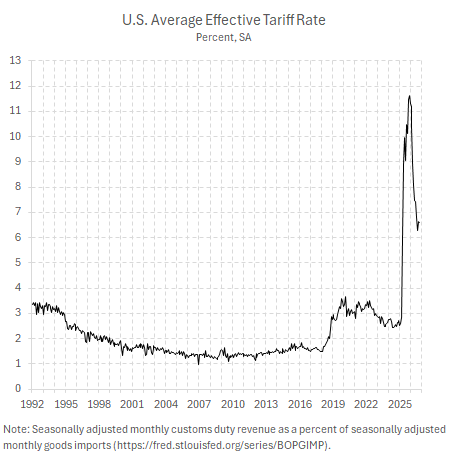
- •The effective tariff rate has declined from its highs, partly because later measures have failed to offset the reciprocal tariffs implemented in 2025, while lingering effects such as elevated fertilizer prices continue to affect agriculture worldwide.
Writing on Econbrowser on Nov. 9, 2026, the blog's author assessed which cost-of-living measures are realistically within reach of Democrats as the party assumes pending control of the House and Senate, citing a Wall Street Journal analysis.
In “Democrats Promised to Fix the Economy. What Can They Really Do?” (Wall Street Journal), Grossman, Whalen and Bade argue that Democrats can do very little to lower the cost of living. Whether they can “make the economy work” isn't assured, despite the party's pending control of the House and Senate. Many demands are beyond the reach of lawmakers to fix. Congress's main tools — taxes and spending — are limited and slow-moving, and lawmakers still face Trump's veto. That constraint frames what near-term relief could look like: with the veto looming, the more immediate levers are targeted moves such as tariff votes rather than sweeping legislation.
The new majority may also struggle to stop the war in Iran, which has driven up energy prices in the months since President Trump's decision to attack. Gasoline prices, largely set by global energy markets, could remain high even if the war ends — a reminder that some major price pressures sit largely outside Congress's reach.
In the Senate, Democrats are teeing up votes to repeal Trump's tariffs on Canada, the Journal reports. The tariffs are part of the president's global trade war, which has contributed to rising prices. Yet Democrats acknowledge that stricter limits on presidential tariff authority — which Trump has taken to its limits worldwide — could be vetoed and would likely have to wait for another administration. Those repeal votes represent the first concrete test of how much pressure the new majority can apply to the tariff program.
The Econbrowser author offers one observation of his own, based on the top item on his list of cost-of-living reduction measures: the effective tariff rate — the duties actually collected on imports, as distinct from the headline rates on the books — is now down from the highs of the past, in part because subsequently implemented measures have failed to make up for the “reciprocal tariffs” implemented in 2025, with further backsliding despite the Section 301 cases wending their way through. The underlying data come from Pawel Skrzypczynski. Those Section 301 cases are one thread to watch as the rate's path forward takes shape.
If Congress can pressure the administration on this widely unpopular — and possibly legally contentious — policy program, one major price pressure will be mitigated, the author argues, although some effects will linger, such as the hit to fertilizer prices hitting agriculture around the world — an example of how tariff effects can outlast the rates that set them in motion.
He is less sanguine, however, about Congressional pressure to mitigate the administration's anti-immigration program, pointing to conflicting signals from Trump — “but talk is cheap” — as well as to a resolution of passage through the Strait of Hormuz, the Gulf shipping chokepoint that carries a substantial share of the world's oil. “But who knows,” he concludes.

