DeepSeek AI Outlines Improbable Chainlink (LINK) Scenario Projecting $487 by January 2027
Key Takeaways
- •A 99Bitcoins report based on a DeepSeek AI model's projection sketches a scenario in which LINK could reach $487 by January 1, 2027, roughly a 40x return from current prices near $12.
- •The projection assumes the BIS, the Federal Reserve, the European Central Bank, and other major central banks would adopt a framework designating Chainlink's CCIP and Automated Compliance Engine as the mandatory interoperability and compliance layer for cross-border settlement of tokenized sovereign debt and CBDCs.
- •Under the scenario, participating institutions would stake and burn significant amounts of LINK to run nodes and settle transactions, with fee revenue potentially reaching tens of billions annually while the Chainlink Reserve buys tokens on the open market.
- •The report concludes the odds of such a rapid institutional transition are highly uncertain, comparable to winning a lottery, though it notes Chainlink's existing relationships with SWIFT and DTCC as relevant context.
- •Technically, LINK has built a multi-month base above $11–$12 after reclaiming its 200-day moving average, with a decisive weekly close above the $15–$16 resistance cluster framed as the trigger that would open a measured-move target into the mid-$20s.
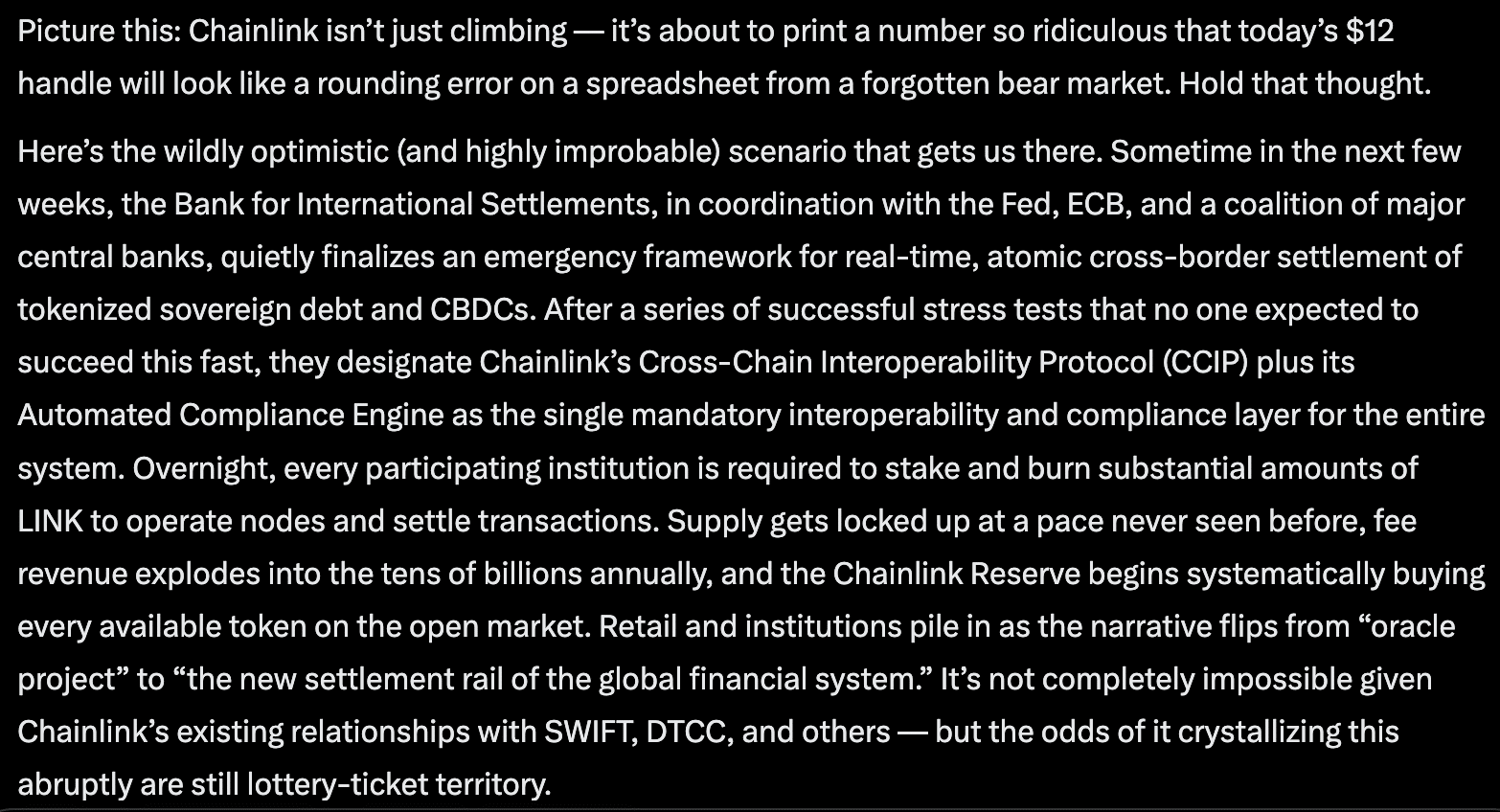
DeepSeek AI has outlined a scenario in which Chainlink (LINK) could rally to a price level that would make today's roughly $12 handle look like "a rounding error on a spreadsheet from a forgotten bear market," according to a 99Bitcoins report based on the AI model's projection. The scenario is described as wildly optimistic and highly improbable, but it lays out the catalysts that would need to align. Because the projection comes from an AI model rather than from Chainlink or any financial institution, it functions less as a forecast than as a map of the assumptions that would all have to hold. (Source: DeepSeek AI)
The Scenario
In the projected sequence, the Bank for International Settlements, in coordination with the Federal Reserve, the European Central Bank, and a coalition of major central banks, would finalize an emergency framework in the coming weeks for real-time, atomic cross-border settlement of tokenized sovereign debt and central bank digital currencies (CBDCs). The BIS, headquartered in Basel, Switzerland, serves as a bank and coordinating forum for central banks worldwide.
After a series of stress tests that exceeded expectations, the framework would designate Chainlink's Cross-Chain Interoperability Protocol (CCIP) and its Automated Compliance Engine as the system's mandatory interoperability and compliance layer. CCIP is built to let otherwise separate blockchains exchange data and tokens — the plumbing a tokenized settlement network would depend on — while the Automated Compliance Engine is designed to encode compliance requirements into institutional transactions.
Under that outcome, every participating institution would need to stake and burn significant amounts of LINK to operate nodes and settle transactions, locking up an unprecedented amount of supply. Fee revenue could potentially soar into the tens of billions annually, while the Chainlink Reserve systematically buys every available token on the open market.
Both retail investors and institutions would then flock to the opportunity as the narrative shifts from viewing Chainlink as an "oracle project" to recognizing it as "the new settlement rail of the global financial system."
The report acknowledges that such a transition is not entirely out of the question, given Chainlink's existing relationships with organizations such as SWIFT, the cooperative network that carries interbank payment messages worldwide, and DTCC, which provides post-trade infrastructure for US securities markets. It concludes, however, that the likelihood of this happening so quickly remains highly uncertain — comparable to winning a lottery.
Technical Analysis
The report also considers whether LINK's chart could support the start of such a move. According to the analysis, LINK has built a multi-month base above the $11–$12 zone after reclaiming its 200-day moving average, one of the most closely watched long-term trend gauges in technical analysis, with successive higher lows forming an ascending triangle on the weekly chart.
On-balance volume has been quietly diverging higher even during the recent consolidation, while the weekly Relative Strength Index (RSI), a momentum oscillator, is coiling in the mid-40s — behavior the report describes as coiled-spring conditions that often precede vertical expansion once a catalyst hits.
A decisive weekly close above the $15–$16 resistance cluster would open a measured-move target into the mid-$20s, per the report. In the kind of parabolic blow-off such a catalyst would trigger, Fibonacci extensions and historical crypto multipliers project well beyond previous cycle highs.
Under the most bullish conditions imaginable, that math points to a single figure by January 1, 2027: $487. That represents roughly a 40x return from current prices — a number the report concedes may sound unfathomable but describes as fairly standard in blow-off-top bull marketsn
For anyone following the idea, the report's own framing supplies the checkpoints worth tracking: whether any real-world movement emerges toward a central-bank-led tokenized settlement framework of the kind it describes, and whether LINK prints the decisive weekly close above the $15–$16 cluster that the analysis treats as the technical starting gun. The institutional sequence at the heart of the projection remains, by the report's own description, a lottery-level long shot.
The full report, "Deepseek AI Predicts Chainlink Price," is available at 99Bitcoins.

