TRM Labs Says 2026 Deepfake Scam Losses Are 263% Above 2025 Total
Key Takeaways
- •Deepfake scam losses recorded so far in 2026 already exceed the total for all of 2025 by 263%, according to TRM Labs' 2026 AI in Crime Adoption Index.
- •Because the index measures a partial 2026 against a full twelve months of 2025, the actual pace of losses is steeper than the headline gap alone indicates.
- •Scammers increasingly persuade victims to move funds themselves rather than hacking wallets, meaning hardware wallets, secure seed-phrase storage, and two-factor authentication cannot stop deception-driven transfers.
- •Exchange OKX adopted Alterya's fraud-prevention tools in February 2026 as platforms strengthen defenses against AI-assisted fraud.
- •Transparency obligations under the EU AI Act, set to begin applying in August 2026, will require disclosure when audio, images, or video have been artificially generated or manipulated.
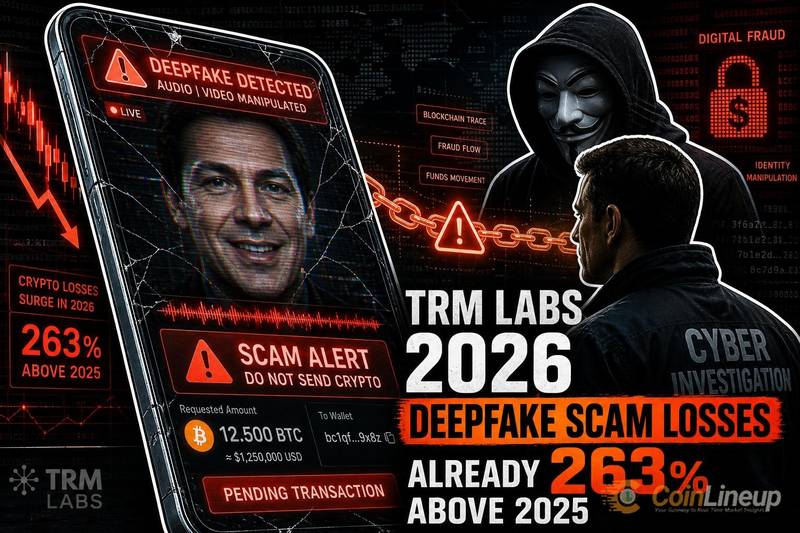
Blockchain intelligence firm TRM Labs says deepfake scam losses in 2026 have already risen 263% above the total recorded for all of 2025, underscoring how rapidly deepfake-driven crypto fraud is expanding as a security threat.
The figure comes from TRM Labs’ 2026 AI in Crime Adoption Index, which tracks how criminals are using artificial intelligence tools. The comparison measures year-to-date 2026 against the full 12 months of 2025, so a partial year is already being set against a complete one, which means the underlying pace of losses implied by the data is steeper than the headline 263% gap alone indicates. TRM Labs built its reputation tracing illicit cryptocurrency flows for exchanges, financial institutions, and law enforcement agencies. For related coverage, see Fintech Revolution Summit Malaysia 2026 Opens Sponsorship, Speaking, and Exhibition Opportunities.
In simple terms, deepfakes are realistic fake audio, video, or images generated by AI. Scammers use them to impersonate real people. TRM Labs says the sharp increase suggests the tactic is scaling quickly. For related coverage, see Coinbase launches four tokenized U.S. stocks on Base with 1:1 backing.
Why Deepfake-Driven Crypto Scams Are Rising
Deepfakes allow scammers to imitate founders, influencers, exchange support staff, or other well-known public figures. A fake video of a trusted name can make a fraudulent pitch appear legitimate. The tactic extends well beyond crypto: in 2024, an employee at the Hong Kong office of engineering firm Arup transferred roughly $25 million after a video conference in which deepfakes impersonated the company’s chief financial officer and other colleagues, one of the most widely reported examples of synthetic video deceiving staff in a live setting. For related coverage, see NoOnes Withdrawal-Only Mode After EU Sanctions Hit Partners.
AI-generated audio or video can give false credibility to phishing messages, fake investment offers, and wallet-drain schemes. Reporting from CryptoSlate says scammers are increasingly focused on persuading victims to move funds themselves, rather than hacking wallets directly. That approach matters for user defenses: hardware wallets, secure seed-phrase storage, and two-factor authentication protect private keys, but they cannot stop an owner from being deceived into authorizing a transfer that appears voluntary.
Because crypto transactions are fast and usually irreversible, once a victim sends funds there is often no practical way to recover them. That makes every successful scam more damaging for retail users. Recent cases, such as the Zilliqa signing bug that exposed thousands of accounts, show how quickly losses can mount when security failures occur.
What the 2026 Spike Means for Users and Platforms
The steep year-to-date increase suggests fraud defenses may need to adapt more quickly than in past cycles. Some platforms are already responding: exchange OKX adopted Alterya’s fraud-prevention tools in February 2026.
For everyday holders, verification is essential. Announcements, support messages, and fundraising requests should be confirmed through official channels before any action is taken, because a convincing video or voice recording is no longer proof of identity.
Enforcement efforts are also ongoing. U.S. authorities recently acted against crypto scams in a case where the Justice Department cited hundreds of millions recovered, highlighting the scale of fraud proceeds. Broader data compiled by CryptoRank also points to a wider rise in AI-assisted crypto crime. Regulation of the content itself is approaching as well: transparency obligations under the EU AI Act, scheduled to begin applying in August 2026, will require disclosure when audio, images, or video have been artificially generated or manipulated, a milestone to watch as the year’s loss figures accumulate.
The practical takeaway for crypto users is straightforward: treat unexpected video calls, voice messages, and urgent investment pitches with caution, and independently verify identity before sending any funds.
Disclaimer: This article is for informational purposes only and does not constitute financial or investment advice. Cryptocurrency and digital asset markets carry significant risk. Always do your own research before making decisions.

