Death Note: The Musical review: A high-shine, high-school take on the trolley problem
Key Takeaways
- •Death Note: The Musical is making its English-language world premiere at London's Barbican Theatre after ten years of cult success in Japan and Korea.
- •The original manga has sold over 30 million copies worldwide since its serialization from 2003 to 2006, making it one of the most recognisable properties in modern Japanese pop culture.
- •The production features a score by veteran Broadway composer Frank Wildhorn and set design by Jon Bausor, with visuals incorporating massive projections of a Tokyo metropolis and neon-drenched lighting.
- •A 2025 survey found that 83.1 per cent of the Japanese public supports the death penalty, providing cultural context for the show's themes surrounding capital punishment and justice.
- •The musical is scheduled to run at the Barbican Theatre for 50 performances, concluding on 12 September.
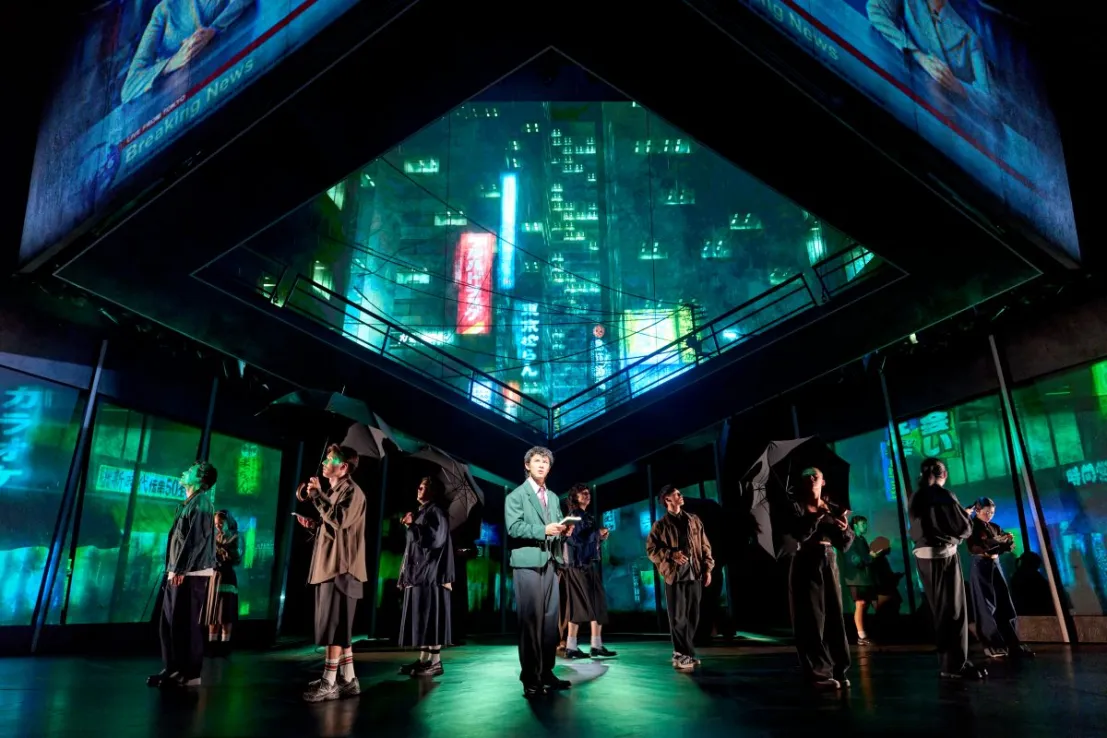
Death Note: The Musical | Barbican Theatre | ★★★☆☆
After ten years of cult success across Japan and Korea, Death Note: The Musical—a pop-rock adaptation of Tsugumi Ohba and Takeshi Obata's early-2000s manga—has arrived in London for its English-language world premiere. The original series, serialized in Weekly Shōnen Jump from 2003 to 2006, sold over 30 million copies worldwide and spawned anime, live-action films, novels, and video games, making it one of the most recognisable properties in modern Japanese pop culture. Currently staged at the Barbican Theatre for a 50-show run, the production has already drawn crowds of costumed fans, a testament to the franchise's enduring cult status.
The premise is elegantly simple: Tokyo high school student Light Yagami discovers a notebook that allows him to kill anyone whose name he writes inside it. He can specify the cause of death if he chooses; otherwise, the victim suffers a heart attack after 40 seconds. This sets up a succession of trolley problems, though the musical's exploration of these ethical dilemmas rarely rises above the level of a high school philosophy discussion.
Light's black-and-white worldview is established in the opening number, "Where is the Justice?" He leads his classmates in a song decrying the Japanese justice system, under which he believes too many criminals go unpunished:
Where is the justice when the guilty all go free? Why don't we lock them up and throw away the key?
His teacher gently rebukes him, suggesting the world is more complicated. This exchange—kill the guilty versus it's not that simple—quickly becomes the show's recurring philosophical refrain.
Light's first use of the notebook—to kill a gunman holding children hostage—is a straightforward moral scenario. However, once Light attracts police attention and begins eliminating anyone who threatens to expose him, the ethical complexity of his framework rapidly collapses.
A shallow examination of capital punishment
For important context, Japan still maintains capital punishment with overwhelming public backing—a 2025 survey found that 83.1 per cent of the Japanese public supports the death penalty. The country also boasts a conviction rate exceeding 99 per cent, though this stems largely from a low prosecution rate, as only cases with strong evidence proceed to trial. These factors help explain Light's absolutist stance on justice, yet his stubborn adherence to this position and his total absence of remorse quickly reduce him to something of a pantomime villain.
When a previously sympathetic shinigami calls him a "childish serial killer" near the show's climax, the moment lands more as a statement of the obvious than a genuine revelation. Meanwhile, a hostage scene featuring pop-star character Misa Misa—who sings powerfully while blindfolded and struggling against chains as she becomes entangled in Light's murders—feels more like a male fantasy than an emotional peak.
What the musical lacks in philosophical depth, however, it compensates for in sheer production value. This is an undeniably impressive staging, bolstered by a talented and energetic cast. The score, by veteran Broadway composer Frank Wildhorn—known for Jekyll & Hyde and Bonnie & Clyde—with lyrics by Jack Murphy, lends the production a sweeping, arena-rock theatricality that helps explain its decade-long popularity across Asia.
The visuals, with set design by Jon Bausor, are magnificent. The stage sits beneath a concrete balcony where the shinigami reside, which in turn is overshadowed by massive projections of a sprawling Tokyo metropolis. The balcony forms a striking diamond structure above the action, evoking a comic-strip 3D aesthetic that suits the source material well. There are also subtle echoes of the Barbican's own brutalist architecture in the set's harsh landscape. Lighting plays a crucial role throughout—scenes are frequently drenched in neon, while blackouts and white flashes punctuate the dramatic high points.
Arguably, the visual design serves as the ideal counterpart to the show's moral framework: stark, sharp, and defined by harsh lines.
Death Note: The Musical runs at the Barbican Theatre until 12 September.
