Orezi Mena says scaling fintech infrastructure for Dangote IPO rush could be costly
Key Takeaways
- •The Dangote Petroleum Refinery IPO offers 4.1 billion shares at ₦525 each, with a minimum purchase of 10 shares worth ₦5,250, running from September 14 to October 13.
- •Heavy simultaneous traffic from prospective investors disrupted access to platforms including Bamboo and Cowrywise when the IPO opened to the public.
- •Orezi Mena argued that permanently expanding infrastructure for a brief demand spike can leave companies with costly excess capacity once the excitement fades.
- •Mena fintechs to adopt flexible systems that scale up during surges and contract afterward, saying one-off crashes do not necessarily signal a need to scale.
- •Mena said the IPO rush could be treated as a customer-acquisition opportunity, making infrastructure spending justifiable if weighed against the customers attracted.
Financial platforms faced a difficult capacity decision during the recent rush to invest in the Dangote Petroleum Refinery IPO, after a surge of interest disrupted access to apps including Bamboo and Cowrywise.
When the offer opened to the public, large numbers of Nigerians attempted to buy shares at the same time. The resulting traffic left many prospective investors unable to access their accounts, prompting questions about why investment platforms had not been better prepared for the expected demand.
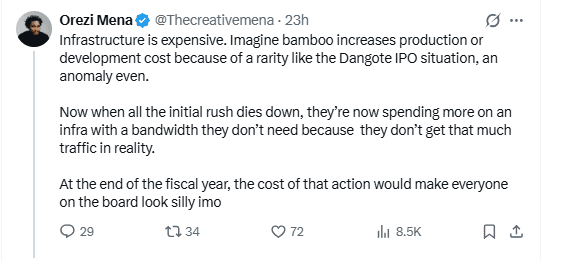
Orezi Mena, a design engineer building Groove, said the issue was more complex than simply concluding that the platforms had failed to prepare. In a post on X, he wrote: “Infrastructure is expensive.”
Mena argued that increasing capacity enough to handle an exceptional traffic spike can be financially burdensome, particularly when the demand may last only for a short period. Platforms that spend heavily to support a temporary surge could be left with excess infrastructure after the Dangote IPO excitement fades, reducing the long-term value of that investment.
The challenge, he said, is to balance immediate demand with sustainable operating costs. Preparing for a brief event by permanently expanding infrastructure may not be an efficient business decision, even when the event attracts substantial public attention.
Mena’s experience bootstrapping a product has given him direct insight into infrastructure costs. That perspective informs his view of the problems encountered during the IPO, although he cautioned against drawing firm conclusions from the outages alone.
He noted that many companies stress-test their systems, anticipate traffic increases and put safeguards in place to manage additional activity. However, accurately predicting how millions of users will behave at the same time remains difficult. “You can never fully know what will happen, no matter how thorough your planning is,” Mena said.
The Dangote IPO was structured to encourage participation by everyday Nigerians. It offered 4.1 billion shares at ₦525 each, with a minimum purchase of 10 shares, equivalent to ₦5,250. The offer opened on September 14 and closes on October 13.
The relatively low minimum entry amount, combined with Dangote’s high profile, generated significant interest. However, Mena distinguished between anticipating strong participation and accurately forecasting how many people would attempt to buy shares simultaneously. That difference can make a major impact on the systems supporting a financial platform.
He also drew a distinction between recurring capacity problems and failures caused by isolated events. If a fintech product repeatedly struggles whenever user activity increases, the pattern may indicate a need to scale its infrastructure. A crash during a one-off event, however, does not necessarily justify a permanent overhaul.
As an example, Mena referred to the O2 website’s failure when a limited number of Wizkid concert tickets went on sale. The incident showed that a system could be overwhelmed by an unusual rush, but it did not necessarily mean O2 needed to make large, permanent infrastructure changes. “One-offs are not a signal that you need to scale,” Mena said.
That does not mean companies should disregard exceptional incidents. Mena said fintech businesses should instead consider flexible systems that can expand quickly when demand rises and contract when activity returns to normal. This approach would allow platforms to respond to unusual events without maintaining the cost of maximum capacity at all times.
“If you build an infrastructure that will be large just in case there’s an IPO rush, I don’t think that’s smart business or smart use of resources,” he said.
The objective, according to Mena, is to make deliberate decisions about when to add capacity and when to reduce it. Flexible infrastructure could help companies remain responsive to market activity while limiting spending on resources that may not be required during normal operations.
The Dangote IPO also presents a customer-acquisition opportunity for investment platforms. Although the initial excitement may eventually subside, Mena pointed to alternatives such as MTN and GTCO that could remain available to investors after the IPO rush. Companies therefore need to assess whether the cost of supporting the event can be justified by the customers they attract.
“You have to calculate your risk and try to manage your burn rate as much as possible,” Mena said. He added that spending on infrastructure could make sense when it forms part of a broader customer-acquisition strategy: “If you’re thinking about putting the cost into customer acquisition, then it makes sense.”
At the same time, he warned that managing a sudden influx of users does not automatically require a permanent expansion of infrastructure. “It’s just a matter of how much risk you can take,” he said, pointing to the different strategies companies may adopt for rare, high-demand events.
For platforms that experienced problems when the Dangote IPO launched, Mena said addressing those issues remains important. “Serve the people that you are serving well, and you will last pretty much,” he said, emphasising continuous improvement and customer service as part of long-term sustainability.
Source: TechNext24
Related coverage: Investors fume as Dangote IPO frenzy freezes Bamboo, Cowrywise, Afrinvest apps · Dangote Refinery unveils IPO prospectus

