Dallas Fed Warns Tokenized Deposits Could Weigh on Bank Lending
Key Takeaways
- •The Dallas Fed said tokenized deposits could reduce banks’ capacity to support lending by weakening the stability of deposits.
- •The bank estimated that a 10% drop in deposits’ weighted average life could cut maturity transformation capacity by about $580 billion in 10-year equivalents.
- •It also said a 10% rise in deposit rate beta could reduce banks’ duration risk appetite by $700 billion in 10-year equivalents, assuming a four-year deposit WAL.
- •Dallas Fed economists argued that tokenized deposits could make it easier for customers to move funds instantly between banks, especially if AI agents automate transfers.
- •Major US banks and industry groups are already building tokenized deposit networks, including a Clearing House-led system targeted for 2027.
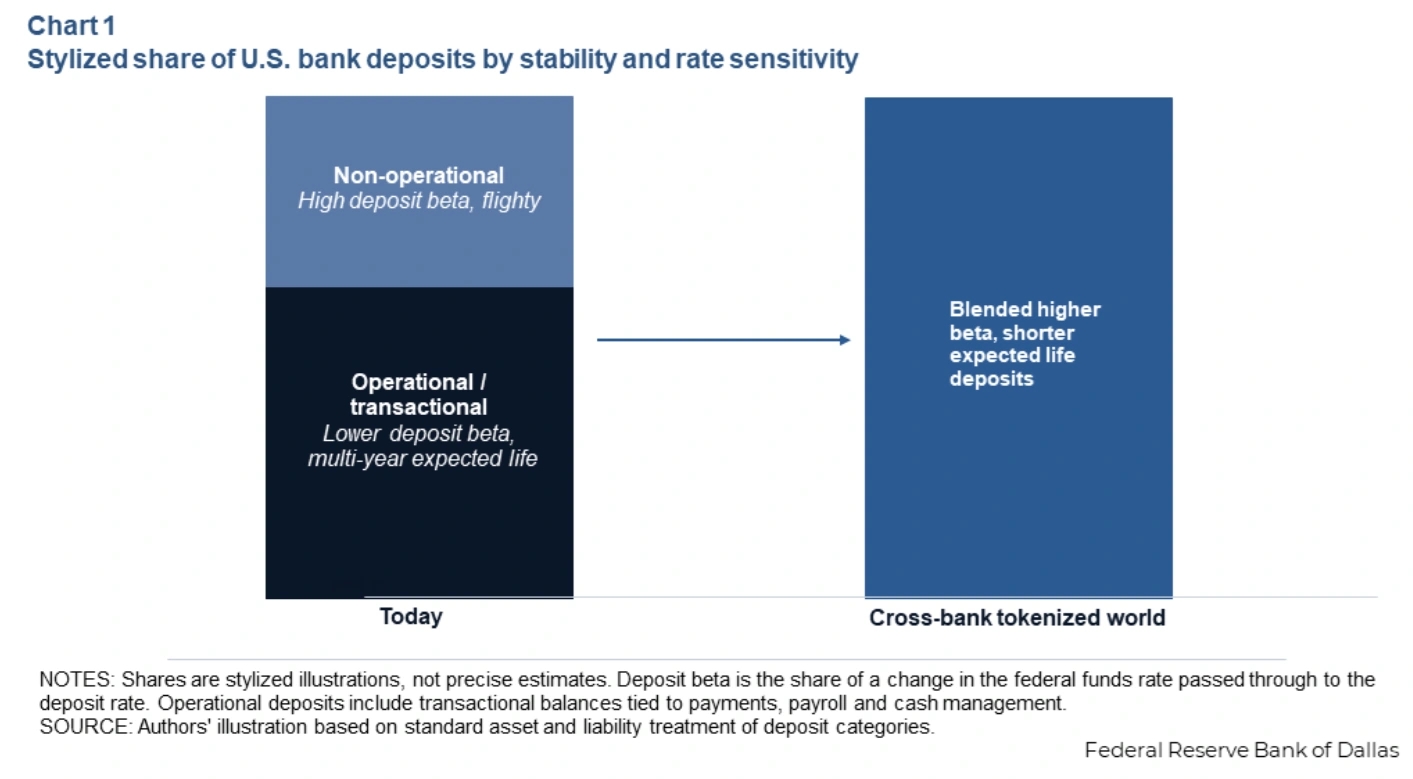
The Federal Reserve Bank of Dallas said the growing use of tokenized deposits could reduce banks’ ability to fund loans for households and businesses as it weighed in on the debate between stablecoins and tokenized deposits.
In a paper published by the Dallas Fed, the bank identified three main ways tokenized deposits could affect banks and, ultimately, the broader economy:
- 80% of the duration risk taken by banks — $5.8 trillion in 10-year equivalents out of $7 trillion total — is supported by the duration characteristics of deposits.
- A 10% reduction in the weighted average life, or WAL, of deposits would reduce maturity transformation capacity across the banking system by about $580 billion in 10-year equivalents.
- A 10% increase in the price sensitivity of deposits, or deposit rate beta, would reduce banks’ duration risk appetite by $700 billion in 10-year equivalents, assuming a deposit WAL of four years.
Why the Dallas Fed is cautious on tokenized deposits
Dallas Fed economists Rosie Levy and Srini Ramaswamy focused on maturity transformation, a core banking function in which banks fund long-term loans with deposits that customers may withdraw at any time.
The current system depends in part on the friction that exists between initiating a withdrawal and completing it. Tokenized deposits, by contrast, would move customer funds onto blockchain rails, allowing deposits to be accessed instantly and around the clock.
That frictionless setup could allow customers to move money from one bank to another offering higher rates in seconds rather than days. The economists said the concern becomes even greater in a scenario where AI agents can automatically reroute money from programmable deposit tokens on behalf of customers.
In the Dallas Fed’s view, banks cannot afford for stable deposits to become unstable reserves, especially if faster transfer features make those balances more sensitive to rate changes.
Banks are choosing tokenized deposits over stablecoins
Banks have been fighting for their position in the digital money landscape since the Trump administration made stablecoin legislation a priority. Banking groups had also held up the CLARITY Act for months over concerns that stablecoin issuers could gain an advantage by paying yields to customers.
Against that backdrop, banks have positioned tokenized deposits as a fully regulated alternative to stablecoins, which still do not have a complete regulatory framework. Tokenized deposits allow banks to remain within the existing banking rulebook and can also pay interest to holders.
The stakes extend beyond banks themselves. If an alternative payment system gains a competitive edge, the impact could reach households and businesses that depend on banks for credit and payments, which is why funding stability is central to the debate.
In June, S&P Global warned that banks could face higher funding costs and lose a large share of payment income if stablecoin firms grow significantly at their expense. McKinsey estimated that for every $1,000 a customer converts into a third-party stablecoin, only about 15% flows back into the banking system as wholesale reserves.
Even so, tokenized deposits give banks an alternative that keeps 100% of customer funds on their books.
Banks are already building the infrastructure
The Dallas Fed’s warning comes as US banks race to build the necessary infrastructure.
JPMorgan Chase, Citigroup, Bank of America and Wells Fargo are backing a shared tokenized deposit network run through The Clearing House, with a target launch in 2027, Cryptopolitan previously reported.
Swift said in July that its blockchain ledger was ready for initial use, with 17 banks across six continents preparing pilots. In addition, a coalition of 39 state bankers associations has formed the BankChain Alliance to give smaller lenders their own path on-chain.
The Dallas Fed noted that for deposit tokens to matter, they must circulate beyond the bank that issued them, which is exactly what these consortia and alliances are intended to support.
Bankers are already considering the implications. Matt McAfee, head of enterprise innovation and digital assets at M&T Bank, told American Banker that the risks feel “familiar” but are “heightened in a world where customers can move money 24/7.”
The Dallas Fed economists did not predict how widely tokenized deposits will be adopted. They said they were outlining the possible consequences “without passing judgment on the likelihood of such adoption occurring.”
