A Year After Buying Bitcoin, Czech Central Bank Won't Say What Its Holdings Are Worth
Key Takeaways
- •The Czech National Bank launched a $1 million pilot portfolio on Nov. 13, 2025, containing bitcoin, U.S. dollar-pegged stablecoins, and a tokenized dollar deposit recorded on a blockchain.
- •Bitcoin traded near $61,000 on Monday, about 44% below the roughly $98,000 level at the portfolio's announcement, but the bank's undisclosed purchase price means its actual loss cannot be calculated.
- •The CNB's audited financial statements provide no separate market valuation of the digital assets, leaving outside observers unable to track the experiment's performance.
- •The initial bitcoin purchase was executed on a regulated foreign exchange, and the coins are safeguarded by an unnamed external custodian that also holds the private keys.
- •The pilot funds sit in the bank's CNB Lab research unit, separate from its roughly $180 billion in international reserves, and the central bank does not plan to add to the initial investment.
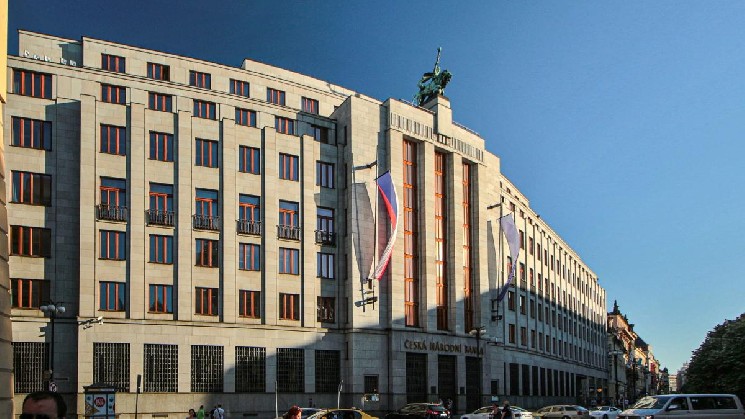
A Year After Buying Bitcoin, Czech Central Bank Won't Say What Its Holdings Are Worth
A year after the Czech National Bank (CNB) made headlines by purchasing bitcoin, the central bank still declines to disclose how much of the cryptocurrency it holds, what it paid, or what the investment is worth following bitcoin's steep decline.
The CNB launched a $1 million test portfolio on Nov. 13, 2025, holding bitcoin, U.S. dollar-pegged stablecoins, and a tokenized dollar deposit — a bank deposit recorded on a blockchain. The purchase was hailed at the time as a milestone for central banking. According to CoinDesk, however, the bank now uses an outside custodian to safeguard its bitcoin, while its audited financial statements provide no separate market valuation of the holdings. The lack of a separate valuation gives outsiders no way to track the experiment's performance from the bank's audited accounts.
The bank's board approved the experiment on Oct. 30, 2025, when bitcoin traded at roughly $110,670. By the time the portfolio was announced on Nov. 13, the cryptocurrency had fallen to about $98,000. On Monday, it traded near $61,000 — approximately 44% below the level at the announcement.
That decline does not establish how much the CNB has lost, because the bank has never disclosed the date or price of its bitcoin purchase, nor how much of the $1 million portfolio was allocated to bitcoin rather than the other digital assets.
"Neither Governor Michl nor the CNB has ever commented on the price at which bitcoin was acquired," Jakub Holas, director of the CNB's communications division, told CoinDesk earlier this week. The bank also declined to say whether its bitcoin holdings have changed since the original purchase or whether it expects to write down their value at year-end.
"The CNB does not disclose the detailed composition of the pilot portfolio, including individual allocations, prices, transaction dates, trading venues or counterparties," Jaroslav Krejčí, a spokesperson for the bank, told CoinDesk in an email.
Krejčí said the first bitcoin purchase "was executed on a regulated foreign exchange" and that the coins are held "through external custody arrangements," meaning an outside firm keeps them, and the private keys, on the bank's behalf. The bank did not identify either the exchange or the custodian.
Relying on an outside custodian does not mean the CNB does not own the bitcoin, but it does mean the central bank is not handling custody entirely in-house. The CNB has previously examined self-custody, under which it would manage the cryptographic keys controlling the assets, as well as arrangements involving external custodians. It described securing its own custody infrastructure as a complex undertaking.
The funds sit in the bank's research and innovation unit, known as CNB Lab, rather than among the roughly $180 billion in international reserves managed under Governor Aleš Michl. At $1 million, the pilot is a small fraction of that reserve total, keeping its financial footprint modest relative to the bank's core reserve operations. The central bank has said it does not plan to add to the initial $1 million investment. Whether the year-end accounts show a write-down of the bitcoin holdings, and whether the pilot's composition is ever disclosed, remain open questions after the portfolio's first year.

