CZ Says Regulated U.S. Hyperliquid Access Could Benefit the Wider Crypto Market
Key Takeaways
- •Zhao said lawful U.S. access for Hyperliquid could expand liquidity, improve execution, and benefit both decentralized and centralized exchanges.
- •Trump said CFTC Chairman Michael Selig was working on a compliant U.S. path for Hyperliquid, but gave no approval, license, or timeline.
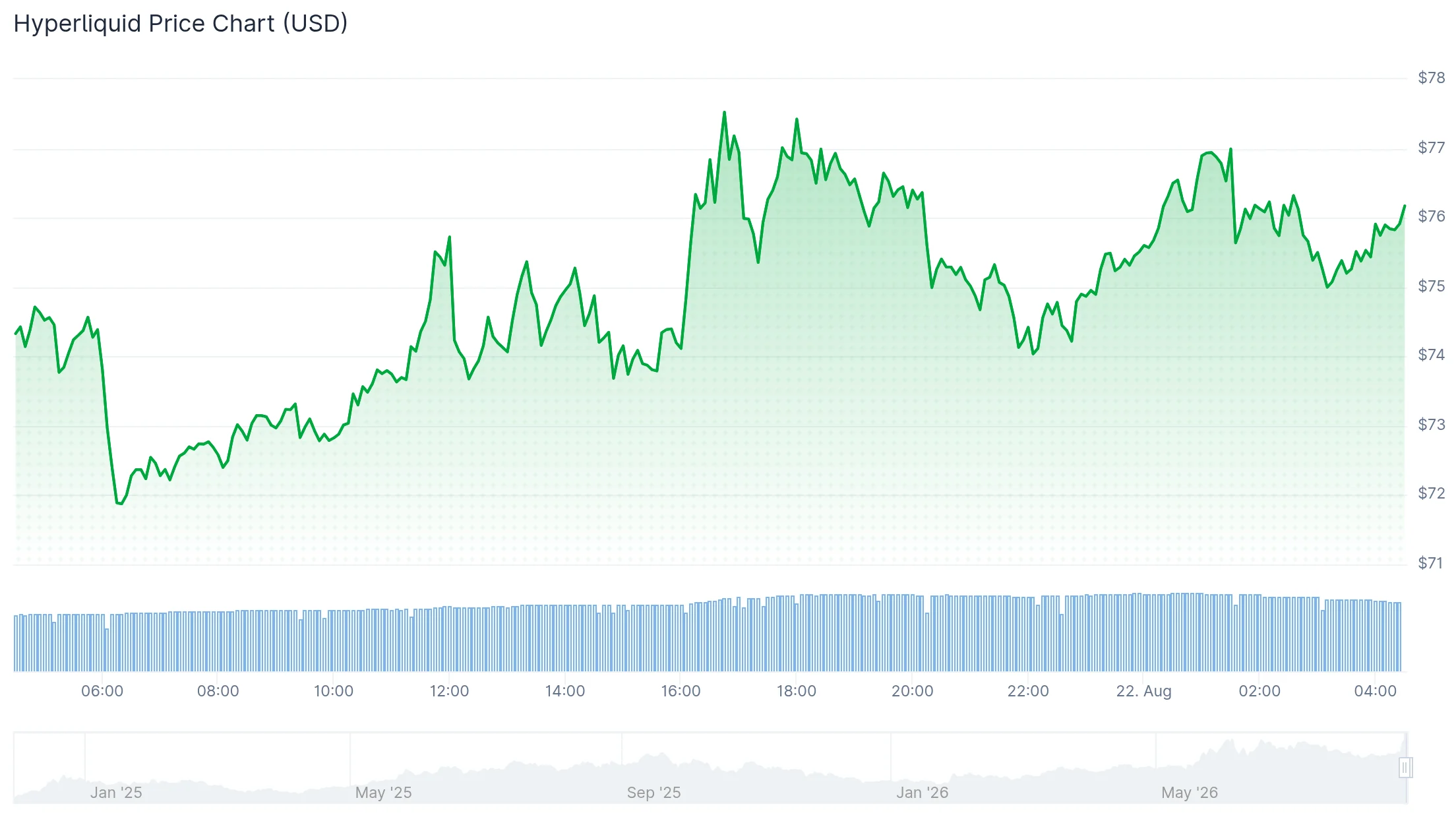
- •HYPE traded near $76.26 and remained close to its $77.55 all-time high after rising 36.3% over seven days.
- •Hyperliquid processed about $200 billion in perpetual futures volume over the past 30 days, highlighting its scale and the related oversight questions.
- •The CFTC has recently discussed crypto market structure and has previously taken action against DeFi protocols offering leveraged derivatives to U.S. users without registration.
Binance founder Changpeng Zhao said a regulated U.S. path for Hyperliquid could benefit the broader crypto industry, as President Donald Trump signaled that CFTC Chairman Michael Selig is working on a legal framework for the platform.
Zhao made the comments at the Wyoming Blockchain Symposium on August 19, shortly after Trump discussed Hyperliquid. Trump said Selig was working toward a fully compliant and legal U.S. entry for the platform, although he did not announce an approval, license, timeline, or formal regulatory structure.
The remarks came as HYPE, Hyperliquid's native token, traded near $76.26 on Friday, about 1.7% below its $77.55 all-time high reached on August 21. The token has risen 36.3% over the past seven days, supported by rising expectations around possible regulated access.
DeFiLlama data shows Hyperliquid processed about $200 billion in perpetual futures volume over the past 30 days, with $16.3 billion in 24-hour volume and $12.55 billion in open interest. That scale has sharpened attention on the oversight questions that would accompany any U.S. entry.
Zhao Says U.S. Access Could Broaden the Market
Zhao said Hyperliquid may represent the first step in a wider shift for decentralized finance if it can obtain lawful access to the U.S. market. In his view, a compliant route could open the door for additional perpetual DEX platforms and related services to serve American traders under clearer federal rules.
He added that such a development would not necessarily benefit Hyperliquid alone. Zhao said broader lawful access could widen the trader base, deepen liquidity, and improve execution across both decentralized and centralized exchanges.
The effect, he said, could extend to Binance and other global trading venues as well. Better U.S. liquidity, Zhao argued, could lead to tighter pricing when customers buy or sell crypto. He framed the issue as an industry-wide policy shift rather than a single-platform advantage. Binance has its own history with U.S. authorities: in 2023 the exchange agreed to pay roughly $4.3 billion to settle federal charges over anti-money-laundering and sanctions failures, a resolution that also required Zhao to step down as chief executive.
Trump’s comments followed a White House meeting with regulators and leading crypto executives. The president identified Selig as the official working on Hyperliquid’s compliant U.S. path, but did not provide further details.
CZ on Trump's Push to Bring Hyperliquid to the U.S.: A Win for the Entire Crypto Industry Binance founder Changpeng Zhao (CZ) @cz_binance said at the Wyoming Blockchain Symposium 2026 on August 19 that President Trump had mentioned CFTC Chairman Michael Selig was working to… pic.twitter.com/lDjKE1P3MO — Wu Blockchain (@WuBlockchain) August 22, 2026
The CFTC regulates futures and derivatives on commodities, while spot crypto trading has historically sat in a contested zone between the CFTC and the Securities and Exchange Commission. That distinction is important for a decentralized venue offering perpetual futures contracts, which have no expiry date and allow traders to gain exposure to asset prices without holding the underlying tokens. In the U.S., derivatives regulation covers registration, market surveillance, leverage, customer safeguards, and anti-money-laundering controls.
Hyperliquid currently blocks U.S. users through its official interface. Any regulated entry would therefore require a fully defined operating model that complies with federal requirements. Neither the CFTC nor Hyperliquid has publicly detailed those legal terms.
Liquidity, Oversight, and the Regulatory Backdrop
The market reaction underscores why the issue has drawn attention. HYPE set a record $77.55 on August 21 after Trump’s remarks fueled expectations of regulated access. It later traded near $76.26, remaining close to that peak.
Hyperliquid’s trading activity also highlights its role in decentralized derivatives. The platform runs an on-chain order book on its Layer 1 network, with users connecting wallets directly rather than opening conventional brokerage accounts. That structure reduces intermediaries, but U.S. access would still require clear rules around identity checks and customer eligibility.
The regulatory backdrop is also shifting. The CFTC held the first meeting of its Innovation Advisory Committee on August 20, where it discussed crypto market structure, blockchain infrastructure, cybersecurity, and operational resilience. The agenda also included modernizing existing rules while preserving market integrity and customer protection.
Those discussions could influence how regulators approach a perpetual DEX. Officials would need to determine how existing derivatives obligations apply to decentralized software, validators, interfaces, and governance. The question is not entirely new: the CFTC has previously charged DeFi protocols, including Opyn and Deridex in 2023, for offering leveraged derivatives to U.S. users without registering. They would also need to decide who bears responsibility if trades, liquidations, or compliance controls fail.
If regulators establish a workable route, Hyperliquid could gain access to one of the world’s largest derivatives markets. Other decentralized platforms could study the same framework, while centralized exchanges may face additional pressure on fees and execution. The CFTC has not yet specified whether one pathway could apply to multiple decentralized venues, and the agency has not disclosed a timetable.

