Cysic (CYS) Is Listed on edgeX: Inside the ComputeFi Network for ZK and AI
Key Takeaways
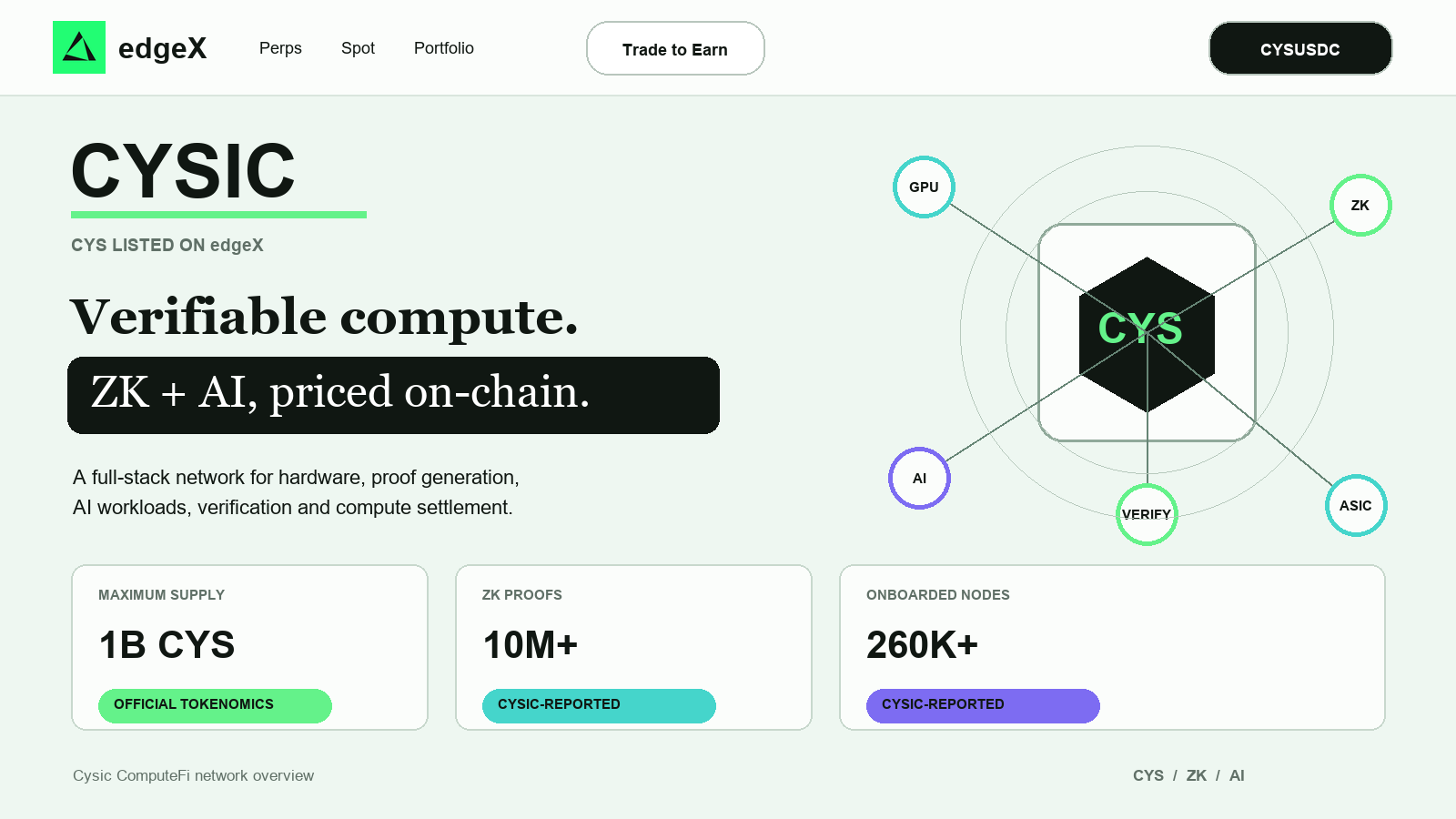
- •edgeX launched the CYSUSDC perpetual market on August 5, enabling eligible traders to take long or short positions on CYS without owning the underlying token.
- •Cysic operates a full-stack ComputeFi network that integrates specialized hardware, a Cosmos CDK-based Layer 1 blockchain, a compute marketplace, and products for ZK proving, AI inference, and software development.
- •The CYS token has a fixed maximum supply of 1 billion, with 56.27% allocated to ecosystem and community incentives and 35.73% to investors and contributors subject to vesting cliffs and linear unlocks.
- •Cysic separates governance from its liquid token by requiring holders to convert or stake CYS into CGT, a non-traded governance credit used for decisions on emissions, marketplace rules, and treasury spending.
- •Cysic reports its mainnet has delivered over 10 million ZK proofs and onboarded more than 260,000 nodes, though these figures remain project-reported and do not independently confirm revenue or recurring demand.
Quick Answer
Cysic is a live ComputeFi network designed to turn verifiable computing power into an on-chain economic resource. Its stack combines specialized hardware, a Cosmos CDK-based blockchain, a compute marketplace, ZK proving, and AI products. The CYS token pays for compute, supports staking and network incentives, and can be converted into non-traded CGT governance credit. Traders can now access the CYSUSDC perpetual market on edgeX, but a perpetual position is a leveraged derivative rather than ownership of CYS.
CYS Arrives on edgeX as Compute Becomes a Crypto Trade
Crypto infrastructure used to treat computation as an invisible input. Rollups bought proving capacity, AI developers rented GPUs, and users rarely saw the market connecting hardware supply with workload demand. Cysic is trying to move that market on-chain. The project describes its network as a full-stack ComputeFi system where compute providers, task requesters, verifiers, and token holders coordinate through a purpose-built blockchain.
That thesis now has a new trading venue. edgeX announced the CYSUSDC perpetual listing on August 5, bringing Cysic's token into an around-the-clock derivatives market. The listing arrives as Cysic moves beyond its ZK-hardware identity. InferBench targets reproducible AI-inference measurement, while CyOps is positioned as an autonomous development environment.
The result is a broader CYS narrative: an attempt to price, verify, and coordinate different forms of computation. Cysic must still turn its hardware, protocol, and developer tools into recurring paid workloads.
https://x.com/edgeX_exchange/status/2084950907259850755
What Is Cysic?
Cysic is a decentralized compute infrastructure project founded in 2022. It began by accelerating zero-knowledge proof generation through GPUs, FPGAs, and custom ASICs. In May 2024, it announced a $12 million pre-A round co-led by HashKey Capital and OKX Ventures to support expansion and hardware production.
The project has since widened its scope. Cysic's current documentation presents a network that can route ZK proofs, AI inference, mining, and other high-performance computing jobs. This is the core ComputeFi proposition: computation becomes a measurable service that can be allocated, priced, verified, and rewarded through a blockchain network.
How the Cysic Stack Fits Together
| Layer | What Cysic Provides | Why It Matters |
|---|---|---|
| Hardware | GPUs, FPGAs, ASICs, mining rigs, and other compute devices | Specialized hardware can reduce the time and cost required for ZK proofs and AI workloads. |
| Consensus | A Cosmos CDK-based L1 with CometBFT and a Proof-of-Compute design | The protocol considers pledged computation alongside token staking when coordinating network security. |
| Execution | Workload routing, job scheduling, bridging, voting, and EVM-compatible functions | This layer connects submitted jobs with providers and handles network operations. |
| Product | ZK proof market, AI inference, agent tools, mining, and other compute services | Products create the real workloads that may generate network fees and token demand. |
| Marketplace | Matching, bidding, verification, performance tracking, and reward distribution | The marketplace turns heterogeneous hardware into an accessible service for requesters. |
How Cysic Works: From Workload Request to Settlement
A Compute Job Moves Through Four Stages
First, a requester submits a job with the information providers need to price and execute it. Depending on the workload, that can include the software version, hardware or memory requirements, runtime constraints, deadline, and reward. A requester could be a rollup operator seeking a zkSNARK proof, a zkVM network buying proving cycles, or an application requesting AI inference.
Second, eligible compute providers bid for the task. Cysic's documentation says selection can consider a weighted combination of reserved tokens and the bid, while the broader marketplace design also tracks performance and reliability. Providers may range from a single GPU operator to a cluster or specialized ASIC deployment.
Third, the selected provider executes the workload and submits the result. Randomly selected verifiers then check it. Verification depends on the job: a ZK proof can be cryptographically validated, a hash-based task can be checked against its target, and AI inference may require attestations or redundant execution because correctness is less straightforward.
Finally, once verification is complete, the network records the outcome and distributes rewards to participating providers and verifiers. The execution layer handles scheduling and routing, while the Cysic blockchain supplies settlement and coordination. The design is intended to reduce reliance on a single compute vendor, but its reliability still depends on provider quality, verification rules, software security, and sufficient economic incentives.
Cysic Applications: What the Network Can Be Used For
Faster ZK Proof Generation
ZK proving is Cysic's original application. Rollups, zkVMs, privacy systems, and coprocessors need large amounts of computation to generate proofs. Cysic combines GPU software with FPGA and ASIC development to reduce proving time and cost, while the marketplace lets projects obtain capacity without operating every machine themselves.
Verifiable AI Inference and Hardware Benchmarking
AI applications can use the network to source inference capacity and add verification or redundancy where a result must be trusted. InferBench supports this direction by measuring real-world inference performance through transparent, reproducible benchmarks. Better measurement can help requesters compare devices, estimate costs, and avoid buying capacity based on a single vendor claim.
Agent-Based Software Development
CyOps extends Cysic into AI-assisted engineering. It is presented as an autonomous development environment in which users supervise a loop spanning planning, implementation, testing, review, and delivery. This is a product-layer application rather than proof that all CyOps activity already settles through the decentralized compute market, so adoption and integration remain important checkpoints.
Mining and Other High-Performance Compute
Cysic's documentation also includes mining frameworks and broader high-performance workloads. Its modular product layer is designed so new proof systems, AI models, or compute services can be added without rebuilding the underlying consensus and hardware layers. Digital Compute, which aims to represent compute as liquid, yield-bearing assets, remains an emerging part of the roadmap rather than a mature use case.
CYS Tokenomics: Utility, Allocation, and Unlocks
CYS is the utility and incentive asset of the Cysic ecosystem. The foundation says it is used for payments for ZK proofs, AI inference, and other compute services; staking in the Proof-of-Compute system; rewards for node operators and compute contributors; and settlement and fee distribution on the network.
Compute providers reserve or stake CYS to participate in workloads. Task priority can reflect both stake and performance, linking token use to the quality and availability of compute. Stakers also help secure consensus and may receive rewards. Contributors can earn CYS through network participation and ecosystem programs.
Governance is deliberately separated. Holders stake or convert CYS to obtain CGT, a governance credit that is not sold or traded. CGT is used for decisions involving emissions, marketplace rules, treasury spending, proof-system upgrades, and validator policy. In theory, this division reduces the direct coupling between liquid-token speculation and governance influence. In practice, its effectiveness will depend on participation, distribution, and the rules governing conversion.
How the 1 Billion CYS Supply Is Allocated
CYS has a fixed total supply of 1 billion tokens. The allocation is weighted toward network growth, but it also contains meaningful investor and contributor ownership. The largest pool, 40.19%, is reserved for ecosystem incentives distributed dynamically through grants, bounties, mining, and staking. A further 16.08% supports community incentives and liquidity.
| Allocation | Share of Supply | Distribution or Unlock Terms |
|---|---|---|
| Ecosystem incentives | 40.19% | Dynamic distribution through grants, bounties, mining, and staking, with gradual DAO handover. |
| Investors | 23.62% | 12-month cliff followed by 12 months of linear vesting; locked tokens cannot be staked. |
| Community incentives and liquidity | 16.08% | Rewards early supporters, testnet and NFT participants, governance activity, community programs, and liquidity. |
| Contributors | 12.11% | 12-month cliff followed by 36 months of linear vesting; locked tokens cannot be staked. |
| Foundation treasury | 8.00% | 12-month cliff followed by 24 months of linear vesting for operations, upgrades, and research. |
Together, the two ecosystem and community pools represent 56.27% of maximum supply. That gives Cysic substantial capacity to subsidize providers, bootstrap liquidity, and fund adoption. It also means token distribution depends heavily on program design. Incentives that attract durable workloads can deepen the network; rewards that mainly attract short-term farming can expand circulating supply without creating lasting demand.
Investors and contributors account for a combined 35.73%. Their allocations do not become liquid immediately, but they matter once cliffs expire. The foundation's 8% treasury adds another strategic pool whose deployment can support development while also affecting supply expectations. Maximum supply therefore answers only one question. Traders also need the circulating supply, unlocked supply, emissions, treasury activity, and liquidity available at a given time.
Vesting Cliffs Are the Next Tokenomics Checkpoint
The vesting calendar deserves attention because CYS launched in the fourth quarter of 2025. Investor tokens carry a 12-month cliff followed by 12 months of linear vesting. Contributor tokens have the same cliff followed by 36 months of linear vesting, while the foundation allocation vests over 24 months after its cliff. Locked tokens cannot be staked before vesting, according to the foundation. As of August 2026, those first one-year cliffs are approaching but should not be treated as active until the precise official unlock dates are confirmed.
That structure delays some supply, but it does not remove dilution risk. As cliffs expire and linear unlocks begin, circulating supply can increase even if network demand is unchanged. Traders should monitor official unlock information rather than assuming a fixed maximum supply means a fixed tradable supply.
The other side of the ledger is utility. Compute providers reserve CYS to run provers, AI nodes, or other jobs, and the protocol says priority reflects stake and performance. If paid compute activity grows faster than emissions and unlocks, more CYS may be committed to productive network roles. If usage remains incentive-led, new supply can overwhelm that demand. Tokenomics therefore connects directly to adoption: the relevant question is not merely how many tokens exist, but how much real computation each unit of issuance helps coordinate.
The Latest Cysic Developments
Cysic's August product activity shifts the focus toward tools that can make compute performance visible and usable. On August 4, the project introduced InferBench for transparent and reproducible AI-inference tests on real hardware. A compute marketplace needs credible performance data before requesters can compare providers or price workloads efficiently.
On August 6, Cysic said it had rebuilt CyOps, consolidating development branches while preserving security decisions, test evidence, and remaining risks. The update emphasizes faster iteration, stronger security guarantees, and a more stable environment.
These products remain execution stories, not proof that adoption is assured. InferBench needs enough devices and workloads to become trusted, while CyOps must improve productivity without weakening review quality. Their importance lies in expanding Cysic's addressable market and potential demand for verifiable compute.
Mainnet Scale Is Promising but Project-Reported
Cysic's foundation says the mainnet has delivered more than 10 million ZK proofs and onboarded more than 260,000 nodes, including provers, verifiers, mobile devices, and professional compute operators. It also names ecosystems including Scroll, Aleo, Succinct, Nexus, Boundless, Polygon CDK projects, and ETHProof among those served during the network's rollout.
Those figures frame the project's scale but remain Cysic-reported. Node counts can mix devices with very different capacity, while cumulative proof totals do not reveal revenue or repeat demand. Stronger indicators will be active compute supply, paid jobs, verification reliability, retention, and fees.
What Could Drive or Break the CYS Thesis
The constructive case begins with demand. ZK rollups need faster proving, AI systems need inference capacity, and developers need credible hardware comparisons. If Cysic makes these workloads easier to buy and verify, CYS may gain utility through payments, reserves, staking, and rewards.
The risk case is equally concrete. Specialized compute is capital intensive and highly competitive. Cloud providers, decentralized GPU networks, proof marketplaces, and hardware vendors attack parts of the same opportunity. Cysic must attract paying demand without creating activity that disappears when token rewards fall.
Security is another boundary. A blockchain can record bids and payouts, but it cannot automatically make every off-chain computation correct. Verification design, hardware integrity, software security, and workload-specific assumptions remain potential failure points, especially where AI inference requires repeated or attested execution.
Unlocks and incentive emissions can create selling pressure. For derivatives traders, leverage adds funding and liquidation exposure. A strong roadmap does not prevent adverse price moves, and a perpetual contract does not confer token ownership or governance rights.
Trade CYS Perpetuals on edgeX
The CYSUSDC perpetual market on edgeX gives eligible traders a way to express long or short views on CYS without taking delivery of the token. Because the market trades as a perpetual derivative, users should check the product page for current leverage limits, funding, fees, liquidity, contract specifications, and availability before opening a position.
Perpetuals can be useful for hedging or tactical positioning, but leverage can magnify losses and liquidation can occur quickly. Traders should size positions around volatility, define invalidation levels, and separate a view on Cysic's technology from the mechanics of the CYSUSDC contract.
The Bottom Line
Cysic is attempting to connect ZK proving, AI computation, and tokenized infrastructure. Its full-stack approach spans hardware, a compute-focused L1, job coordination, verification, and user-facing products. CYS supplies the economic asset, while CGT separates governance into an earned credit.
The edgeX listing gives traders a new way to follow the thesis, but the question remains operational. Cysic must convert reported scale and ambitious products into recurring paid workloads and sustainable fees. Adoption, security, unlocks, and execution will determine whether the model becomes durable.
Frequently Asked Questions
What is Cysic?
Cysic is a full-stack decentralized compute network for ZK proofs, AI inference, and other verifiable workloads. It combines specialized hardware, a blockchain, a compute marketplace, and product-specific execution and verification systems.
What is the CYS token used for?
CYS is used for compute payments, provider reserves, staking, node and contributor rewards, settlement, and fee distribution. It can also be converted into CGT governance credit.
What is the total CYS supply?
The official maximum supply is 1 billion CYS. Maximum supply is different from circulating supply, which changes as incentives are distributed and vested allocations unlock.
Is CYS the Cysic governance token?
CYS is the liquid utility and incentive token. Governance rights are exercised through CGT, a non-traded credit obtained by converting or staking CYS under the network's rules.
What are InferBench and CyOps?
InferBench is Cysic's platform for reproducible AI-inference benchmarking on real hardware. CyOps is an autonomous development environment designed to coordinate a software-engineering loop from planning to reviewed delivery.
Is CYSUSDC the same as owning CYS?
No. CYSUSDC on edgeX is a perpetual derivative. It can provide long or short price exposure but does not represent ownership of CYS or provide token-based governance rights.
Where can readers verify the current CYS price?
Check the live edgeX market page or another reputable real-time market-data venue immediately before making a trading decision. This article does not state a live CYS price.

