Week 37 Crypto Market Watch: Bitcoin ETF Outflows, Broken $80K Hold, and a Liquidity Reset
Key Takeaways
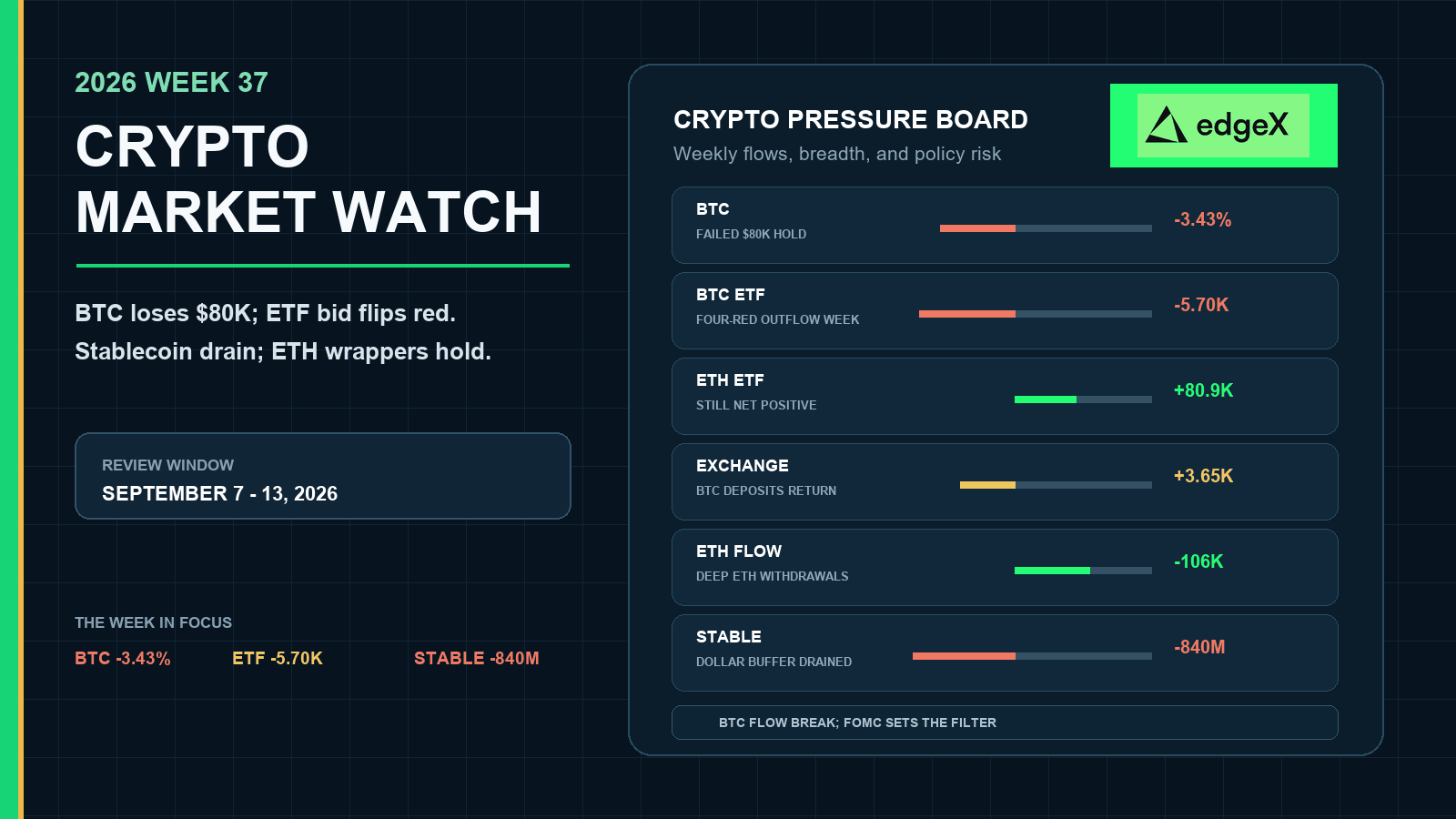
- •Bitcoin fell approximately 3.43% in Week 37, briefly touching $76,565 on September 10 and failing to reclaim the $80,000 level as inflation, oil above $100, and nearly 90% September Fed hike odds weighed on risk assets.
- •Bitcoin spot ETFs recorded roughly 5,700 BTC (~$463 million) in net outflows across September 8–11, breaking a three-week inflow streak, while Ethereum ETFs remained net positive with about 80,890 ETH (~$197 million) absorbed.
- •On-chain positioning deteriorated as Bitcoin exchange netflow flipped to about +3,648 BTC in net deposits and stablecoin exchange balances drained roughly $840.15 million, leaving less buying capacity ahead of the policy week.
- •Altcoins broadly underperformed, with SOL losing the $100 level (-6.4%), XRP sliding about 9.1% to near $1.30 despite positive ETF inflows, and former leaders such as ZEC, LINK, ADA, SUI, and DOGE surrendering their Week 36 gains.
- •Week 38 pivots on the September 15–16 FOMC decision and the CLARITY Act's procedural path, where a less hawkish Fed could repair Bitcoin ETF demand and halt the stablecoin drain, while a hawkish outcome would extend the reset.
Quick Answer
Week 37 answered Week 36’s open question the hard way. The selective rebound did not hold once inflation, oil, and September hike odds reclaimed the macro tape. Bitcoin lost the $80,000 shelf, printed a clean multi-session ETF outflow week, and saw exchange balances refill just as stablecoin liquidity left venues. Ether kept a more constructive institutional split—still-positive ETF creations and a large exchange withdrawal—but price still failed to trend away from the macro drag. Altcoins underperformed: SOL lost $100, XRP lagged despite ETF inflows, and former leaders such as ZEC, LINK, ADA, SUI, and DOGE gave back the Week 36 bounce. Week 38 therefore starts with weaker Bitcoin demand, a split ETF complex, thinner dollar buffers, broken alt breadth, and two policy catalysts that can either stabilize risk appetite or extend the reset.
Week 37 Turned the Rebound Into a Flow Break
The completed Week 37 record mattered more than the hopeful setup Week 36 left behind. After a selective rebound above the digestion shelf, the market had to show that ETF demand, exchange withdrawals, and broadened alt participation could survive the next macro impulse. They could not. Higher inflation prints, a three-digit oil shock, and rising Fed hike odds forced risk assets lower, and crypto’s flow stack broke first in Bitcoin.
Bitcoin lost the $80,000 hold
BTCC’s September 7–13 wrap put Bitcoin down about 3.43% on the week. Price rolled over from above $79,000, briefly tagged $76,565 on September 10, and spent the rest of the week failing to reclaim and hold $80,000. That is a different tape from Week 36’s high-$79,000s finish and selective rebound setup. The technical point is not only the weekly percentage. It is that the post-rebound shelf stopped acting like a defended base once wrapper demand and exchange supply flipped.
Ether did not collapse in a straight line. It started near $2,500, squeezed up to about $2,663 on September 11, then faded back toward the low-to-mid $2,500s into the week wrap. Relative resilience inside a down week is not the same thing as confirmed leadership. Both large caps still traded the rate path more than any single crypto-native catalyst.
Flows Split: Bitcoin Out, Ether Still In
Week 37’s most important signal was not a single candle. It was the break in Bitcoin’s institutional bid while other wrappers stayed selectively open.
Bitcoin ETFs printed a four-red week
The CoinGlass Bitcoin ETF table for September 8–11 shows about −389 BTC, −1.53K, −3.61K, and −172 BTC, totaling approximately −5.70K BTC. There was no midweek rescue session like Week 36’s September 3 rebound. Public reports put the dollar outflow near $463 million, with September 10 alone around $283 million, ending a three-week inflow streak. Total net assets on the later CoinGlass header sat near $98.91B, underscoring that the Bitcoin ETF complex entered Week 38 with a weaker asset base after the Week 37 outflow run.
Ether ETFs stayed net positive on a two-way path
Ethereum ETF native-unit flows were about −9.76K, +13.97K, −12.12K, and +88.80K ETH, totaling approximately +80.89K ETH. That is still constructive and close to Week 36’s +89.28K ETH total, but the path depended heavily on a single large September 11 creation day. BTCC’s dollar wrap put Ether funds near +$197M for the week, their fourth consecutive positive week in that accounting. The split is clear: Bitcoin wrappers became the pressure valve; Ether wrappers still absorbed cash.
Solana and XRP stayed net buyers; HYPE reversed
Solana ETF flows printed about −6.75K, +108.39K, −4.93K, and −3.04K SOL, totaling roughly +93.67K SOL. The week stayed positive only because September 9 was enormous. XRP ETFs added about +13.47M XRP across September 8–10 with no red session in the active window. HYPE ETFs flipped from Week 36’s +141K intake to about −319.25K HYPE of net outflows. Product demand therefore remained selective rather than market-wide.
Exchange and Stablecoin Liquidity Turned Defensive
If Week 36’s soft spot was fading BTC withdrawals, Week 37 made that deterioration explicit and added a stablecoin drain.
Bitcoin exchange netflow flipped back to deposits
CryptoQuant’s all-exchange BTC series for September 7–13 was about +208, +2,149, +2,417, −3,418, +2,725, +121, and −553 BTC, totaling approximately +3,648 BTC. After Week 35’s deep withdrawal and Week 36’s near-flat −954 BTC, the Week 37 print is a supply-side warning. Visible Bitcoin returned to exchanges in the same week ETFs leaked.
Ether left exchanges even harder
ETH exchange netflow was about −2,244, −25,785, −1,404, +27,026, −36,435, −45,931, and −21,493 ETH, totaling approximately −106,267 ETH. That is a much larger withdrawal impulse than Week 36’s −15,527 ETH. Combined with still-positive Ether ETF creations, the ETH complex kept a stronger absorption signature than Bitcoin even while spot price stayed choppy.
Stablecoin balances shrank
All-stablecoin exchange netflow swung to about −$452.4M, −$73.8M, −$123.9M, +$231.1M, −$503.8M, +$65.8M, and +$16.9M, totaling approximately −$840.15M. Week 36’s +$593.35M dollar-buffer rebuild is gone. The largest drains hit early week and again on September 11, so later repair days never restored the prior buffer. Less exchange-based stablecoin capacity into a rate-hike week means less dry powder for an immediate V-shaped repair.
| Week 37 signal | Reading | What the result means |
|---|---|---|
| BTC price, BTCC week | About −3.43%; low $76,565; no $80K hold | Rebound shelf failed under macro pressure |
| ETH price, BTCC week | Spike to ~$2,663, finish near low/mid-$2,500s | Volatile, not a clean escape |
| BTC ETF net flow | About −5.70K BTC; ~−$463M | Three-week inflow streak broken |
| ETH ETF net flow | About +80.89K ETH; ~+$197M | Institutional bid still alive in ETH |
| SOL / XRP / HYPE ETFs | +93.67K SOL / +13.47M XRP / −319.25K HYPE | Selective wrappers, HYPE reversed |
| BTC exchange netflow | About +3,648 BTC | Deposits replaced W36’s mild drain |
| ETH exchange netflow | About −106,267 ETH | Stronger ETH absorption than BTC |
| Stablecoin exchange netflow | About −$840.15M | Dollar buffer flipped from rebuild to drain |
Altcoins Gave Back the Week 36 Bounce
Week 37 was an altcoin-risk-off week, not another privacy-and-beta leadership tape. After Week 36’s catch-up bounce, the CoinGecko multi-asset listing snapshot into mid-September showed most large- and mid-cap alts underperforming Bitcoin’s already soft weekly tape. Total crypto market capitalization sat near $2.60T, with Bitcoin dominance around 58.5%. Capital concentrated defensively rather than rotating into a second alt leg.
The table uses the CoinGecko listing snapshot for relative ranking. Seven-day percentages span late Week 37 into the soft early-Week 38 open, so they are breadth evidence rather than a second certified full-week scoreboard for every name. BTCC remains the locked source for Bitcoin’s completed Week 37 −3.43%.
| Asset | Snapshot price | 7d % | What it signals |
|---|---|---|---|
| SOL | ~$97.38 | −6.4% | Lost $100 despite still-positive SOL ETF week |
| XRP | ~$1.30 | −9.1% | Price lagged even with net-positive XRP ETF creations |
| BNB | ~$714.76 | −5.6% | Large-cap beta cooled with the complex |
| HYPE | ~$77.77 | −9.5% | Softened as HYPE ETF flows flipped to outflows |
| ZEC | ~$1,130 | −5.5% | Leadership premium cooled vs W36-end ~$1,213 |
| DOGE | ~$0.0802 | −11.3% | High-beta meme/large-cap lag |
| ADA | ~$0.1955 | −11.5% | Week 36 bounce reverse |
| LINK | ~$10.91 | −13.1% | Infrastructure beta underperformed |
| SUI | ~$0.692 | −15.6% | One of the steeper large-cap givebacks |
| UNI | ~$6.33 | −7.3% | DeFi catch-up faded |
| AVAX | ~$7.29 | −8.8% | Mid-cap L1 pressure |
| BCH | ~$219.63 | −15.3% | Deep lag versus majors |
| NEAR | ~$2.36 | +0.1% | Rare flat outlier |
| XMR | ~$508.75 | +2.1% | Privacy relative resilience |
| WLD | ~$0.36 | −21.3% | High-beta mid-cap lag |
| DOT | ~$0.95 | −20.7% | High-beta mid-cap lag |
Large-cap alts lost the post-rebound shelves
Solana was the clearest large-cap technical failure outside Bitcoin. The snapshot left SOL near $97, down about 6.4% over seven days and below the $100 area it had defended into Week 36. That matters because Solana ETF creations were still net positive on the week. Product demand alone did not stop spot from giving back the shelf once macro risk-off hit.
XRP told a similar split. ETF wrappers still absorbed about +13.47M XRP, but price sat near $1.30, down about 9.1% over seven days. BNB eased toward about $715 (−5.6%). HYPE fell toward the high-$70s (−9.5%) as its ETF wrapper flipped from Week 36 intake to about −319K HYPE of net outflows. Residual creations were not strong enough to offset beta selling.
Former leaders and high-beta names reversed hardest
The Week 36 leadership set did not hold. ZEC stayed elevated in absolute terms near $1,130, but the seven-day reading near −5.5% and the drop from the Week 36-end reference near $1,213 show the privacy sprint cooled. UNI (−7.3%), DOGE (−11.3%), ADA (−11.5%), LINK (−13.1%), SUI (−15.6%), and BCH (−15.3%) all underperformed Bitcoin’s locked weekly loss. Mid-cap high-beta names such as WLD and DOT printed steeper seven-day declines above 20%.
Relative outliers were narrow. NEAR was roughly flat, and XMR held a modest green print near +2.1%. That is selective resilience inside a down tape, not proof that altcoin risk appetite survived. Breadth failed the Week 36 repair test: prior washout losers did not keep bouncing, and leaders did not keep leading.
Idiosyncratic memes did not repair market beta
BTCC flagged BSC stock-meme names and the political LAPTOP launch as high-volatility sideshows, including an extreme spike-and-crash pattern. Venice Token and Bitway strength stayed idiosyncratic. Those tapes can dominate social feeds without fixing Bitcoin ETF demand, stablecoin balances, or large-cap alt shelves. The investable conclusion is forced de-risking across alts, not a second alt season.
Macro Repriced Crypto Through Oil, Inflation, and Hike Odds
Week 37’s crypto break was not mainly a protocol-specific event. August CPI at 3.4% year over year, firm PPI, and oil’s move through $100 pushed September FOMC hike odds toward roughly 90%. That combination raised real-yield and dollar pressure, hit gold, and removed the soft-landing relief that had helped Bitcoin finish Week 36 near the high-$79,000s before the Week 37 break. Crypto traded like a high-beta risk asset again.
Policy week now decides whether the flow break heals
Week 38 brings the September 15–16 FOMC decision and communication, the Senate CLARITY Act procedural path, and institutional calendar items such as Circle’s Arc mainnet. A less hawkish Fed delivery could help repair Bitcoin ETF demand and stop the stablecoin drain. A hawkish hold-plus-tight guidance, or a regulatory disappointment, would keep the Week 37 flow break in force.
Week 38 Outlook: Defend Under a Policy Binary
Week 38 covers September 14–20, 2026. The base case is defensive consolidation under a policy binary rather than an immediate replay of Week 36’s rebound. Bitcoin enters the week below the failed $80,000 hold, with ETF outflows fresh, exchange deposits up, and stablecoin balances lower. Ether enters with better wrapper and withdrawal evidence but no price trend independence from the macro.
The constructive path needs Bitcoin demand to stop leaking
First, Bitcoin ETF sessions need to stop printing four-red clusters and at least stabilize near flat to net positive. Second, BTC exchange netflow should roll back toward withdrawals rather than multi-day deposits. Third, stablecoin exchange netflow should stop the ~$840M-style drain. Fourth, Ether’s still-positive ETF bid needs to show up in a less fragile ETH price if the complex is going to lead a repair. On levels and breadth, the constructive case is BTC defending the mid-to-high $70,000s, ETH holding the low $2,500s, SOL reclaiming $100, XRP stabilizing above $1.30, and former leaders such as ZEC, LINK, ADA, and SUI stopping their relative underperformance versus Bitcoin.
The downside path begins with another ETF outflow week or hawkish FOMC
Another net-negative Bitcoin ETF week, a second stablecoin drain, or a Fed package that keeps hike odds elevated would raise the odds that Week 37 was the start of a deeper demand reset rather than a one-week flush. The first mechanical warnings would be BTC losing the mid-$70,000s while exchange deposits stay positive, ETH’s ETF bid fading, SOL staying below $100, and high-beta alts such as SUI, LINK, and DOGE continuing to underperform Bitcoin.
The decision criterion for Week 38 is not whether a meme tape can spike. It is whether Bitcoin wrapper demand, exchange-dollar liquidity, and alt breadth can stabilize after a week in which all three broke. If they stabilize, Week 37 is a failed rebound inside a still-defensible range. If they do not, the market will have to rebuild demand with less help from ETFs and less stablecoin dry powder.
Trade Crypto With Leverage - Without Giving Up Custody
Decentralized perpetual exchanges have moved well past niche status. According to CoinGecko's 2025 Annual Crypto Report, DEX perpetual trading volume surged 346% last year, reaching $6.7 trillion, while centralized exchange open interest fell 20.8% over the same period. Traders are committing serious capital to on-chain derivatives, and the reasons are straightforward: counterparty risk is real, custodial failures happen, and censorship resistance matters.
edgeX is a decentralized perpetual futures exchange built for traders who want market access without sacrificing control. Here's what sets it apart:
- No KYC, no barriers. Connect a wallet and start trading. No identity verification or account approvals are required.
- True self-custody. edgeX combines off-chain order matching with verifiable on-chain settlement secured by Ethereum. Forced-withdrawal mechanisms keep funds recoverable directly from the blockchain even if the operator goes offline.
- Deep liquidity, tight spreads. edgeX maintains $10 million of market depth within a one-basis-point spread, with sub-0.1-basis-point slippage on trades exceeding $100,000.
- Up to 100x leverage. Traders can scale positions to match their risk framework, whether hedging exposure or trading momentum.
- 140% trading fee rewards. Active traders can earn rewards on their trading activity, reducing the net cost of frequent strategies.
- Institutional-grade infrastructure. edgeX processes up to 200,000 orders per second with matching latency below 10 milliseconds.
Start trading crypto perpetual futures on edgeX and put your market view to work.
Frequently Asked Questions
What dates does the Week 37 Crypto Market Watch cover?
The review covers September 7 through September 13, 2026, using UTC dates. Week 38 refers to September 14–20, 2026.
Why did Bitcoin weaken in Week 37?
Bitcoin fell about 3.43% as inflation, oil’s move through $100, and rising September FOMC hike odds pressured risk assets. Price lost the $80,000 hold after a September 10 dip to $76,565 and never staged a clean reclaim.
What did the ETF data show?
Bitcoin spot ETFs lost about 5.70K BTC across the four U.S. sessions, roughly −$463M, ending a three-week inflow streak. Ethereum spot ETFs still added about 80.89K ETH (~+$197M). Solana and XRP ETF wrappers stayed net positive, while HYPE ETFs flipped to about −319.25K HYPE.
Did exchange flows confirm demand?
No for Bitcoin, yes more for Ether. BTC exchange netflow flipped to about +3,648 BTC of net deposits. ETH exchange netflow deepened to about −106,267 ETH. Stablecoin exchange netflow swung to about −$840.15M, reversing Week 36’s liquidity rebuild.
What happened to altcoins after Week 36’s rebound?
Altcoins underperformed. On the CoinGecko listing snapshot, SOL fell to about $97 (−6.4% 7d), XRP to about $1.30 (−9.1%), SUI about −15.6%, LINK about −13.1%, ADA about −11.5%, and DOGE about −11.3%. ZEC cooled near $1,130 after Week 36 leadership. Positive SOL and XRP ETF creations did not stop spot weakness. Meme spikes stayed idiosyncratic.
What should traders watch in Week 38?
Watch the September 15–16 FOMC decision, the CLARITY Act procedural path, whether Bitcoin ETF flows stabilize after the four-red week, whether BTC exchange netflow stops depositing, whether stablecoin balances stop draining, and whether ETH’s still-positive wrapper bid can support price if macro pressure eases.

