Week 36 Crypto Market Watch: Selective Rebound, Zcash Leadership, and ETF Churn
Key Takeaways
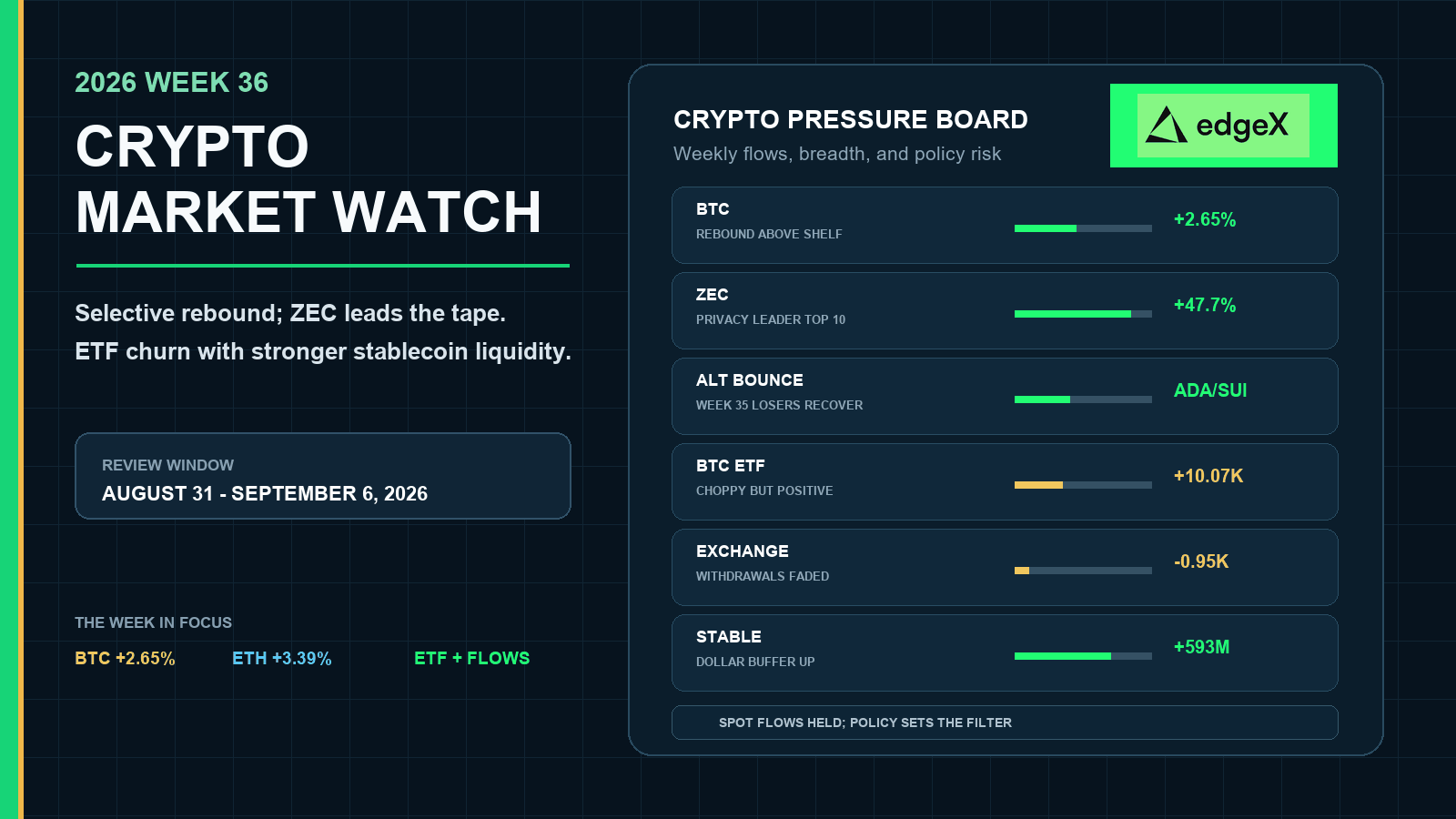
- •Bitcoin finished Week 36 up roughly 2.65% near $79,705 after spiking above $82,200 on September 3, its highest level in three months, while total crypto market capitalization held above $2.7 trillion.
- •Zcash surged nearly 48% to about $1,213, breaking above $1,200 for the first time since late 2016 and displacing HYPE from the top-10 market-cap ranks.
- •Bitcoin spot ETFs added about 10,070 BTC for the week despite consecutive outflows on September 1–2, while Ethereum ETFs took in about 89,280 ETH, a steep decline from Week 35's 253,080 ETH.
- •BTC exchange netflow was nearly flat at about −954 BTC compared with Week 35's deep outflow of roughly 19,374 BTC, while stablecoin exchange netflow added about $593 million, exceeding the prior week's $451 million.
- •Fed Governor Christopher Waller's comments that he could support holding rates steady sent September hike odds toward a coin flip and helped push Bitcoin back above $81,000 midweek, before U.S. jobs data trimmed the gains.
Quick Answer
Week 36 answered the question Week 35 left open: could crypto defend the post-breakout shelf after Warsh, Friday’s Bitcoin ETF streak break, and altcoin mean reversion? The price answer was constructive. Bitcoin and Ether finished the week higher, the aggregate market stayed above $2.7T, and several Week 35 losers bounced. The flow answer was more mixed. Bitcoin and Ether ETFs remained net buyers on the week, but the path was choppy, Ether’s haul slowed sharply from Week 35, and BTC exchange withdrawals almost disappeared. Altcoins told the strongest story. Zcash led a privacy-and-beta rebound, while Solana held the large-cap lane without repeating Week 35’s clean ETF dominance. Week 37 therefore starts with a better tape than Week 35 ended, but with less proof that institutional wrappers and exchange supply are still pulling in the same direction.
Week 36 Turned Digestion Into a Selective Rebound
The completed Week 36 record mattered more than the cautious setup that framed it. After Week 35’s confirmation pause, the market had to decide whether higher-yield pressure and ETF churn would force a deeper retracement or whether cash demand could still support prices above the old pre-breakout range. The answer was a selective rebound: majors stabilized higher, breadth improved, and a few non-Bitcoin leaders ran hard, while flow quality became more uneven.
Bitcoin moved from the mid-$77,000s into a week that included a run above $82,000 and a finish near the high-$79,000s. Ether reclaimed the low-$2,500s.
Price reclaimed the high end of the post-breakout shelf
The important technical point is what held. Bitcoin did not lose the post-breakout area that Week 35 defended. It spent the week oscillating higher, spiked to a three-month high above $82,200 on September 3, then gave back the extreme without collapsing through the prior consolidation zone. Bitcoin.com’s week wrap put the weekly Bitcoin gain near 1.2% into a roughly $80,200 close with about $1.6T in market value; the CoinMarketCap seven-day reading into early September 7 was closer to +2.65% near $79,705.
Ether’s seven-day gain near +3.39% and the ETH/BTC lift to about 0.03139 show that relative large-cap leadership was no longer one-sidedly Bitcoin. Solana finished near $105.32, up about 3.66%, keeping the large-cap exception status it earned in Week 35 even as its ETF tape turned two-way. Total market capitalization opened the week just above $2.71T, peaked near $2.82T with Bitcoin’s midweek surge, and held a roughly 2% weekly gain after the U.S. jobs-data pullback.
Altcoins Broadened After the Week 35 Washout
Week 36 was not another “majors digest, alts bleed” tape. After Week 35 concentrated leadership into Bitcoin and a few product-supported names, capital rotated back into beaten-up and idiosyncratic alts. Bitcoin dominance eased toward about 59.1% from the high-59% to low-60% zone of the prior week.
Zcash turned the privacy trade into market leadership
Zcash was the clearest market leader. The CoinMarketCap seven-day reading near +47.7% to about $1,213 matched Bitcoin.com’s report of a nearly 40% jump through $1,200, the first such breach since late 2016, and a return to the top-10 market-cap ranks by displacing HYPE. CoinDesk’s September 4 tape also flagged Zcash as the standout daily gainer when rate-hike odds faded.
Uniswap, NEAR, and Chainlink extended the selective-risk message. UNI’s seven-day gain near +38.4%, NEAR near +33.3%, and LINK near +17.7% show that the rebound included DeFi and infrastructure beta, not only privacy coins.
Week 35 losers bounced, but the rebound was still selective
The Week 35 chase cohort did not keep grinding lower. ADA rose about 13.2%, SUI about 12.1%, DOGE about 9.5%, AAVE about 9.7%, and XRP about 4.1%. That bounce improves breadth, but it is still a recovery from a washout rather than proof of a durable second alt leg. HYPE gained about 7.6% even after losing its top-10 slot to ZEC, and BNB added about 9.3% after tagging a multi-month high near $779. Monero stayed constructive near +5.1%, keeping privacy exposure broader than a single-name spike.
The weaker large-cap reads were mild rather than catastrophic. TRX was basically flat on the CoinMarketCap seven-day print, and Bitcoin.com’s wrap still showed small weekly losses for ETH and SOL on its own methodology. Leadership broadened and the complex looked healthier than Week 35, but winners stayed concentrated in privacy, catch-up beta, and infrastructure names.
Flows Stayed Positive, but Quality Deteriorated
Week 36’s price rebound did not come with a clean upgrade in every flow metric. Institutional wrappers remained net buyers, and stablecoin liquidity on exchanges improved again. The missing piece was the deep BTC exchange withdrawal impulse that made Week 35 look like accumulation during digestion.
Bitcoin ETF demand survived early-week outflows
The CoinGlass Bitcoin ETF table shows a five-session sequence of about +2.79K, −3.01K, −1.31K, +9.45K, and +2.15K BTC, totaling approximately +10.07K BTC. That is only slightly below Week 35’s +11.52K BTC total, but the path is different. September 1–2 printed consecutive outflows after public reports of a roughly $236.5M dollar outflow day into the new month. September 3 then delivered the week’s largest native-unit rebound, and September 4 stayed green.
Ether ETF demand cooled from Week 35’s institutional surge
Ethereum ETF native-unit flows were about +36.26K, +3.49K, −19.94K, +59.14K, and +10.33K ETH, totaling approximately +89.28K ETH. That remains positive, but it is a steep step down from Week 35’s +253.08K ETH and no longer a clean five-green sequence. The September 2 outflow broke the prior week’s steadier institutional bid.
Altcoin ETF wrappers turned two-way just as spot breadth improved
Solana ETF flows printed about +8.85K, +86.42K, −61.04K, +63.75K, and −50.07K SOL, totaling roughly +47.91K SOL. The category stayed net positive, but the September 2 and September 4 red sessions end the idea of an uninterrupted product bid. XRP ETFs added about +13.80M XRP on the week, with a large September 1 intake and a September 2 reversal. HYPE ETFs still attracted about +141.45K HYPE, almost entirely from a September 1 print and a September 4 Bitwise-led burst.
Exchange withdrawals faded while stablecoin liquidity expanded
CryptoQuant’s all-exchange BTC netflow readings were +1,296.08, −328.98, +3,441.49, +2,339.72, −6,275.71, −2,248.20, and +821.16 BTC from August 31 through September 6. The weekly total was only about -954.44 BTC. After Week 35’s roughly −19,374 BTC drain, that is a major change in the spot supply backdrop. Midweek deposits on September 2–3 offset much of the late-week withdrawal impulse.
Ether exchange netflow told a stronger withdrawal story than Bitcoin. CryptoQuant’s all-exchange ETH series was about −9,234.94, +31,480.49, +61,737.01, −25,727.77, −34,613.86, −19,332.67, and −19,835.47 ETH, totaling approximately -15,527 ETH. Early-week deposits on September 1–2 were more than offset by four consecutive withdrawal days into the weekend.
Stablecoin exchange netflow stayed the clearest constructive liquidity signal. Daily readings were about +$150.42M, +$393.71M, −$19.21M, −$150.20M, +$74.90M, −$15.82M, and +$159.55M, totaling approximately +$593.35M. That exceeds Week 35’s +$451.25M repair week. Exchange-based dollar capacity improved again even while BTC exchange netflow went nearly flat.
| Week 36 signal | Reading | What the result means |
|---|---|---|
| BTC price, early-Sep snapshot | $79,704.74; +2.65% 7d | Rebound above the digestion shelf |
| ETH price, early-Sep snapshot | $2,502.33; +3.39% 7d | Large caps joined the bounce |
| ZEC / UNI / NEAR | +47.7% / +38.4% / +33.3% | Privacy and high-beta leadership |
| ADA / SUI / DOGE | +13.2% / +12.1% / +9.5% | Week 35 losers bounced |
| BTC ETF net flow | About +10.07K BTC | Demand survived early-week outflows |
| ETH ETF net flow | About +89.28K ETH | Still positive, much slower than W35 |
| SOL / XRP / HYPE ETF flows | +47.91K SOL / +13.80M XRP / +141.45K HYPE | Wrappers two-way, still net positive |
| BTC exchange netflow | About −954 BTC | Withdrawal impulse nearly gone |
| ETH exchange netflow | About −15,527 ETH | ETH supply still left exchanges |
| Stablecoin exchange netflow | About +$593.35M | Exchange dollar buffer expanded again |
| BTC dominance | About 59.1% | Slightly less concentrated than W35 |
Macro Softened Midweek, Then Jobs Data Capped the Spike
The week’s macro path was not a straight extension of the Warsh shock. By September 4, the rates market had done more of the work for crypto than any single crypto-native headline. CoinDesk reported Bitcoin back above $81,000 as September Fed hike odds fell toward a coin flip after Fed Governor Christopher Waller said he could support holding rates steady if price pressures kept easing. That midweek soft-landing repricing helped the risk-asset bounce.
The week did not close on pure policy relief. Bitcoin.com’s recap flagged a pullback after U.S. jobs data even as the market kept a positive weekly print.
Derivatives risk shifted from squeeze fuel to chase risk
Week 34 was amplified by short covering. Week 35 was about whether leverage would re-crowd into a rates shock. Week 36’s risk is late chase. With Zcash, UNI, NEAR, and other high-beta names already extended, the danger is late chase rather than another empty squeeze. A clean continuation needs funding and open interest to stay secondary to spot and ETF demand. If leverage rebuilds into privacy and catch-up beta after a jobs-data fade, the next downswing can hit the exact names that look strongest on the week.
Week 37 Outlook: Hold the Rebound, or Lose the Flow Confirmation
Week 37 covers September 7–13, 2026. The base case is that the market tries to hold the Week 36 rebound rather than immediately launching a second vertical leg. Bitcoin enters the week still above the old breakout shelf, with ETF demand net positive but choppy, exchange withdrawals no longer deep, and stablecoin balances stronger.
The constructive path needs ETF consistency more than a new high
First, Bitcoin ETF flows need to avoid another early-week outflow cluster like September 1–2. Second, Ether ETF demand should stay net positive even if it cannot match Week 35’s surge. Third, BTC exchange netflow should not flip into a multi-day deposit wave that reloads visible supply. Fourth, stablecoin exchange netflow should keep at least part of the +$593M buffer intact. On price and breadth, the constructive case is BTC holding the high-$70,000s to low-$80,000s, ETH/BTC staying near 0.031, SOL defending $100, and the rebound in ADA, SUI, and DOGE not immediately reversing.
The downside path begins with deposits, ETF fatigue, or oil shock
A second week of soft Bitcoin ETF sessions, a sustained positive BTC exchange netflow, or a fresh geopolitical oil spike would raise the odds that Week 36’s rebound was only a dead-cat repair after digestion. The first mechanical warning would be BTC losing the high-$70,000s while exchange deposits rise, stablecoin balances shrink, and high-beta leaders such as ZEC, UNI, and NEAR reverse harder than Bitcoin.
The decision criterion for Week 37 is therefore not whether Zcash can print another 40% week. It is whether spot ETF demand, exchange balances, and broadened altcoin participation can defend the rebound after a week in which withdrawals faded and wrappers became choppier. If they can, Week 36 was the first real repair after digestion. If they cannot, the market will have to prove demand again with less help from exchange outflows.
Trade Crypto With Leverage - Without Giving Up Custody
Decentralized perpetual exchanges have moved well past niche status. According to CoinGecko's 2025 Annual Crypto Report, DEX perpetual trading volume surged 346% last year, reaching $6.7 trillion, while centralized exchange open interest fell 20.8% over the same period. Traders are committing serious capital to on-chain derivatives, and the reasons are straightforward: counterparty risk is real, custodial failures happen, and censorship resistance matters.
edgeX is a decentralized perpetual futures
exchange built for traders who want market access without sacrificing control.
Here's what sets it apart:
- No KYC, no barriers. Connect a wallet and start trading. No identity verification or account approvals are required.
- True self-custody. edgeX combines off-chain order matching with verifiable on-chain settlement secured by Ethereum. Forced-withdrawal mechanisms keep funds recoverable directly from the blockchain even if the operator goes offline.
- Deep liquidity, tight spreads. edgeX maintains $10 million of market depth within a one-basis-point spread, with sub-0.1-basis-point slippage on trades exceeding $100,000.
- Up to 100x leverage. Traders can scale positions to match their risk framework, whether hedging exposure or trading momentum.
- 140% trading fee rewards. Active traders can earn rewards on their trading activity, reducing the net cost of frequent strategies.
- Institutional-grade infrastructure. edgeX processes up to 200,000 orders per second with matching latency below 10 milliseconds.
Start trading crypto perpetual futures on edgeX
and put your market view to work.
Frequently Asked Questions
What dates does the Week 36 Crypto Market Watch cover?
The review covers August 31–September 6, 2026, using UTC dates. Week 37 refers to September 7–13, 2026.
Did Week 36 confirm a new breakout leg?
Not cleanly. Bitcoin tagged a three-month high above $82,200 and finished the week higher, but the close settled back toward the high-$79,000s after a jobs-data pullback. The week looks like a selective rebound above the digestion shelf rather than a completed second-leg breakout.
What did the ETF data show?
Bitcoin spot ETFs added about 10.07K BTC across the five sessions, with outflows on September 1–2 and a large rebound on September 3. Ethereum spot ETFs added about 89.28K ETH, still positive but far below Week 35. Solana, XRP, and HYPE ETF wrappers stayed net positive on the week while printing two-way daily flows.
Did exchange flows confirm demand?
Only partly. BTC exchange netflow was a mild net withdrawal of about 954 BTC, much weaker than Week 35’s deep outflow. ETH exchange netflow was a clearer withdrawal print at about 15,527 ETH. Stablecoin exchange netflow was strongly positive at about $593.35M, improving exchange dollar capacity.
Why did altcoins outperform?
After Week 35’s washout, capital rotated into privacy and catch-up beta. Zcash led with a top-10 reclaim, while UNI, NEAR, LINK, ADA, SUI, and DOGE bounced hard. Breadth improved, but leadership remained selective rather than universal.
What should traders watch in Week 37?
Watch whether Bitcoin ETF flows stay net positive after the early-week churn, Ether ETF demand holds, BTC exchange netflow avoids a deposit wave, stablecoin balances keep the new buffer, BTC defends the high-$70,000s, SOL holds above $100, and the rebound in former losers does not immediately reverse.
