Crypto Fees in 2026: The Real Cost of Sending and Trading - and How to Reduce Them
Key Takeaways
- •Bitcoin's average transaction fee fell 72.64% year over year to $0.2576 on October 11, 2026, while Ethereum's dropped 67.36% to $0.2504.
- •Layer 2 transfers cost roughly $0.001 versus about $0.02 on Ethereum mainnet, a gap that can widen to 50 times or more during congestion.
- •Hidden costs such as spreads, withdrawal fees, and card markups can dwarf network fees; a Phemex example showed a $1,000 beginner trade losing 7.6% to fees despite a 10% price gain.
- •Bitcoin ATM transactions carry all-in costs of roughly 7% to 20%, base spot trading fees at low-cost exchanges range from 0% to 0.40%.
- •Bitcoin daily transactions rose 41% in five months to 651,655 by June 2026, and the early 2028 halving is expected to increase fees' share of miner revenue.
Crypto transaction fees can range from a fraction of a cent to several dollars for what is essentially the same transfer. The cost depends on three things: the network used, the platform chosen, and how the order is placed.
This report compiles fee data from market trackers, exchange fee comparisons and cost guides published through 2026. All figures are for 2026 unless otherwise noted, and the most recent daily readings are from October 11, 2026.
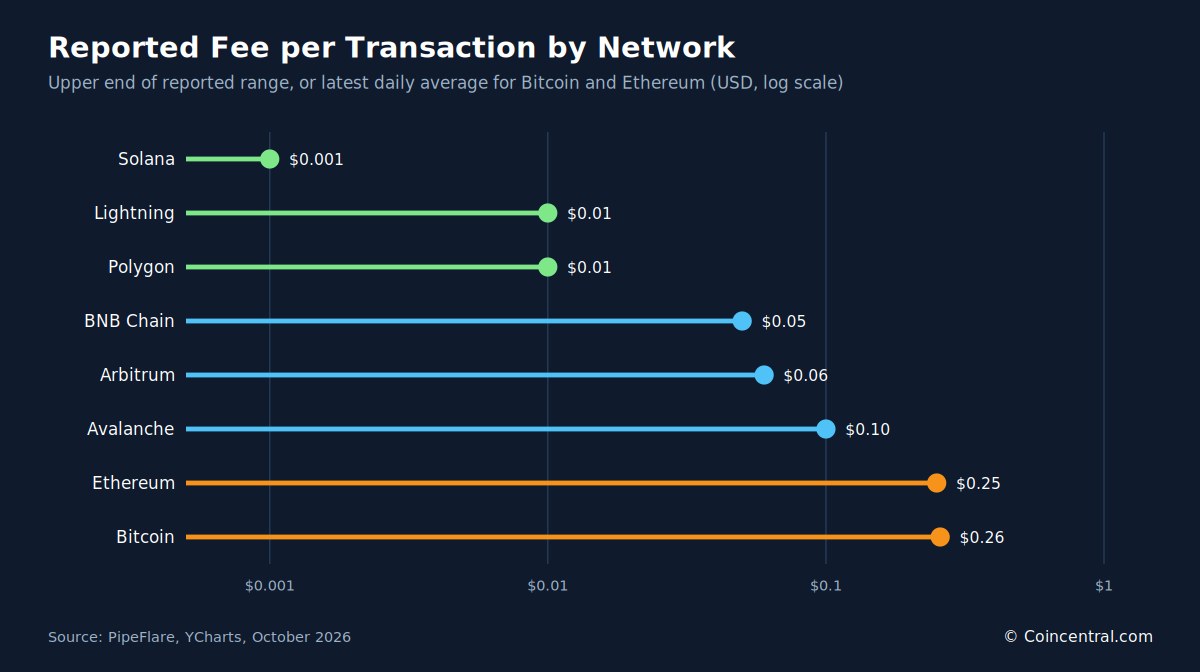
At the base-layer level, fees on the largest networks are currently low. Bitcoin's average transaction fee stood at $0.26 per transaction and Ethereum's at $0.25. The larger costs are usually found elsewhere - in exchange spreads, withdrawal charges and payment method markups.
For anyone sending funds regularly or trading frequently, these costs compound. A one-cent network fee is trivial on a single transfer, but a 2% spread on every trade adds up quickly.
Key Crypto Fee Statistics for 2026
- Bitcoin's average fee was $0.2576 per transaction on October 11, 2026, down 72.64% from $0.9414 a year earlier.
- Ethereum's average fee was $0.2504 per transaction, down 67.36% from $0.7671 a year earlier.
- Layer 2 networks cost roughly $0.001 per transfer, against about $0.02 on Ethereum mainnet, per ethereum.org figures cited by PipeFlare.
- Spot trading fees at low-cost exchanges range from 0% to 0.40%, according to CoinLedger.
- A beginner trade placed on a simplified interface can lose 7.6% of a $1,000 deposit to fees, based on a Phemex worked example.
- Bitcoin ATM transactions cost roughly 7% to 20% of the amount, according to PipeFlare.
How Crypto Fees Work
Every blockchain prices its block space differently. Bitcoin runs an auction denominated in satoshis per virtual byte, meaning the fee depends on the size of the transaction data - not the dollar value being sent. Because new blocks are produced on a roughly ten-minute schedule, the supply of block space is fixed, and users effectively bid against one another for the next slot.
Ethereum charges a base fee plus an optional tip for each unit of gas under the EIP-1559 model, which has been in force since the London hard fork on August 5, 2021. Under this model the base fee is burned rather than paid to validators, while the tip goes to the block producer. A simple transfer consumes 21,000 gas units, while a token swap can consume 150,000 or more.
Solana charges a flat 5,000 lamports per signature, which PipeFlare estimates at roughly $0.0005 to $0.001. Layer 2 networks batch many transactions together and post a single compressed proof back to Ethereum. The Lightning Network routes Bitcoin payments off-chain, where fees stay under one cent for almost any payment size.
On top of these network fees, exchanges add their own charges: trading fees, spreads, payment method fees and withdrawal fees, each covered in the sections below.
The Chain Matters More Than the Amount Sent
Ethereum's own Layer 2 comparison puts a typical Layer 2 transfer at about $0.001 versus about $0.02 on mainnet. During periods of congestion, the gap can widen to 50 times or more.
Base fees fell 10 to 100 times after the Dencun upgrade in March 2024 introduced blob transactions, known as EIP-4844. PipeFlare estimates that users who default to Layer 1 can overpay by 10 to 100 times as a result.
Bitcoin Transaction Fee Statistics
YCharts, using Blockchain.com data, put the average Bitcoin fee at $0.2576 per transaction on October 11, 2026. That figure is 2.34% from the previous day and down 72.64% from $0.9414 one year earlier. BitInfoCharts showed a similar reading of $0.244, or 1.9 satoshis per virtual byte. Bitcoin traded near $83,691 on the same day, according to YCharts.
Daily data from August 24 through October 11 illustrates how much fees can move. The 49-day average was $0.37, with a median of $0.37. The highest daily reading was October 1 at $0.69; the lowest was August 30 at $0.19, making the peak roughly 3.6 times the trough.
Bitcoin fees are determined by data size rather than the amount sent. A transaction with many inputs and outputs occupies more block space and therefore carries a higher fee. Wallets typically suggest a fee rate based on how crowded the mempool is at the time of sending.
Longer-run figures show the same volatility pattern. CoinLaw reports a 2026 average of about $0.82 with a median of $0.30 - the gap between the two indicates that a handful of spike days pull the average upward. In 2025, the typical monthly average hovered around $0.62, with occasional spikes above $2, while quiet periods saw fees drop to 1 satoshi per virtual byte. YCharts notes that the 2017 bull market pushed the average fee to nearly $60.
Fees tend to rise when prices swing sharply and many users move funds simultaneously; bull markets can also lift fees as new users join the network. The same fee applies whether the recipient is across the street or on the other side of the world.
Ethereum and Layer 2 Fee Statistics
Ethereum's average fee was $0.2504 on October 11, 2026, based on Etherscan data from YCharts. That is up 0.72% from the day before and down 67.36% from $0.7671 a year earlier. Ethereum traded at $2,534.63 and processed about 1.6 million transactions per day. Because fees are paid in ETH, a price move changes the dollar cost even when gas usage stays constant.
Daily readings were notably steady. Aside from a single spike to $0.5391 on September 27, fees stayed within a band of $0.2391 to $0.2775. Two days showed $0.00 in the source data, which appear to be missing readings and are excluded from the chart. Ethereum's daily range was much tighter than Bitcoin's over the same period: Bitcoin moved between $0.19 and $0.69, while Ethereum stayed within a few cents of $0.25.
Averages can conceal busy periods. PipeFlare notes that mainnet transfers can cost several dollars when demand surges, such as during NFT launches or sharp market swings. Fees depend on the level of demand for block space and the complexity of the action: a token swap or contract requires far more gas than a plain transfer, which is why the same wallet can display very different costs for two actions on the same day.
Layer 2 networks and alternative chains offer cheaper routes. Arbitrum transfers cost roughly $0.02 to $0.06 according to third-party trackers, while Avalanche runs $0.01 to $0.10. Polygon stays under one cent for most transactions, and BNB Chain is typically under $0.05.
Bitcoin Network Activity and Fees
The period of low fees has coincided with a busier network. CoinLaw, citing BitInfoCharts, reports that average daily Bitcoin transactions rose from 462,000 in January 2026 to 651,655 in June - a gain of 41% in five months. June's average was up 90% from the 342,866 daily average recorded in June 2025.
Through July 5, Bitcoin had logged 99.3 million transactions across 186 days. The network recorded 59 days at or above 600,000 transactions in 2026 through July 5, compared with five such days in all of 2025 and 107 in 2024. CoinLaw attributes the increase to inscription and runes demand, plus a return of routine wallet usage as fees stayed cheap. YCharts lists about 806,000 transactions per day in its most recent data.
Dollar-denominated activity tells a different story. Bitcoin's 24-hour trading volume was about $17.8 billion on July 4, 2026, and the average fee that day was $0.206 per transaction. CoinLaw flags the divergence between on-chain activity near multi-year highs and shrinking dollar volume as a trend worth watching.
Miners still earn a fixed reward of 3.125 BTC per block. The next halving, expected in early 2028, will cut that to 1.5625 BTC. Fee guides note that transaction fees will account for a growing share of miner income as block rewards shrink.
Crypto Exchange Fee Statistics
Exchange fees form a separate layer on top of network costs. CoinLedger compared eight low-fee platforms in 2026 and found base spot fees ranging from 0% to 0.40%. Binance lists 0.10% for both makers and takers and offers a 25% discount for paying fees in BNB. Kraken Pro lists 0.16% maker and 0.26% taker, while Gemini ActiveTrader, Bitstamp and Phemex charge between 0.20% and 0.40%.
Fee schedules vary by source and date. PipeFlare lists Kraken Pro at 0.25% maker and 0.40% taker on its base tier, and reports that Binance.US cut its rates in April 2026 to 0% maker and 0.02% taker; CoinLedger lists 0.38% to 0.57% for the US platform. Because the two figures come from different dates, users should always check the live fee page before transacting.
The distinction between maker and taker matters: a maker adds an order to the order book, while a taker fills an existing order, and makers usually pay less. Using limit orders can therefore convert a taker fee into a maker fee.
The type of trade matters as well. CoinLedger notes that buying crypto with dollars usually costs more than swapping one coin for another. Deposit fees tend to be lower than withdrawal fees, and some exchanges offer free withdrawals for certain assets or user tiers. Other platforms operate under different models: decentralized exchanges typically charge 0.1% to 0.5% plus blockchain gas, based on CoinLedger figures.
Hidden Costs Behind the Fee You See
Phemex, an exchange, argues that the fee shown on a pricing page is only one of up to five costs. Its report is a useful map of those layers, though readers should keep in mind that it also promotes the platform's own services.
The first layer is the maker or taker fee, typically 0.04% to 0.25%. The second is the spread: on BTC and ETH pairs it is often under 0.05%, but on mid-cap coins it can reach 0.5% to 3%. Simple or Instant Buy modes can embed spreads of 2.0% to 2.5% while advertising zero trading fees. PipeFlare adds that Coinbase's Simple interface bundles a spread with a fee, and that Gemini's mobile app stacks a convenience fee on top.
The third layer is the withdrawal fee, and the fourth is the funding rate on perpetual futures, which can reach 0.1% to 0.3% every 8 hours during strong trends. The fifth is payment and conversion markups: 1.5% to 5% on card purchases and 0.5% to 2% on in-app conversions.
Some of these costs appear only in the price. Robinhood charges no commission, but PipeFlare says it earns a spread built into the quoted price. Bitcoin ATMs follow a similar model, adding a spread on the BTC price plus a flat convenience fee, bringing the all-in cost to roughly 7% to 20%.
Phemex traced a $1,000 beginner journey: the user pays a 3.5% card fee, buys ETH with a 1.8% spread, sees a 10% price gain, sells with another 1.8% spread, and withdraws USDT for $5. The four fees total $76.13, or 7.6% of the deposit - meaning the ETH position gained 10% but the final return was just 1.86%. Phemex estimates that an advanced interface, limit orders, a cheaper deposit method and a cheaper withdrawal network would have cut the total cost to $12 to $15. That figure is the exchange's own estimate, not an audited result.
How to Reduce Crypto Fees
The sources consulted agree on a short list of practical steps. Most boil down to choosing the right network, the right interface and the right timing, and none requires special skills. Phemex says the checks take about 30 minutes to learn and estimates active traders can save $500 to $2,000 a year; again, that is the exchange's own estimate.
Use a Layer 2 Network
Moving everyday Ethereum activity to Base, Arbitrum or Optimism cuts costs by 10 to 100 times compared with mainnet, according to PipeFlare. Most Layer 2 networks work with standard wallets.
Pick a Cheaper Chain
Coin Wallet notes that Polygon and BNB Chain transfers can cost a few cents, while Solana fees are often a fraction of a cent. For stablecoin transfers, the recipient only needs to accept the cheaper network.
Send at Quieter Times
Fees tend to drop late at night in UTC and on weekends. Coin Wallet says a Saturday night transaction can cost up to 50% less than one sent on a weekday. Gas trackers such as Etherscan and Blocknative show current prices before sending.
Switch to the Advanced Screen and Use Limit Orders
Phemex says simple modes can cost 5 to 25 times more through hidden spreads. Limit orders save 0.02% to 0.10% per trade by earning the maker rate. Coinbase and Kraken both offer cheaper pro interfaces, according to PipeFlare.
Choose the Cheapest Withdrawal Network
The same stablecoin can carry very different fees depending on the network. USDT on TRC-20 costs $0.50 to $5 in the Phemex data, while USDT on ERC-20 costs $5 to $25. On a $500 transfer, a high withdrawal fee can consume 1% to 5% of the amount.
Batch Payments and Avoid On-Chain Swaps
Grouping several payments into one transaction lowers the cost per recipient on supported blockchains. Swaps executed directly on decentralized exchanges can incur high gas costs and slippage; aggregators such as 1inch route trades through cheaper paths.
Cut Bitcoin Fees With Low Priority and Fewer Inputs
Bitcoin fees depend on transaction size, so consolidating small inputs into one balance before a large send can shrink the fee. Choosing a slower confirmation setting also lowers the rate when a payment is not urgent. The Lightning Network is an option for small everyday payments.
Use Fee Discounts and Track the Tax Benefit
Paying fees in a native token such as BNB can earn a discount, and VIP tiers lower rates for high-volume users. CoinLedger notes that trading fees can be added to cost basis or subtracted from proceeds, which lowers taxable gains.
Wallet choice also plays a role. Coin Wallet says MetaMask, Trust Wallet and its own app pass along only the network fee for basic transfers, while wallets with built-in exchanges may add a spread or service fee on swaps.
Conclusion
Network fees were low in October 2026: Bitcoin and Ethereum both averaged about a quarter per transaction, while Layer 2 networks, Solana and the Lightning Network cost far less. The larger costs sit around the network - spreads, card fees, withdrawal charges and ATM markups can reach several percent of a trade.
The data points to simple habits: pick a low-cost network, use the advanced trading screen, place limit orders and check the withdrawal network before sending.
Fees may also shift over the longer term. As block rewards shrink with each halving, Bitcoin transaction fees are expected to matter more to miner revenue, while Lightning and Layer 2 networks aim to move small payments off the main chain.
Sources
- Lower Your Crypto Fees (PipeFlare)
- Bitcoin Average Transaction Fee (YCharts)
- Ethereum Average Transaction Fee (YCharts)
- Bitcoin Avg. Transaction Fee Chart (BitInfoCharts)
- Bitcoin Statistics 2026: Market Cap, Hashrate and Institutional Flows (CoinLaw)
- 8 Lowest Fee Crypto Exchanges (2026) (CoinLedger)
- The Real Cost of Trading Crypto in 2026: Why the Fees You See Aren't the Fees You Pay (Phemex)
- How to Reduce Crypto Transaction Fees in 2026 (Coin Wallet)
- Bitcoin Fees Explained: Everything You Need to Know in 2026
This article was first published by CoinCentral.

