Strategy, Coinbase Shares Battered as Bitcoin Hits Two-Year Low and AI Stocks Slide
Key Takeaways
- •Strategy closed Friday at $77.80, down roughly 30% for the week, after bitcoin fell below the company's average acquisition cost of approximately $75,446 per coin, leaving its holdings underwater.
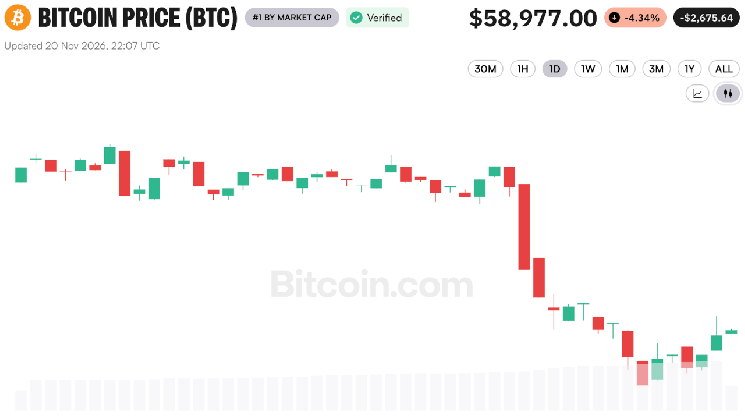
- •Bitcoin dropped to $57,799.29 on Friday, a 2026 low and its weakest price since September 2024, putting it on course for a potentially seventh straight weekly loss.
- •U.S. spot bitcoin ETFs recorded about $582 million in net outflows on Thursday, including $541 million from BlackRock's iShares Bitcoin Trust, while $1.9 billion in leveraged positions were liquidated within 24 hours.
- •Coinbase fell roughly 20% to $101.97, a nearly three-year low, and Robinhood, Bitmine Immersion Technologies, Circle, and Galaxy Digital also posted significant weekly declines.
- •The broader U.S. market logged its worst week in about 19 months amid doubts over AI valuations and infrastructure spending following Nvidia CEO Jensen Huang's resignation, and Anthropic's record $81 billion IPO failed to restore confidence as its shares slid more than 8% on Friday.
Shares of cryptocurrency companies plunged during a tumultuous week on Wall Street, with Strategy, Coinbase, and other prominent industry names posting double-digit declines as bitcoin sank to its lowest level since September 2024 and investors pulled back from artificial intelligence investments.
Strategy (MSTR), the world's largest corporate bitcoin holder, finished Friday at $77.80 per share, down roughly 30% from the previous week's closing price of $111.62. The company has been particularly exposed to bitcoin's slide, with the cryptocurrency now trading well below Strategy's average acquisition cost of approximately $75,446 per coin — meaning the aggregate value of its holdings sits beneath what it paid, on average, to build them. Because that treasury is concentrated in a single asset, the company's equity tends to move with amplified sensitivity to the coin's price, and Friday's close marked the stock's lowest level since February 2024.
Coinbase (COIN) ended Friday at $101.97, down roughly 20% for the week and at a roughly three-year low for the exchange's shares. Robinhood (HOOD), which has substantial exposure to cryptocurrency trading, shed about 20% over the last week to finish at $62.17, while ether treasury company Bitmine Immersion Technologies (BMNR) dropped approximately 26% to $12.98. The declines trace a common pattern: exchanges and brokerages earn revenue that rises and falls with trading activity, while treasury companies hold digital assets whose value moves with the tokens themselves.
Stablecoin issuer Circle (CRCL) and Galaxy Digital (GLXY) also recorded significant weekly declines, underscoring the breadth of the selling across companies involved in cryptocurrency trading, investing, and digital asset treasuries.
Bitcoin Falls Below $58,000 as November Rout Deepens
The equity losses accompanied another brutal week for bitcoin, which plunged to $57,799.29 on Friday, setting not only a 2026 low but also the lowest price registered since September 2024.
At a recent price near $59,000, bitcoin has lost approximately 15% over the past week and 31% over the last month, erasing its late-summer recovery and deepening a sell-off that has wiped out more than half of its value since the cryptocurrency peaked at a record $126,080 in October 2025.
The decline leaves bitcoin on course for a seventh consecutive weekly loss, potentially its longest weekly losing streak since 2022. November is also shaping up as one of the cryptocurrency's worst months since the 2022 crypto market collapse, with the latest losses returning bitcoin to levels that previously attracted buyers during the summer.
Institutional demand has weakened considerably. U.S. spot bitcoin exchange-traded funds — the primary U.S. vehicles for traditional investors seeking direct bitcoin exposure since their debut in January 2024 — recorded approximately $582 million in net outflows on Thursday, including $541 million withdrawn from BlackRock's iShares Bitcoin Trust. Whether such outflows persist in coming sessions will serve as a running gauge of institutional appetite. Friday's rout also triggered $1.9 billion in leveraged position liquidations over the last 24 hours as of this writing, according to data from Coinglass, predominantly affecting traders betting on rising prices. Liquidations occur when exchanges forcibly close leveraged trades whose collateral no longer covers losses, converting paper losses into forced sales that add sell-side pressure.
Prominent altcoins have seen price declines similar to bitcoin's over the last week, with some taking harder hits: Ether (ETH) is down 18% over the same span, while zcash (ZEC) has fallen nearly 24%.
AI Stocks Lead Wall Street's Collapse
Cryptocurrency companies were hardly alone in suffering substantial losses. The broader U.S. stock market logged its worst week in roughly 19 months as investors reassessed lofty artificial intelligence valuations, enormous capital commitments to AI infrastructure, and the leadership upheaval at Nvidia, whose founder and CEO Jensen Huang departed amid reported extramarital affairs with employees and a suspected Chinese spy.
Rival chipmakers AMD, Broadcom, and Micron also suffered steep losses as investors questioned whether the industry's massive spending on artificial intelligence infrastructure could continue producing sufficient returns.
Even Anthropic's historic initial public offering failed to restore confidence. The maker of the Claude chatbot completed the largest IPO on record on Thursday, raising approximately $81 billion. Its shares initially surged above $111 before closing their debut session at $97.17, roughly 17% above the $83 offering price.
Anthropic stock subsequently fell more than 8% on Friday, illustrating how quickly investor enthusiasm has deteriorated despite continued demand for artificial intelligence services.
The market decline has been exacerbated by uncertainty surrounding AI-related capital expenditures, tighter financing conditions, and Nvidia's leadership transition following Huang's resignation earlier this month.
For cryptocurrency investors, the simultaneous weakness in bitcoin and technology equities underscores the difficulty of escaping a broader retreat from speculative investments. With both sectors facing substantial selling pressure, the next major test will be whether bitcoin can defend its summer lows while Wall Street attempts to stabilize after one of its most punishing weeks in recent years.

