Crypto Market Holds Steady as Bitcoin and Ethereum Resist Semiconductor Selloff
Key Takeaways
- •Major cryptocurrencies traded within narrow ranges on July 30, 2026, with Bitcoin down just 0.67% to approximately $63,906, as the digital asset market decoupled from volatile semiconductor stocks.
- •Samsung Electronics reported a semiconductor profit increase exceeding 250-fold driven by AI memory chip demand, but shares gained only around 2% because investor expectations had already been elevated.
- •SK Hynix posted a 557% jump in operating profit, yet its shares declined 17%, highlighting that market expectations rather than results were driving equity reactions.
- •Weekly crypto performance revealed selective weakness across altcoins, with HYPE down 8% and XRP falling 6%, while BNB was the only major cryptocurrency holding a modest weekly gain.
- •Samsung and SK Hynix announced plans to invest a combined 800 trillion won, approximately $554 billion, in a new semiconductor manufacturing hub to support growing AI-driven demand.
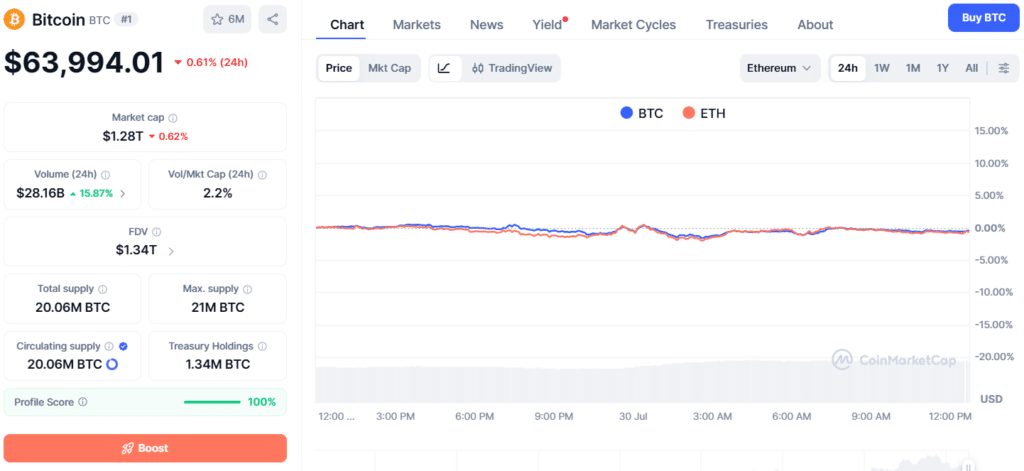
The cryptocurrency market remained largely steady on July 30, 2026, with most major digital assets posting only modest declines even as semiconductor stocks experienced another volatile trading session. Samsung Electronics reported a dramatic jump in chip profits driven by strong artificial intelligence demand, but equity investors remained cautious because market expectations had already risen sharply.
Cryptocurrencies avoided the sharp swings seen across technology shares and continued to trade within relatively narrow ranges. The latest price action indicates that crypto-specific factors and market liquidity are exerting a greater influence on digital assets than the turbulence affecting AI-related stocks. This marks a notable shift from earlier in July, when Bitcoin had moved in tandem with semiconductor shares as both served as vehicles for investor exposure to the AI growth narrative.
Major Cryptocurrency Prices
Bitcoin is trading around $63,906.06, down 0.67% over the past 24 hours. Ether is changing hands near $1,898.12, down 0.98%, while XRP is hovering around $1.07 with a 1.28% decline. Solana is trading close to $73.42 after easing 0.72%. BNB stands near $572.59 with a 0.35% gain, while TRON is priced around $0.3264 after rising 0.25%. Hyperliquid's HYPE is trading around $53.69, down 3.02%, and Dogecoin is changing hands near $0.06985, down 1.19%.
Bitcoin's market capitalization remains approximately $1.28 trillion, while its 24-hour trading volume stands at about $28.18 billion. Ether has recorded roughly $10 billion in trading volume, reflecting measured market activity rather than aggressive positioning. (CoinMarketCap, CoinMarketCap)
Samsung Earnings Underscore AI Demand Despite Investor Caution
Samsung Electronics reported that profit from its semiconductor business rose by more than 250-fold as demand for AI memory chips continued to strengthen. The magnitude of the increase partly reflects comparison against a depressed prior-year base, when the global memory chip industry was cycling through a severe downturn that had driven down prices and compressed margins across the sector. Despite that performance, Samsung's shares gained only around 2%, signaling that investors had already priced in exceptionally strong results. (Yahoo Finance, The Hindu)
SK Hynix also reported a 557% jump in operating profit, yet its shares fell 17% after the announcement. The broader message from the market was clear: results were not the problem—expectations were. Investors are increasingly looking beyond headline earnings and focusing on whether current AI spending can deliver sustainable long-term returns.
Samsung's semiconductor division generated operating income of 89.2 trillion won, or approximately $62 billion, surpassing analyst expectations. Quarterly revenue also reached a record 171.5 trillion won, equivalent to about $119 billion. The company said demand for memory products is expected to remain strong during the second half of the year as AI infrastructure expands and server memory demand continues to grow.
Samsung and SK Hynix together produce roughly two-thirds of the world's memory chips, giving their results outsized weight as a barometer of AI hardware demand. Both companies continue investing heavily to support AI-driven demand, even as investors remain cautious about the scale of future capital spending.
Weekly Performance Shows Selective Weakness
Although daily price movements have remained limited, the broader weekly trend has been weaker across several leading cryptocurrencies. HYPE has declined 8% over the past seven days, making it the weakest performer among major digital assets. XRP has fallen 6%, Solana has lost 5%, Dogecoin has declined 4%, and Bitcoin is down 3% over the same period. BNB remains the only major cryptocurrency holding onto a modest weekly gain.
The crypto market has therefore experienced selective weakness, particularly across altcoins. Reduced market depth tends to amplify price moves in smaller tokens, where relatively modest order flow can produce outsized percentage changes. Current trading suggests thinning liquidity is a more likely explanation than direct pressure from equity markets, although broader macro sentiment continues to remain an underlying factor for risk assets. (CoinDesk)
Crypto Detaches From Semiconductor Volatility
The crypto market has largely avoided the volatility affecting semiconductor shares. Bitcoin tracked chip stocks through much of July, rising and falling alongside the semiconductor trade. However, it remained resilient through the recent $797 billion decline in U.S. mega-cap technology companies and continued holding steady during South Korea's sharp equity market swings.
South Korea's Kospi index swung between a 6% gain and a 2% loss before settling after a stretch that left the benchmark more than 40% below its June peak. Even against that backdrop, Bitcoin continued trading within a relatively narrow range instead of following the dramatic moves in equities. (Digital Today, BloomingBit)
Broader Signals Influencing Investor Sentiment
Investors continue monitoring whether AI-related spending can justify current market valuations despite another round of strong earnings from memory chipmakers. Samsung has announced a chip supply agreement worth more than $200 billion with Broadcom through 2030, while SK Hynix has secured long-term agreements with around 10 customers.
Jeremy Tan, chief executive officer of Tiger Fund Management, said that forward pricing and long-term contractual commitments are becoming more important than quarterly earnings because they provide greater visibility into future valuations. At the same time, investors are weighing rising competition from Chinese memory manufacturers and the significant capital required to expand semiconductor production.
Samsung and SK Hynix have announced plans to invest a combined 800 trillion won, or about $554 billion, in a new semiconductor manufacturing hub as AI demand continues to grow.
Overnight earnings in the United States also reflected mixed sentiment. Microsoft gained nearly 9% in extended trading after reporting its fastest cloud growth in four years, while Meta declined around 8% following weaker revenue guidance. Nasdaq 100 futures later rose about 1% after the index entered a technical correction on Wednesday.
Derivatives Data Signals Cautious Positioning
Current derivatives data points to cautious positioning across digital assets. CoinGlass data shows total liquidations at approximately $276.25 million, down 36.18%. Open interest stands at $112.16 billion, down 0.6%, while the average Relative Strength Index is 43.41, indicating neutral momentum. The Altcoin Season Index remains at 62, also signaling neutral market conditions. (CoinGlass)
Outlook
Investors will continue assessing whether digital assets can remain insulated from volatility in global technology stocks as expectations around artificial intelligence spending evolve. Recent trading suggests cryptocurrencies are responding more to liquidity conditions and market positioning than to every move in semiconductor equities. The cryptocurrency market continues to demonstrate relative resilience even as volatility persists across semiconductor shares and technology stocks. Samsung's earnings reinforced the strength of AI-driven demand for memory chips, but they also highlighted that elevated investor expectations now matter as much as corporate performance. The coming sessions will indicate whether that resilience can continue as investors monitor both developments in global technology stocks and broader sentiment across digital asset markets.

