Crypto Sentiment Hits Top-Three Low Since FTX Collapse, Bitwise Report Shows
Key Takeaways
- •Bitwise's Cryptoasset Sentiment Index fell to -1.88 standard deviations on Nov. 20, one of the three lowest readings since the FTX collapse in November 2022.
- •Fed funds futures priced a 93% probability of a December rate hike, which Bitwise identifies as the primary driver of the selloff across crypto and equities.
- •The share of Bitcoin's supply held at a profit dropped from 59.1% to 43.2% over 14 days, leaving roughly $953 billion of invested capital underwater.
- •Seven-day realized losses totaled $5.3 billion, below the November 2025 and February episodes, while options open interest rose about 18.5% as investors bought downside protection.
- •Redemptions hit every major U.S. spot Bitcoin ETF in Bitwise's data, with BlackRock's IBIT accounting for about three-quarters of the outflows.
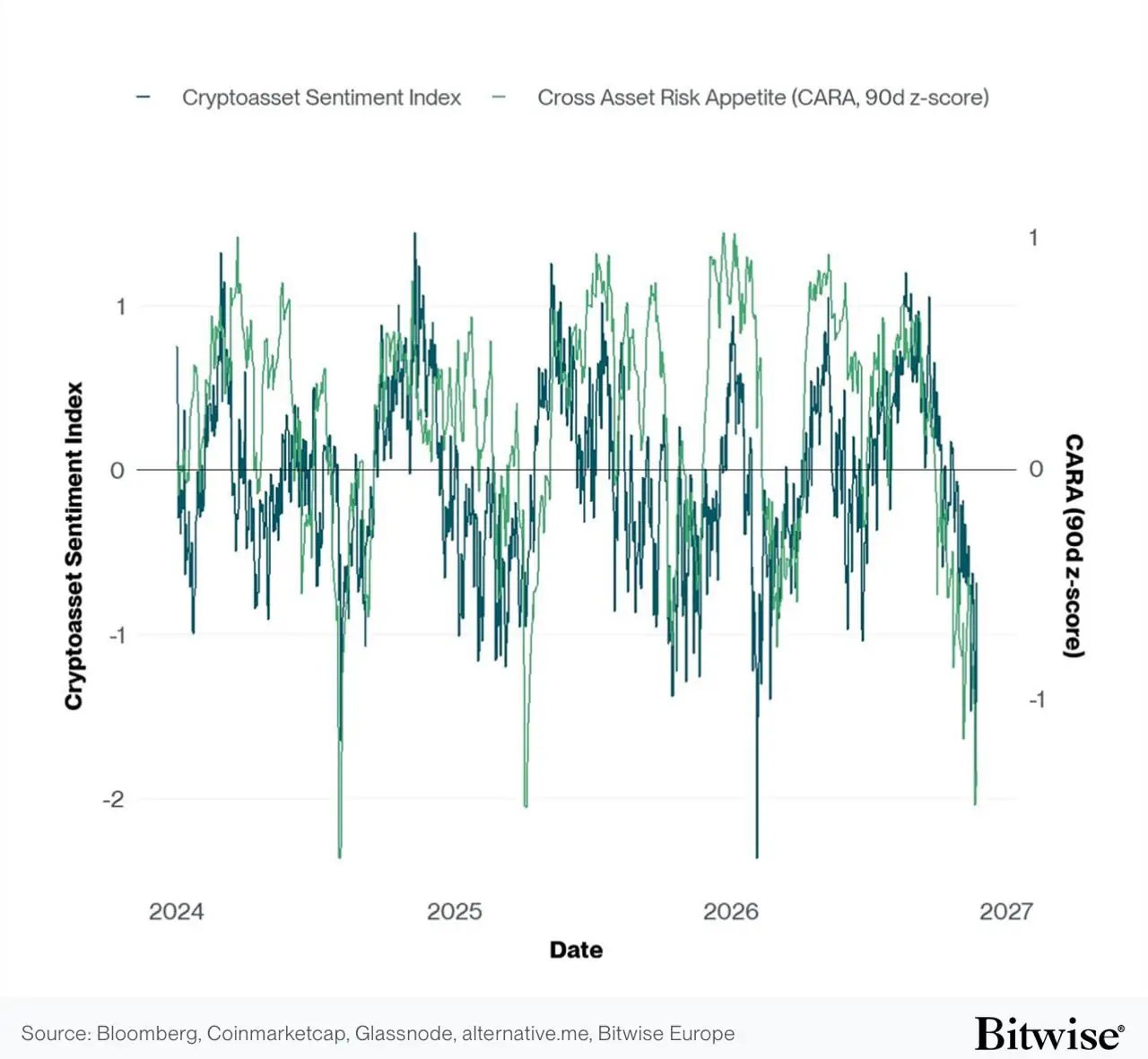
Crypto sentiment has crumbled to one of its three weakest readings since the collapse of the FTX exchange in November 2022, according to Bitwise's Crypto Market Compass for week 48, the firm's weekly research publication, published on Nov. 23. The report's sentiment and on-chain data run through Nov. 20, meaning they predate Bitcoin's weekend slide to $55,130.
Sentiment falls to a post-FTX extreme
Bitwise's Cryptoasset Sentiment Index, a composite of 15 indicators, touched -1.88 standard deviations on Nov. 20, placing the composite nearly two standard deviations — a statistical measure of how far a reading sits from its norm — below its typical level. By the firm's count, that is the weakest print since February's capitulation and one of the three lowest readings since FTX imploded in November 2022. Only four of the index's 15 indicators still sat above their short-term trends, and the separate Crypto Fear & Greed Index, a widely watched barometer of crypto market mood, remained pinned in its extreme-fear zone.
The deterioration was not universal. Two futures-based gauges actually improved — BTC long futures leverage dominance and the net positioning of CME commercial traders — which Bitwise interprets as a sign that leveraged longs had already been forced out. Commercial traders on the CME trimmed their net short from 11.11% of open interest to 7.28%. Pulling in the opposite direction, investors moved more coins onto exchanges, a pattern the firm links to possible selling, although the report provides no inflow volumes.
Equities fell just as hard
The decline reached well beyond digital assets. Bitcoin lost about 10% over the week covered by the report, roughly matching the Nasdaq Composite's drop. The S&P 500 fell 8.6%, Nvidia slid 22.9%, and TSMC dropped 20.1% — its worst week since 2006. Gold lost 8.9% and silver 16%, so the conventional hedges offered no shelter. Ether fared worse than Bitcoin, declining 14%.
Bitwise's Cross Asset Risk Appetite gauge, which tracks appetite for risk across traditional markets, slid from -0.51 to -1.11 after touching -1.14 midweek. The firm notes that matches the lows of the mid-2024 yen carry-trade unwind and the early-2025 tariff selloff. Bitwise also discounts the Binance hack as a driver, since it occurred several weeks earlier.
Equity options were calmer by comparison. The VIX, which measures expected 30-day volatility in the S&P 500, closed at 35.89 on Nov. 20. Bitwise notes that was the highest close of 2026, yet it stayed below the 38.57 close of August 2024 and the 52.33 close of April 2025. Stock traders paid up for protection, though not at the panic levels of those two episodes. Crypto investors, by contrast, turned about as fearful as at any point since 2022.
Rate-hike bets drove the selloff
The pressure originated in interest-rate expectations. According to Bitwise, Fed funds futures priced a 93% chance of a December rate hike and a 63% chance of two more hikes by January 2027. Minutes from the October FOMC meeting showed almost all officials expected further tightening, and Governor Christopher Waller floated a 50-basis-point move — half a percentage point — in December. Rate bets of this kind matter for crypto because higher expected rates lift the yield on safe cash, raising the bar for assets that generate no cash flow of their own.
Bitwise argues the Fed is now “approaching peak hawkishness.” The firm's gauge of the tone of Fed officials' public comments has returned to levels last seen in 2021, and the ten-year Treasury yield, at 4.95%, sat only 29 basis points above the two-year yield at 4.66%. In Bitwise's view, a large December hike would likely invert that curve, pushing short-term yields above long-term ones. Inversions have usually been followed by a pause and later cuts — though that is the firm's reading of past cycles, and the Fed itself has given no sign of a pause.
Holders are underwater, but most are not selling
On-chain data illustrate how much paper damage the drop inflicted. In the 14 days through Nov. 20, the share of Bitcoin's supply held at a profit fell from 59.1% to 43.2%, a level that had been lower on only 99 of the previous 5,970 days. Bitwise estimates that about $953 billion of invested capital was sitting at a loss, a magnitude it compares with the FTX collapse. Both measures value each coin at the price it last moved on-chain, so they count coins, not investors.
Realized losses capture how much of that damage holders actually locked in. Coins that moved at a loss on Nov. 20 accounted for $1.36 billion in losses, a daily total exceeded on only 18 earlier days, while realized profit fell to about 15 cents for every dollar of realized loss. Over seven days, losses totaled $5.3 billion — below the roughly $5.7 billion of the November 2025 capitulation and far below February's $9.1 billion, which Bitwise ranks as the most severe of these episodes. Because a coin can move between wallets without being sold, these figures estimate selling rather than record actual trades.
The upshot: fear and paper losses are close to post-FTX extremes, but loss-taking spiked for only one day and stayed below the last two capitulations. Bitwise does not say whether holders are refusing to sell or whether the flush is unfinished, and the on-chain data alone cannot settle the question.
Traders hedged instead of dumping
Derivatives reveal the same restraint. Leverage drained out of perpetual futures: open interest fell about 4.5% to roughly 439,000 BTC, annualized funding — the recurring payments between long and short perpetual holders that keep contract prices tethered to spot — dropped to about 1.7% from 6.6% a week earlier, and the three-month basis, the annualized premium of futures over spot, narrowed to about 4.5% from 5.2%. Combined liquidations came to about $4.9 billion.
Options moved the other way. Open interest jumped about 18.5% to roughly 548,100 BTC, and the put-to-call ratio on crypto-native exchanges rose to 0.83, near the 99.9th percentile of its three-year range. Twenty-five-delta skew — which shows how much more traders pay for puts than for comparable calls — sat at or above the 99th percentile for every maturity from one week to six months. In short, investors bought downside protection rather than selling their coins.
How close Bitcoin came to holders' average cost
The weekend low was Bitcoin's weakest price since September 2024 and set a new cycle low below the late-June trough near $58,000. A relief bounce then lifted it to about $61,000. The cost-basis levels Bitwise tracks show how close that range runs to what holders paid on average.
Saturday's low came close to the realized price, the broadest measure of what Bitcoin holders paid on average. Bitwise treats a drop to the long-term holders' cost basis as outside its base case, though it names that level as the next reference if the realized price gives way.
What would mark a turn
Monday offered an early read. The Nasdaq rose 6.5% while Bitcoin gave back its intraday rally. Bitcoin fell with stocks but did not recover with them, which leaves crypto's own demand as the open question.
Fund flows show where that demand stood during the week. Redemptions hit every major U.S. spot Bitcoin ETF in Bitwise's data, with BlackRock's IBIT accounting for about three-quarters of the total, and U.S. spot Ether funds lost assets as well.
Bitwise notes that sentiment readings this low have historically been followed by strongly positive 12-month returns, though it publishes no hit rate or sample size. Three things will test that thesis sooner: whether ETF redemptions slow, whether realized losses jump again if Bitcoin trades back toward its realized price, and what the Fed does in December. If prices bounce while fund flows stay negative, the bounce would rest on less support than the sentiment index alone implies.
Disclaimer: This article is for informational purposes only and does not constitute financial, investment or trading advice. Figures and historical comparisons are drawn from Bitwise's research and public market data, and may be revised. Past patterns in sentiment or on-chain data do not guarantee future results. Cryptocurrencies are highly volatile; do your own research and consider consulting a licensed financial adviser before making any investment decision.

