Crypto Advocacy Groups Urge Senate to Schedule CLARITY Act Floor Vote Before August Recess
Key Takeaways
- •The CLARITY Act has passed both the Senate Banking Committee and the Senate Agriculture Committee but has not yet received a full floor vote in the Senate.
- •Three major crypto advocacy groups jointly petitioned Senate Majority Leader John Thune and Minority Leader Chuck Schumer to prioritize scheduling a vote before the August recess.
- •Ethics provisions that would prohibit public officials from issuing or sponsoring cryptocurrencies have become a primary source of Democratic opposition to the bill.
- •Passage requires 60 votes in the Senate, where Republicans hold a 52-47 majority, making bipartisan support essential.
- •Kalshi event contracts indicated approximately a 40.3% probability that the Senate would vote on the legislation before the August recess.
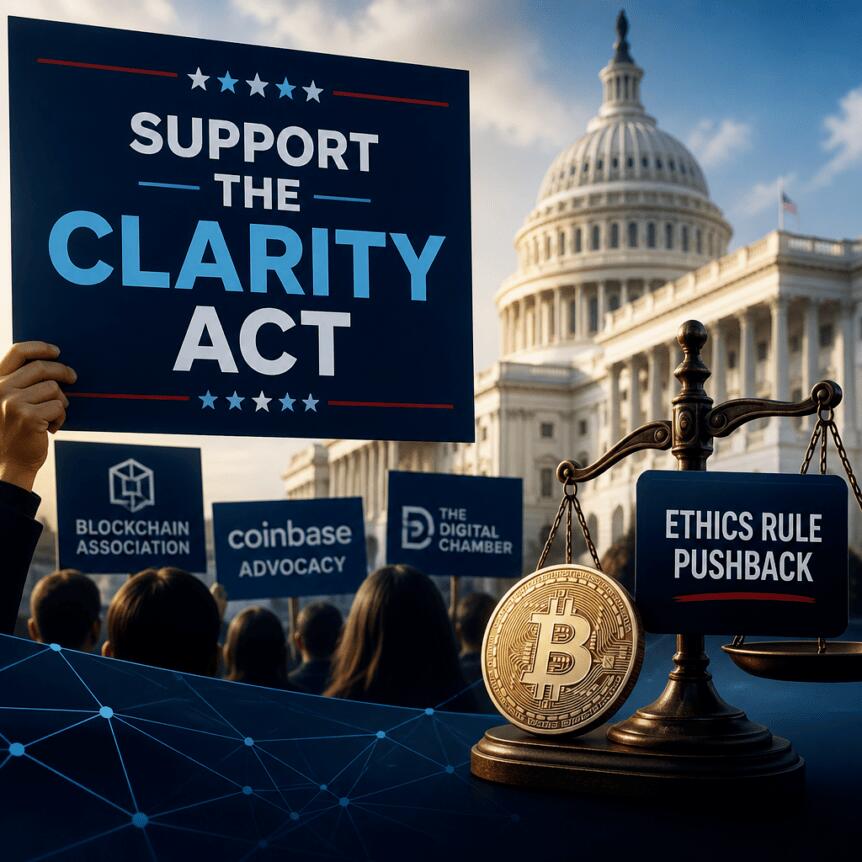
Three major cryptocurrency advocacy organizations have called on U.S. Senate leadership to bring the Digital Asset Market Clarity (CLARITY) Act to the Senate floor for a full vote before the chamber departs for its August state work periods. In a joint letter delivered Friday to Majority Leader John Thune and Minority Leader Chuck Schumer, the groups emphasized that bipartisan negotiations remain active and urged lawmakers to sustain momentum toward a vote.
The push comes after the CLARITY Act cleared both the Senate Banking Committee and the Senate Agriculture Committee—a dual-track pathway that reflects the bill's core aim of drawing a clearer jurisdictional line between the Securities and Exchange Commission and the Commodity Futures Trading Commission over digital asset markets. However, unresolved policy disputes and the Senate's vote arithmetic have created considerable uncertainty around timing. Republicans hold a 52–47 majority over Democrats, but passage requires 60 votes, making cross-party support indispensable.
Advocates Press for Floor Consideration
The Crypto Council for Innovation, the Digital Chamber, and the Blockchain Association used their letter to ask senators to prioritize scheduling CLARITY for floor consideration. The organizations acknowledged that "constructive bipartisan negotiations remain underway" and encouraged lawmakers on both sides of the aisle to continue engaging in good-faith discussions.
Committee approval alone does not guarantee a floor vote. While the legislation has advanced through the banking and agriculture panels, the advocacy groups' letter indicates that political leaders are still evaluating whether the final bill language will adequately address key concerns. Timing is critical: if the Senate does not vote before the August recess, the debate could extend into the period leading up to the 2026 U.S. midterm elections, potentially shifting the political incentives for lawmakers in both parties.
Ethics Provisions Emerge as Central Sticking Point
CLARITY is widely regarded as one of the most significant pieces of U.S. crypto legislation, largely because it seeks to establish clearer regulatory rules for digital asset markets by defining which assets fall under SEC oversight as securities and which fall under CFTC oversight as commodities. The most recent Republican effort incorporated ethics provisions intended to prohibit public officials from issuing or sponsoring cryptocurrencies, according to reporting that cited the bill text released earlier in the week.
Those ethics measures have become a flashpoint for Democratic opposition. Politico reported that Senator Ruben Gallego criticized the GOP's counterproposal as falling far short of what Democrats said they had been promised during negotiations. Gallego told Politico that, despite extensive collaboration with Republican colleagues, the new offer did not constitute a serious effort to address the concerns raised during earlier rounds of bargaining.
"After all the work that we've done with our Republican colleagues, that they would take the months and months of work and somehow interpret that and turn around and think what they offered was even remotely close," Gallego said, according to Politico.
The criticism highlights a core tension in the legislative process: even as the bill's broader market-structure objectives gain traction, lawmakers may be unwilling to advance the legislation without firmer consensus on ethics and enforcement-related safeguards.
Industry Leaders Emphasize Compliance and Innovation Stakes
Beyond the ethics debate, industry executives are underscoring what they view as CLARITY's practical significance for U.S. digital asset regulation—particularly for non-custodial models.
Coinbase CEO Brian Armstrong argued that the United States still lacks a comprehensive federal framework for digital assets, and that this regulatory gap has allowed harmful practices to reach consumers while pushing business activity outside U.S. oversight. In a Wednesday post on X, Armstrong said the bill would deliver consumer protections, equip law enforcement with necessary tools, and position the country to lead in the industry.
Orest Gavryliak, chief legal officer of the DeFi platform 1inch, discussed the legislation on Cointelegraph's Chain Reaction podcast on Friday. He said CLARITY would help establish a legal framework for non-custodial protocols, contrasting that approach with what he described as regulators attempting to force decentralized systems into custodial regulatory structures. Gavryliak argued that rules designed for custodial models do not translate cleanly to non-custodial protocols, which he said makes the bill's passage "very important."
Market Signals and Procedural Outlook
Even with committee approvals secured, reaching the 60-vote threshold remains the principal legislative hurdle. That requirement incentivizes lawmakers to negotiate aggressively on unresolved provisions rather than rely on a narrow coalition. As a result, procedural timing—whether Senate leadership can build sufficient alignment to schedule a floor vote—may prove as consequential as the substantive content of the bill itself.
As of Friday, Kalshi event contracts reflected approximately a 40.3% probability that the Senate would vote on the CLARITY Act before the August recess, indicating a market consensus that passage may not be imminent even as the bill continues to advance.
For investors, traders, and developers, the central question is not only whether CLARITY clears its procedural obstacles, but also what modifications—if any—emerge as senators work to reconcile disagreements over ethics language. If those provisions remain the primary point of contention, negotiations could broaden rather than converge. Conversely, if Senate leadership succeeds in unifying enough support for floor consideration, CLARITY could become a foundational reference point for U.S. cryptocurrency compliance planning well before lawmakers pivot to the broader midterm election cycle.

