Coinbase, Strategy, and Robinhood Q2 2026 Earnings: Divergent Outcomes Amid Bitcoin's 11% Decline
Key Takeaways
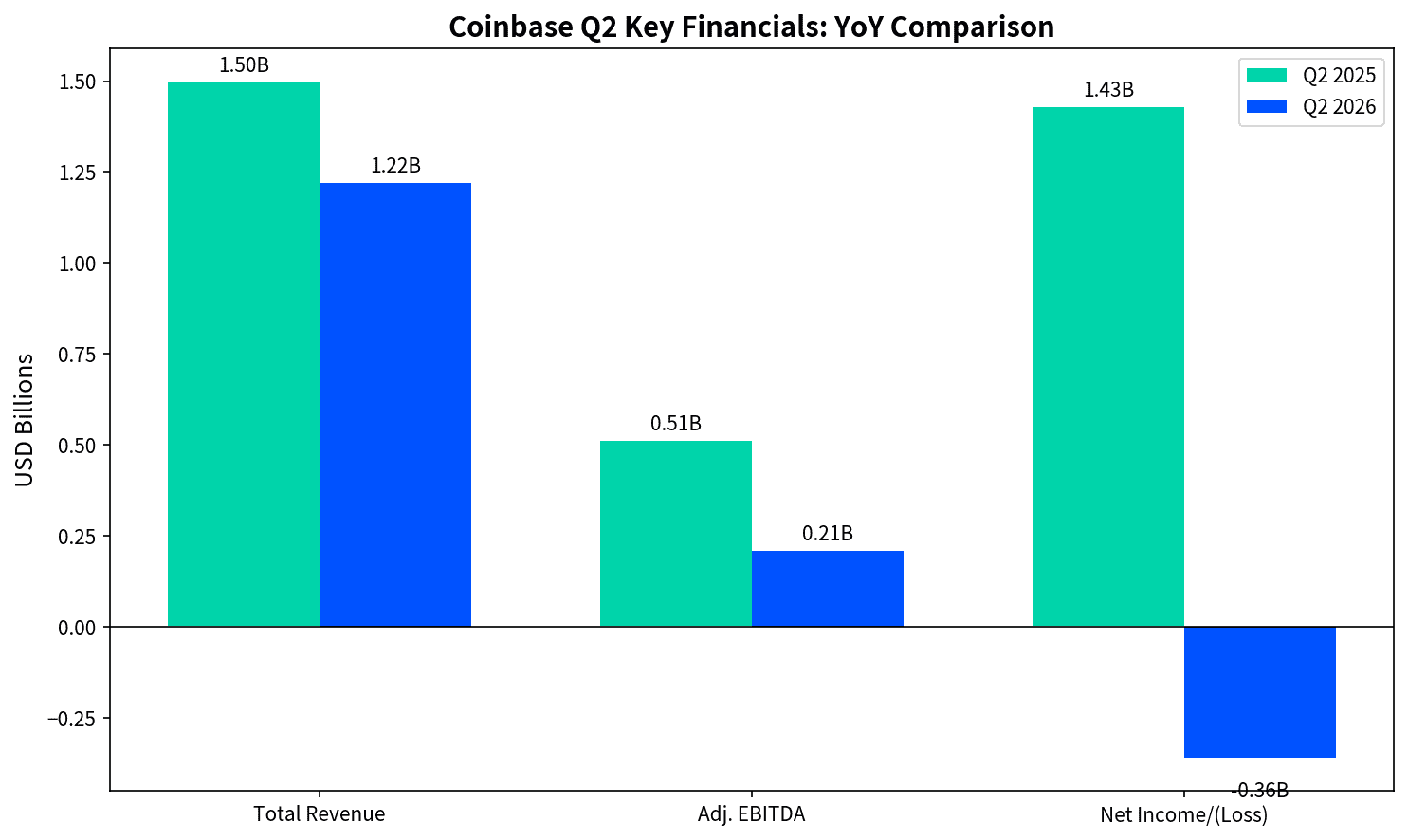
- •Coinbase reported Q2 2026 total revenue of $1.22 billion, falling $70 million short of analyst estimates, and recorded a GAAP net loss of $359.5 million, marking its third consecutive quarter of losses.
- •Strategy's $8.22 billion net loss resulted from fair-value accounting rules that require bitcoin holdings to be marked to market each quarter, a non-cash adjustment rather than an operational cash outflow.
- •Robinhood posted record total net revenue of $1.31 billion in Q2 2026, a 32% year-over-year increase, as options revenue rose 29% and equities revenue surged 95% to compensate for a 38% decline in crypto transaction revenue.
- •An approximately 11% decline in bitcoin's price over the quarter reduced spot trading volumes and negatively affected companies whose financial results remain structurally linked to the cryptocurrency.
- •Strategy expanded its bitcoin holdings by roughly 11% quarter over quarter to 843,775 bitcoins while raising $8.4 billion in capital during the same period.
Three of the cryptocurrency sector's most prominent publicly traded companies—Coinbase, Strategy, and Robinhood—released their second-quarter 2026 earnings within a span of hours between Wednesday and Thursday. The three represent distinct archetypes of public-market crypto exposure: a pure-play exchange, a leveraged bitcoin treasury, and a diversified retail brokerage with a growing crypto arm. Two of them conveyed the same sobering message: when bitcoin declines, companies tied to it suffer, regardless of whatever strategic milestones they may have achieved.
Coinbase fell short of revenue expectations. Strategy recorded a loss exceeding $8 billion. Both attributed their results to the same factor—a roughly 11% decline in bitcoin's price over the quarter, which also pulled spot trading volumes lower. Robinhood, by contrast, posted record revenue despite the same crypto headwinds. That divergence defines this earnings season more than any individual metric.
Coinbase: Diversification Efforts Tested by Market Downturn
Coinbase reported total revenue of $1.22 billion for the second quarter of 2026, falling $70 million short of Wall Street's $1.29 billion projection and representing a 19% year-over-year decline from $1.5 billion in the same period last year. The company recorded a GAAP net loss of $359.5 million, or $1.36 per diluted share, well beyond what Street analysts had anticipated. This marks Coinbase's third consecutive quarter of losses.
The results were not solely attributable to trading revenue weakness. Subscription and services revenue—which includes USDC interest income, staking rewards, and Coinbase One membership—came in at $555 million, below analyst estimates of $599 million and down from $584 million in the first quarter. This segment is intended to serve as a buffer against precisely this type of market downturn, making the sequential decline a setback for the narrative that Coinbase has meaningfully decoupled its business from bitcoin's price fluctuations.
There were notable operational achievements. Crypto trading volume market share rose to 10.3% from 9.1% in the prior quarter, marking a third consecutive record. Prediction markets revenue surged 106% quarter over quarter, surpassing $100 million in annualized revenue—a category that has gained traction across retail trading platforms as event-contract products move further into the mainstream. However, total crypto market capitalization fell 11% quarter over quarter and spot trading volumes declined 25%, headwinds that outweighed the company's operational gains. Coinbase shares dropped approximately 5 to 6% in after-hours trading following the earnings release.
Strategy: $8.22 Billion Loss Driven by Fair-Value Accounting
Strategy, led by Michael Saylor, reported an $8.22 billion net loss for the second quarter of 2026, as declining bitcoin prices reduced the value of its holdings. The diluted loss came in at $24.45 per share, compared to analysts' estimate of a $2.19 per share loss. Strategy operates the largest publicly disclosed corporate bitcoin treasury in the world, and its earnings have become a barometer for how institutional-grade balance-sheet exposure to the asset translates into reported results.
Importantly, this figure does not represent cash leaving the business. The loss is a mechanical result of a fair-value accounting rule effective for calendar-year public companies from January 2025, which requires bitcoin holdings to be marked to market through the income statement at each quarter-end. Prior to this rule, bitcoin holdings could only be written down, never written up, meaning companies like Strategy now experience large swings in reported earnings that closely track bitcoin's price in both directions.
Operationally, Strategy expanded its bitcoin holdings by approximately 11% quarter over quarter, bringing total holdings to 843,775 bitcoins. According to its earnings call, the company raised $8.4 billion in capital during the quarter, including $5.5 billion in digital credit—exceeding any quarter in the prior year—while reducing convertible debt by 18% to $6.7 billion.
Software revenue, the segment of the business that most closely resembles a conventional enterprise, reached $122.4 million, up 6.9% from $114.5 million a year earlier, though still slightly below consensus. Strategy's stock moved minimally on the news, suggesting the market has largely accepted that the company's quarterly earnings will function like a leveraged bitcoin derivative going forward.
Robinhood: Record Revenue Driven by Diversified Revenue Streams
Robinhood posted record total net revenue of $1.31 billion in Q2 2026, up 32% year over year, with diluted earnings per share of $0.62. The results exceeded consensus estimates of approximately $1.25 to $1.28 billion in revenue and about $0.41 in EPS. This occurred despite a difficult quarter for its crypto business: crypto transaction revenue fell 38% to $100 million from $160 million a year earlier, marking the only major transaction category to decline.
Other segments compensated for the crypto shortfall. Prediction markets revenue overtook crypto trading for the first time, reaching $156 million versus $100 million. Options revenue rose 29% to $342 million, and equities revenue jumped 95% to $129 million. Robinhood Gold subscriptions, net deposits, and total platform assets all reached record levels. The results effectively demonstrate the diversification strategy that Coinbase has been pursuing—except Robinhood's figures substantiated the thesis this quarter.
Key Takeaway
Taken together, the three earnings reports paint a clear picture. Companies whose financial results remain structurally linked to bitcoin's price—whether through balance sheet exposure or dependence on spot trading fees—endured a difficult quarter because bitcoin itself had one. Companies that developed genuinely independent revenue engines navigated the downturn with relative resilience. The results underscore a question that will carry into future reporting periods: whether the diversification models now being built across the sector can hold up if crypto market weakness persists, or whether the resilience displayed this quarter is itself partly a product of favorable conditions in non-crypto asset classes.

