2026 Week 30 Crypto Market Watch: Market Cap Slips as ETH Rotation Challenges Bitcoin Dominance
Key Takeaways
- •Total crypto market capitalization finished slightly lower for the week, despite a wide trading range between about $2.17 trillion and $2.25 trillion.
- •Bitcoin dominance fell modestly over the week, ending at 59.13% after briefly reaching around 59.60%.
- •ETH/BTC strengthened from 0.02904 to 0.02963, indicating Ethereum outperformed Bitcoin on a relative basis.
- •Spot ether ETFs drew about $103.9 million in net inflows, compared with about $33.8 million for spot bitcoin ETFs.
- •The upcoming week featured major catalysts, including the Federal Reserve decision, Coinbase earnings, and U.S. GDP and PCE data.
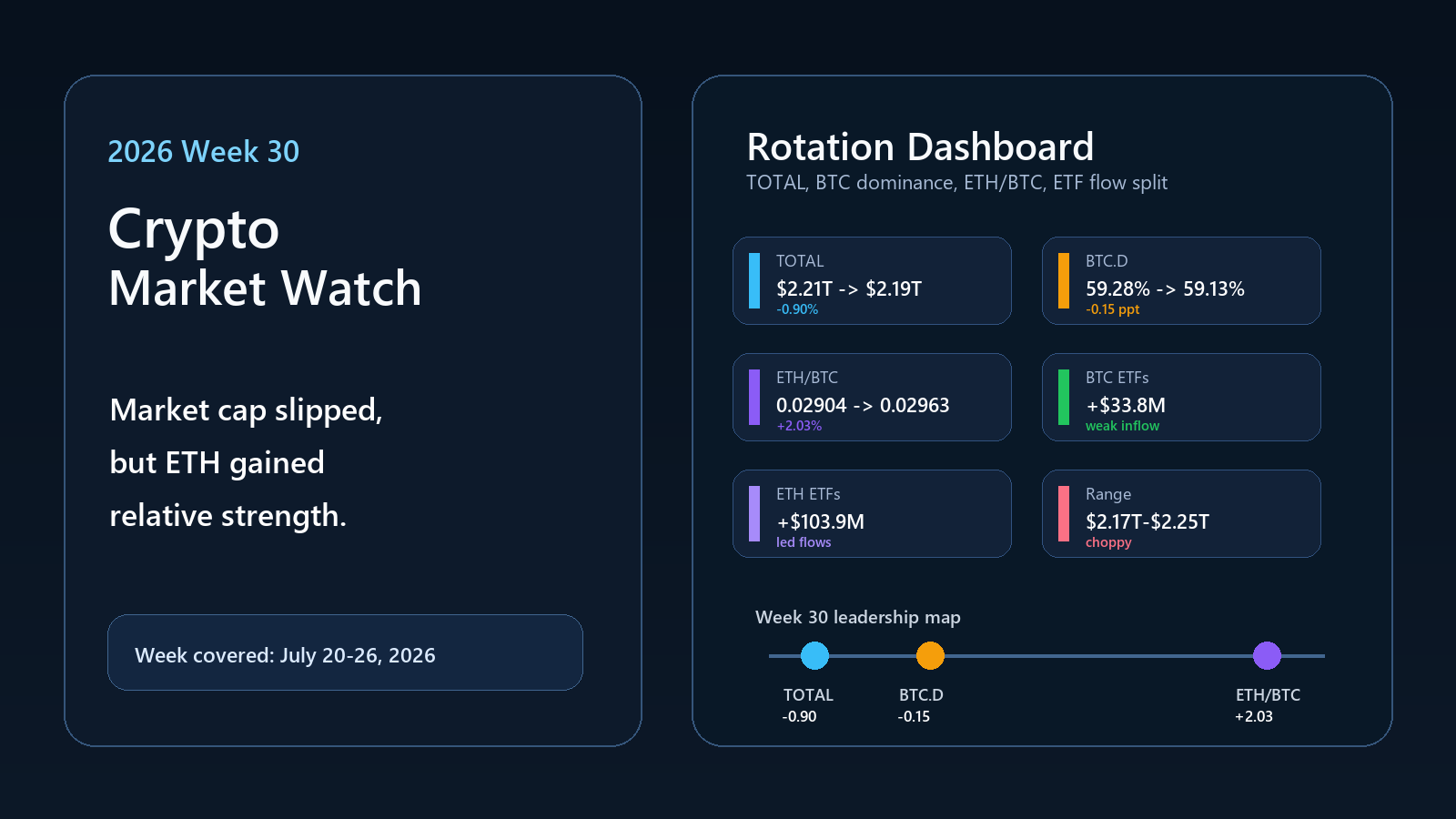
Crypto Market Setup for Week 30
Week 30 did not deliver the kind of broad expansion that makes crypto feel easy. TradingView TOTAL moved from about $2.21T on July 20 at 23:59 to about $2.19T on July 26 at 23:59. The weekly high was roughly $2.25T, while the low was about $2.17T. That is a market that moved around, defended its lower band, and still ended slightly lower.
The more interesting part was leadership. BTC dominance started the week at 59.28%, reached a visible high near 59.60%, and ended at the weekly low of 59.13%. ETH/BTC moved in the opposite direction, rising from 0.02904 to 0.02963 after touching a weekly low near 0.02871. That combination matters because it says the market was not just hiding in Bitcoin. Ethereum improved on a relative basis even though the total market cap did not expand.
This is why the Week 30 crypto story should not be read as a repeat of the Bitcoin story. Bitcoin held a range, but the broader market question was different: did capital broaden out, or did it simply rotate from one large-cap pocket to another? The answer was closer to selective rotation. ETH improved, BTC dominance softened, but the whole market did not add enough value to call it a broad liquidity wave.
The timing also shaped the tape. The week ended ahead of a heavy macro calendar, with the Federal Reserve decision, Coinbase earnings, and U.S. GDP and PCE data all sitting in the following week. That made traders more willing to reward relative-strength stories but less willing to chase the entire market higher.
Total market cap fell, but the rotation was not bearish everywhere
A small decline in TOTAL can hide meaningful rotation underneath. If total market cap falls while BTC dominance rises, the usual read is defensive: capital is clustering in Bitcoin. Week 30 did not fit that pattern. TOTAL fell, but BTC dominance also declined. That makes the week more nuanced. Capital did not leave crypto evenly. It moved unevenly across the largest assets.
That nuance is important for traders. A market can be weak at the index level while still producing tradable relative-strength pockets. In Week 30, ETH/BTC was the cleanest example. The ratio's move from 0.02904 to 0.02963 was not dramatic, but it was directionally meaningful because it came while total market cap slipped.
Week 30 Crypto Dashboard
| Signal | Week 30 Reading | Market Meaning |
|---|---|---|
| TOTAL crypto market cap | $2.21T to $2.19T | Slight market-cap contraction |
| TOTAL weekly range | $2.17T-$2.25T | Wide but unresolved band |
| BTC dominance | 59.28% to 59.13% | Bitcoin’s share softened slightly |
| BTC.D weekly high | 59.60% | Defensive bid appeared early |
| ETH/BTC | 0.02904 to 0.02963 | ETH gained relative strength |
| ETH/BTC weekly low | 0.02871 | Dip was bought |
| Spot bitcoin ETF weekly flow | About +$33.8M | Positive, but weak |
| Spot ether ETF weekly flow | About +$103.9M | ETH led ETF demand |
The dashboard shows why Week 30 needs a balanced reading. Total market cap finished lower, so the week was not a broad upside confirmation. But BTC dominance also slipped and ETH/BTC improved, so it was not a simple flight to Bitcoin either.
That is the kind of tape where a market-wide article needs to avoid one-word labels. “Bullish” misses the weak market-cap close. “Bearish” misses the ETH rotation. “Choppy” is closer, but still incomplete. The better description is selective rotation inside a still-cautious market.
ETF Flows Favored ETH Over Bitcoin
ETF flows made the rotation easier to see. The Block, using SoSoValue data, reported that U.S. spot bitcoin ETFs recorded about $33.8M of net inflows for the week ending July 24. That kept bitcoin ETFs positive for a third straight week, but the quality was weak. The funds drew roughly $499.1M over the first three sessions, then lost about $225.2M on Thursday and $240.1M on Friday.
Ether ETFs looked stronger. The same report said spot ether ETFs drew about $103.9M during the week, more than three times the bitcoin funds' total and enough for a third consecutive positive week. The Block also noted that ether ETF inflows during the past three weeks nearly matched bitcoin ETF inflows despite ether funds having much smaller net assets.
The ETF split changed the market read
That split matters because it gives the ETH/BTC move a fundamental flow story. ETH did not merely outperform on chart structure. It also had stronger ETF demand at the institutional wrapper level. In a week when total crypto market cap slipped, that makes ETH's relative strength more credible than a purely speculative bounce.
Still, it should not be overstated. ETH ETF inflows were stronger than BTC ETF inflows, but the whole market did not surge. ETF demand helped identify the strongest large-cap lane. It did not prove that capital was flooding into every part of crypto.
BTC Dominance Softened, But Altseason Stayed Out of Reach
The fall in BTC dominance from 59.28% to 59.13% is small, but the weekly close at the low matters. It says Bitcoin did not gain share into the weekend. For a market that had been heavily Bitcoin-led, that is enough to put rotation back on the watchlist.
The problem is scale. A 0.15 percentage point decline in dominance is not a regime change. It is a clue. ETH/BTC confirmed the clue by moving higher, but TOTAL did not confirm it with market-wide expansion. The result is a market that can support ETH relative strength without confirming a full altcoin season.
ETH/BTC was the cleaner signal
ETH/BTC rising from 0.02904 to 0.02963 was more informative than the small move in dominance alone. The ratio also finished at its weekly high, after dipping to 0.02871 earlier in the week. That sequence says ETH weakness was bought and ETH strength lasted into the close.
For Week 31, this ratio deserves priority. If ETH/BTC keeps rising while BTC dominance falls again, the rotation thesis strengthens. If ETH/BTC stalls and BTC dominance reclaims the 59.60% area, Week 30 will look more like a temporary relative-strength bounce than the start of a broader shift.
Macro and Earnings Kept the Market From Chasing
The following week was full of catalysts. The Federal Reserve's July 28-29 meeting sat directly ahead, while Coinbase said it would report Q2 results after the July 30 close. U.S. GDP and PCE data were also due July 30, giving traders fresh macro evidence after the Fed decision.
That calendar helps explain why market cap did not expand even though ETH showed relative strength. Crypto traders had reasons to rotate, but also reasons to avoid overcommitting. A softer Fed tone could help duration-sensitive risk assets. A hotter inflation or stronger-rate message could pressure them again. Coinbase earnings could confirm activity in crypto trading, stablecoins, derivatives, and retail participation, or it could show a more cautious environment.
The market therefore entered Week 31 with a split setup. The bullish side had ETH ETF inflows and a stronger ETH/BTC ratio. The cautious side had lower TOTAL, weak bitcoin ETF quality, and a macro calendar dense enough to change positioning quickly.
Trending Projects Beyond BTC and ETH
A market-wide crypto watch also needs to look past the two largest assets. CoinDesk’s July 24 market update said the CoinDesk 20 index was lower on the day, with Dogecoin and Ethereum among the weaker components while XRP and Solana also slipped. HYPE was the exception in that update, rising on the day even though it was still down over the prior week. That is exactly the kind of mixed breadth that matched the Week 30 dashboard: ETH had the cleaner relative signal, but the broader altcoin tape was not uniformly strong.
A July 27 CoinGecko-backed market table published by The Motley Fool showed the same kind of uneven large-cap behavior around the post-week snapshot. BNB and Tron were positive over the prior seven days, while Solana, XRP, Dogecoin, Cardano, and Chainlink were negative. Those readings are not a replacement for the July 20-26 TradingView weekly window, but they help explain why the Week 30 article should not call the move a broad altcoin breakout.
| Trending Project | Week 30 / Post-Week Signal | Why It Mattered |
|---|---|---|
| XRP | Slipped in CoinDesk's July 24 market update | Large-cap participation was not universal |
| Solana | Also slipped in the same CoinDesk update | High-beta L1 appetite stayed selective |
| Dogecoin | Among the weaker CoinDesk 20 names on July 24 | Meme-sector risk did not confirm broad euphoria |
| HYPE | Rose on July 24 but remained down over seven days | Perp-DEX attention persisted, but momentum was uneven |
| BNB | Positive in the July 27 CoinGecko-backed table | Exchange-token demand was not uniformly weak |
| Tron | Positive in the same post-week snapshot | Payment/stablecoin-network narratives still had support |
| Chainlink | Negative in the post-week snapshot | Infrastructure names did not all follow ETH higher |
The takeaway is not that any single token controlled Week 30. The point is breadth discipline. If ETH leads while XRP, SOL, DOGE, and LINK are mixed, traders should treat the move as selective rotation rather than a market-wide chase. For Week 31, a healthier crypto tape would show ETH/BTC staying firm while more of these large-cap and narrative-heavy projects stop lagging.
Scenario Map for Week 31
| Scenario | What Would Confirm It | What Would Weaken It |
|---|---|---|
| ETH-led rotation extends | ETH/BTC holds above 0.02963, BTC dominance falls below 59.13%, and ether ETF inflows stay positive. | ETH/BTC loses the Week 30 close while BTC dominance reclaims 59.60%. |
| Choppy market-cap range | TOTAL stays between $2.17T and $2.25T while flows remain mixed. | A decisive break above or below that range with ETF confirmation. |
| Defensive Bitcoin rotation | BTC dominance rises back through 59.60% as TOTAL weakens. | ETH/BTC keeps rising and TOTAL holds the weekly low. |
| Broad altcoin confirmation | XRP, SOL, DOGE, LINK, and other large-cap names begin confirming ETH strength. | ETH leads alone while most high-beta names keep lagging. |
This map keeps the Week 31 question practical. The market does not need every token to rally for rotation to continue. But if TOTAL cannot stabilize, ETH leadership will remain a relative trade rather than a broad market signal.
What to Watch Next Week
The first checkpoint is ETH/BTC. It was the cleanest Week 30 rotation signal. A continued move higher would tell traders that ETH’s ETF advantage is becoming visible in relative price action.
The second checkpoint is TOTAL. The market needs to hold the $2.17T area or reclaim the $2.25T high to turn rotation into a healthier market-cap signal. Without that, leadership may stay narrow.
The third checkpoint is breadth beyond ETH. XRP, Solana, Dogecoin, HYPE, BNB, Tron, and Chainlink do not need to move together, but a healthier market should show more than one leadership pocket. If ETH keeps outperforming while the rest of the watchlist stays mixed, the rotation remains narrow.
The fourth checkpoint is the catalyst calendar. The Fed decision, Coinbase earnings, GDP, and PCE can all affect liquidity expectations. For crypto, the best version of Week 31 would be a stable macro backdrop, positive ETH and BTC ETF flows, improving large-cap breadth, and BTC dominance drifting lower without TOTAL breaking down.
Trade Crypto With Leverage - Without Giving Up Custody
Decentralized perpetual exchanges have moved well past niche status. According to CoinGecko's 2025 Annual Crypto Report, DEX perpetual trading volume surged 346% last year - reaching $6.7 trillion - while centralized exchange open interest fell 20.8% over the same period. Traders are committing serious capital to on-chain derivatives, and the reasons are straightforward: counterparty risk is real, custodial failures happen, and censorship resistance matters.
edgeX is a decentralized perpetual futures exchange built for traders who want market access without sacrificing control. Here's what sets it apart:
- No KYC, no barriers. Connect a wallet and start trading. No identity verification, no account approvals. Onboarding is fast regardless of where you’re based.
- True self-custody. edgeX combines off-chain order matching with verifiable on-chain settlement secured by Ethereum. Forced-withdrawal mechanisms keep your funds recoverable directly from the blockchain, even if the operator goes dark.
- Deep liquidity, tight spreads. edgeX maintains $10 million of market depth within a one-basis-point spread, with sub-0.1-basis-point slippage on trades exceeding $100,000. When crypto moves fast, that precision matters.
- Up to 100x leverage. Scale positions to match your conviction, whether you're hedging exposure or trading momentum.
- 140% trading fee rewards. Active traders can earn back more than they pay in fees, reducing the net cost of high-frequency strategies over time.
- Institutional-grade infrastructure. edgeX processes up to 200,000 orders per second with matching latency below 10 milliseconds, delivering performance on par with major centralized exchanges without the custody trade-offs.
Start trading crypto perpetual futures on edgeX and put your market view to work.
Frequently Asked Questions
What week does this Crypto Market Watch cover?
This Crypto Market Watch covers 2026 Week 30, from July 20 to July 26, 2026. Publication-time catalysts such as the Fed decision and Coinbase earnings are treated as forward-looking context for Week 31.
Was the crypto market bullish or bearish in Week 30?
It was mixed. Total crypto market cap slipped from about $2.21T to $2.19T, but BTC dominance fell slightly and ETH/BTC improved. That points to selective rotation rather than a clean bullish breakout or a simple defensive market.
Why did ETH matter more than usual?
ETH mattered because ETH/BTC rose from 0.02904 to 0.02963 while spot ether ETFs drew about $103.9M, more than three times the bitcoin ETF total reported for the same week.
Did Bitcoin dominance confirm an altcoin season?
No. BTC dominance fell from 59.28% to 59.13%, but that is too small to confirm a full altcoin season. It was a rotation clue, not a regime shift.
Which non-BTC and non-ETH projects mattered?
XRP, Solana, Dogecoin, HYPE, BNB, Tron, and Chainlink mattered because they showed whether ETH strength was becoming a broader crypto move. The picture was mixed, so Week 30 looked more like selective rotation than a broad altcoin breakout.
What is the most important level for Week 31?
For the broad market, TOTAL needs to hold around $2.17T or reclaim the $2.25T weekly high. For rotation, ETH/BTC needs to hold above the 0.02963 Week 30 close.

