Crypto Market Rout Deepens as XRP Hits Two-Year Low and Bitcoin ETF Money Flees
Key Takeaways
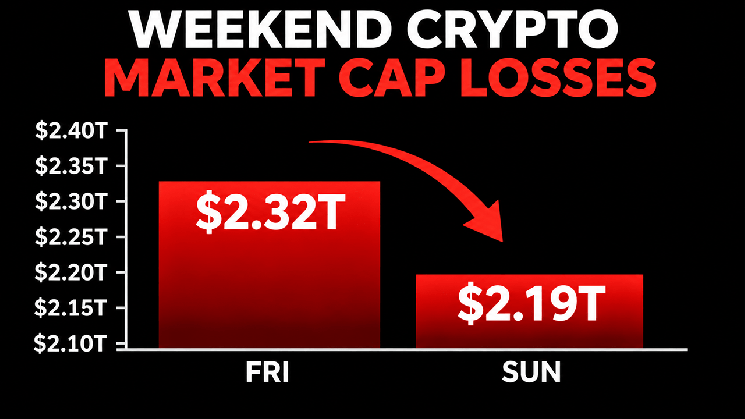
- •The total cryptocurrency market capitalization fell to $2.19 trillion after shedding $130 billion since Friday's trading sessions.
- •Bitcoin dropped to an intraday low of $61,947 and remains down 14.5% over seven days, while XRP hit a two-year low of $0.8922 after slipping beneath $1.
- •Approximately $1.71 billion in crypto positions were liquidated over 24 hours, affecting 260,271 traders, with long positions accounting for 80.2% of the total.
- •U.S. spot bitcoin ETFs recorded $2.97 billion in net outflows across 12 trading sessions from Oct. 29 through Nov. 13, with combined net assets contracting about 17.33% to $86.20 billion.
- •The Crypto Fear & Greed Index fell to 10, deep in extreme fear territory, while the stablecoin market cap shrank to $284.85 billion from its May peak of $311 billion.
Crypto Market Rout Deepens as XRP Hits Two-Year Low and Bitcoin ETF Money Flees
$130 Billion Vanishes as Bitcoin and XRP Breach Critical Levels
The weekend delivered fresh losses for cryptocurrency investors, with the market's aggregate valuation retreating to $2.19 trillion after shedding $130 billion since Friday's trading sessions. The decline extended a broader November retreat, leaving numerous digital assets with substantial losses.
On Bitstamp, bitcoin's price tumbled to an intraday low of $61,947 per unit before recovering toward the mid-$64,000 range, though the leading cryptocurrency remained down 14.5% over the past seven days. XRP, the token associated with Ripple's cross-border payments network, endured an equally consequential breakdown, slipping beneath the psychological $1 threshold to touch an intraday low of $0.8922 — a two-year low for the token. By 11:30 a.m. Eastern time on Sunday, XRP had rebounded to $0.95 per coin.
Weekly Damage Spans Major Cryptocurrencies and Altcoins
The seven-day decline stretched across the major cryptocurrencies. Zcash (ZEC) posted the steepest drop among the tracked assets at 29.7%, followed by Solana (SOL) at 19.8%, Ethereum (ETH) at 19%, XRP at 17.4%, BNB at 15.1%, and Hyperliquid (HYPE) at 12.9%. Tron (TRX) proved comparatively resilient, slipping just 4.4%. Percentage declines tend to steepen further down the market-cap ladder, since assets with thinner liquidity and lighter order books can see the same selling pressure translate into larger price swings.
The selling pressure also swept through the broader altcoin segment. Uniswap (UNI) plunged 26.66% to $5.11, while Aerodrome Finance (AERO) shed 26.47% to $0.4348. Holo (HOT) fell 24.33% for the week, and ApeCoin (APE) and Centrifuge (CFG) surrendered 24.23% and 23.91%, respectively. Aptos (APT) retreated 23.55%, Basic Attention Token (BAT) lost 23.39%, and Pudgy Penguins (PENGU) slipped 23.31%. Curve DAO's CRV token rounded out the group with a 23.19% weekly loss, underscoring the severity of the selling gripping the altcoin market.
$1.71 Billion Liquidated as Extreme Fear Grips Traders
Leveraged traders bore the brunt of the selloff. Liquidations occur when an exchange forcibly closes a leveraged position whose collateral can no longer cover potential losses, and the automatic selling involved can compound downward moves. Coinglass statistics recorded at Sunday 11 a.m. Eastern time showed approximately $1.71 billion in cryptocurrency liquidations over 24 hours, affecting 260,271 traders. Long positions accounted for $1.37 billion, representing 80.2% of the total, compared with $338.09 million in short liquidations — an imbalance that illustrates how much borrowed exposure had been positioned for prices to rise.
Bitcoin derivatives alone absorbed approximately $690 million in liquidations, while Ethereum positions accounted for another $400.35 million. Hyperliquid recorded $79.69 million, Solana $75.45 million, and XRP $43.88 million. The largest individual liquidation involved a $16.17 million Ethereum long position on Binance.
Bitcoin-specific data shows more than $486 million in BTC longs were liquidated, along with over $200 million in shorts. Hyperliquid, Binance, and Bybit collectively represented more than 81% of those bitcoin liquidations, illustrating the concentration of leveraged exposure across major trading venues.
Market sentiment deteriorated in parallel. The Crypto Fear & Greed Index, a composite sentiment gauge that runs from 0 to 100, fell to 10, firmly within the extreme fear band the index reserves for readings below 25. That is down from a reading of 13 the previous day and 20 earlier in the week — a rapid erosion of investor confidence as prices breached established support levels. Such depressed readings have historically preceded temporary recoveries, but extreme lows offer no assurance that selling pressure has been exhausted.
ETF Withdrawals and Shrinking Stablecoin Supply Deepen the Damage
Institutional selling pressure has added another dimension to the market's troubles. Spot bitcoin ETFs, which began trading on U.S. exchanges in January 2024, hold the cryptocurrency directly and offer exposure through ordinary brokerage accounts, and their daily flow reports have become a closely tracked barometer of institutional demand. According to Sosovalue statistics, U.S. spot bitcoin exchange-traded funds (ETFs) registered $2.97 billion in net outflows across the 12 trading sessions from Oct. 29 through Nov. 13, with only two sessions recording positive flows. November alone has accounted for $2.35 billion in withdrawals, including $1.07 billion during the latest five-day trading week, marking an extended retreat from investment products that previously supplied substantial buying demand.
Even more striking, the combined net assets held by U.S. spot bitcoin ETFs contracted from $104.27 billion on Oct. 29 to $86.20 billion on Nov. 13 — a reduction of $18.07 billion, or approximately 17.33%. That decline reflects both investor withdrawals and falling bitcoin valuations; cumulative net inflows also retreated from $57.62 billion to $54.63 billion over the same period. The figures illustrate how sustained redemptions and deteriorating cryptocurrency prices have simultaneously eroded the sector's institutional investment base.
Liquidity conditions have tightened considerably as well. Stablecoins — tokens pegged to fiat currencies such as the U.S. dollar — act as the primary settlement and quoting layer for crypto trading, so their aggregate supply is often read as a measure of how much capital sits ready to be put to work in digital assets. The stablecoin economy has shed $26.15 billion since its May peak of $311 billion. According to DefiLlama statistics collected Saturday, Nov. 14, the sector's capitalization stood at $284.85 billion, reflecting a 5.36% decline over the last 30 days. Tether's USDT and Circle's USDC collectively accounted for $244.42 billion, with both recording monthly contractions approaching 5%.
Weekend trading conditions compounded these pressures, as thinner order books left cryptocurrency prices more vulnerable to aggressive selling and cascading liquidations. The market now faces an uncomfortable combination of institutional withdrawals, contracting stablecoin liquidity, and damaged investor confidence.
Bitcoin has recovered somewhat from its recent lows, standing at $64,624 at 11:30 a.m. Eastern time on Sunday. The indicators most closely watched in the sessions ahead — daily ETF flow tallies, stablecoin capitalization, and sentiment readings — have all trended lower in recent weeks. The central question remains whether sufficient buying demand can return before another wave of selling tests the market's remaining defenses.

