Crypto Hack Losses Hit $8.74 Billion Through October 2026, Led by $6.36 Billion Binance Breach
Key Takeaways
- •The 29 October 2026 Binance hack, valued at $6.36 billion, is the largest single crypto theft in DefiLlama's dataset and makes up roughly 73% of this year's $8.74 billion total.
- •Excluding the Binance incident, 2026 losses of $2.38 billion sit below the $2.51 billion recorded over the same ten months of 2025.
- •Exchanges suffered the largest dollar losses, with four incidents totaling $6.78 billion, while DeFi protocols were targeted most often across 232 incidents worth $1.19 billion.
- •Setting Binance aside, key compromise was the costliest attack type at $721 million, followed closely by bridge and cross-chain attacks at $701 million.
- •Most incidents were relatively small: the median loss was $517,000, and 188 of the 305 incidents with recorded amounts stayed under $1 million.
Crypto hacks cost $8.74 billion between January and October 2026, according to DefiLlama's incident dataset — already more than any full year on record there. A single incident, the 29 October Binance hack valued at $6.36 billion, makes up roughly 73% of the total. Excluding that event, 2026 stands at $2.38 billion, just below the $2.51 billion lost over the same ten months of 2025.
The figures are compiled in the Cryptsy Crypto Hacks Index, which breaks DefiLlama's public hacks data down by month, attack type and target, and sets it against earlier years. This edition is based on a snapshot taken on 2 November 2026 at 07:49 UTC and covers incidents dated through 31 October 2026. Every figure is a gross loss as recorded in the dataset, before any recovery.
Key Findings on Crypto Hacks in 2026
- $8.74 billion lost across 325 recorded incidents; 20 of those incidents do not yet have a loss figure.
- Losses are extremely concentrated. Binance alone accounts for 72.8% of the total, and the ten largest incidents together represent 92.5%.
- The typical hack is small. The median loss is $517,000, and 188 of the 305 incidents with a loss figure stayed under $1 million. Only 7 incidents reached $100 million.
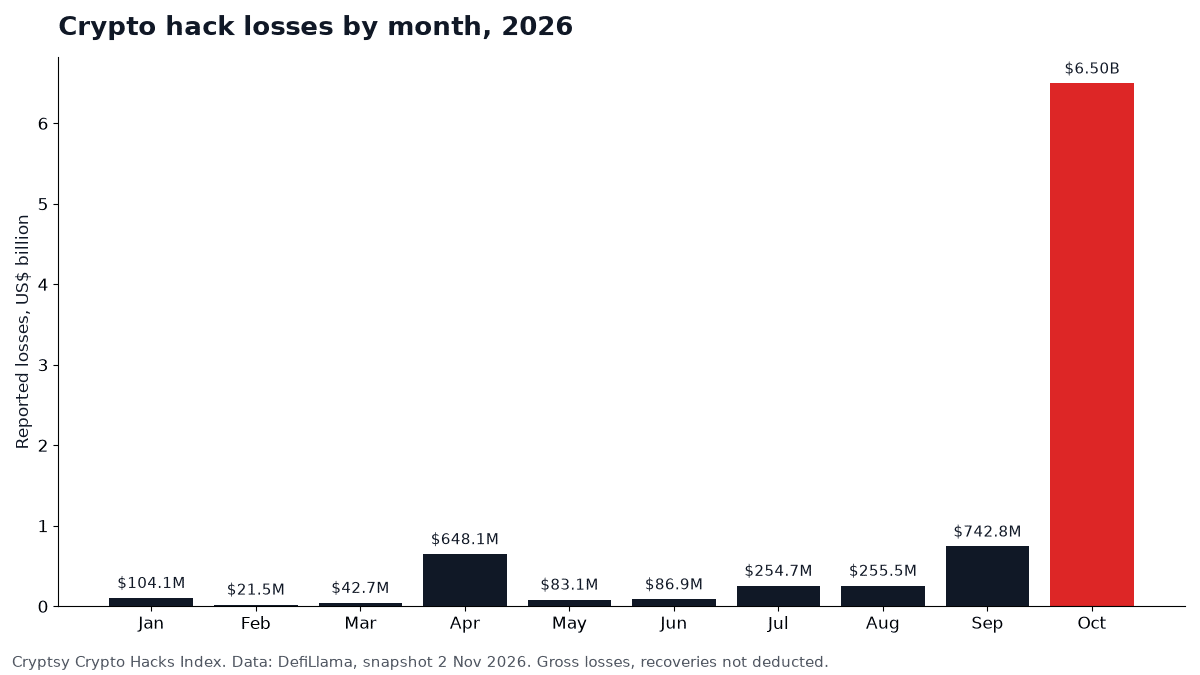
- October was the worst month by far at $6.50 billion. Without Binance, October comes to $136 million.
- More incidents are being recorded. The dataset lists 325 incidents for January to October 2026, against 120 for the same months of 2025, while the median loss fell from $1.1 million to $517,000. Wider coverage by the dataset may explain part of that rise.
- Outside Binance, key compromise is the costliest attack type at $721 million, with bridge and cross-chain attacks close behind at $701 million.
How Much Was Lost Each Month in 2026?
Monthly crypto hack losses ranged from $21 million in February to $6.50 billion in October. Before the Binance hack, the most expensive months were September at $743 million and April at $648 million. Each of those months contains incidents of roughly $300 million or more.
What Are the Biggest Crypto Hacks of 2026?
The year's largest hack is Binance at $6.36 billion — more than 16 times the next largest, Bitget at $387 million. The top ten incidents span exchanges, DeFi protocols, a Bitcoin sidechain and two hardware wallet brands.
DefiLlama's entry for the Binance incident describes unauthorized withdrawals across several blockchains after a suspected compromise of a DevOps engineer's laptop, with no evidence that wallet private keys leaked. It says about $3 billion was later frozen and that Binance committed to covering all losses from its SAFU fund — the exchange's emergency reserve for user losses — and company reserves. Early estimates were lower: Cryptsy's 30 October coverage of the Binance hack carried figures of $5.3 billion to $5.9 billion.
Two wallet incidents stand out because they hit people who had moved coins off exchanges. DefiLlama attributes the Coldcard losses to a firmware bug that weakened seed generation, and the Ledger losses to genuine devices that were modified and resold with hidden hardware that captured recovery phrases. According to the Ledger entry, the company confirmed that its Secure Element, operating system and internal infrastructure were not compromised.
How Do Crypto Hackers Get In?
Attackers took the most money in 2026 through infrastructure attacks and stolen keys. Leaving Binance aside, key compromise — incidents in which attackers obtain the private keys that control funds — cost $721 million across 36 incidents. Oracle manipulation, in which attackers distort the external price data that on-chain protocols rely on, was far more frequent than its share of losses suggests, with 42 incidents and $75 million lost. Measured by incident count, the most common categories were token and share accounting with 58 incidents and access control with 54.
Ethereum was involved in the most 2026 incidents, with 115, followed by BSC with 62, Base with 36, Arbitrum with 32 and Solana with 19. Because a single incident can touch more than one chain, these counts overlap. Social engineering shows only 5 direct entries in the category data, but the descriptions of the Drift and Kelp incidents also involve tricking people — an indication of how much crypto theft begins with a person rather than a smart contract.
Exchanges, DeFi or Wallets: Who Lost the Most?
Exchanges lost the most money in 2026, while DeFi protocols were hit the most often. Four exchange incidents total $6.78 billion, and 232 DeFi incidents total $1.19 billion. Without Binance, exchange losses drop to $417 million and DeFi becomes the largest group.
Are Crypto Hacks Getting Worse? Losses by Year
Measured in dollars, 2026 is the worst year in the dataset, and it still has two months to run. That result, however, rests on one event. Without Binance, the $2.38 billion recorded so far sits below the full-year totals for 2020 ($3.98 billion), 2021 ($2.87 billion), 2022 ($3.63 billion) and 2025 ($2.72 billion). With November and December still ahead and DefiLlama revising entries between editions, both the 2026 total and the all-time ranking can still move before the year closes.
What Are the Biggest Crypto Hacks in History?
By DefiLlama's dollar figures, the largest crypto hack in history is the 2026 Binance hack — about 1.8 times LuBian ($3.50 billion, 2020) and about 4.5 times Bybit ($1.40 billion, 2025). These amounts use the values recorded for each incident, so older hacks are not restated at today's coin prices.
Other well-known entries sit just below this tier: Wormhole Portal at $326 million (2022), DMM Bitcoin at $305 million (2024) and KuCoin at $281 million (2020). Exchanges and cross-chain bridges fill almost every place in the all-time top ten, and hot wallets — wallets that stay connected to the internet — come up repeatedly.
What the Data Means for Crypto Users
Exchange balances carry a large but rare risk. Only four exchange incidents appear in ten months, yet they include the two largest losses of the year, and funds stay exposed while a platform freezes withdrawals.
Self-custody moves risk rather than removing it. Both wallet incidents described above reached users directly, and the Ledger case — in which genuine devices were tampered with and resold — highlights the case for buying hardware wallets straight from the manufacturer.
Bridges, which connect separate blockchains and hold the assets moving across them, warrant extra care: DefiLlama flags 51 incidents in 2026 as bridge hacks, worth $753 million. DeFi positions face many small risks — with 232 protocol incidents this year, the choice of protocol matters.
How the Crypto Hacks Index Is Built
All figures are calculated from the DefiLlama hacks dashboard and its public hacks API, which held 1,334 records at snapshot time. The recorded amount per incident is summed and grouped by DefiLlama's date, category and target type, and the entries were not independently audited.
The totals are gross, not net. The dataset's returned-funds field totals only about $6 million for 2026 and does not reflect the roughly $3 billion its own Binance entry describes as frozen.
Figures can change. DefiLlama adds and revises entries, so loss estimates and incident counts can move between editions, and the index is recalculated each month from DefiLlama's public data. Incidents with no amount count toward incident totals but add nothing to loss totals or the median.
Frequently Asked Questions
How much crypto was stolen in hacks in 2026?
DefiLlama's dataset records $8.74 billion in crypto hack losses from January through October 2026, across 325 incidents. That is a gross figure that does not deduct funds later frozen or returned.
What is the biggest crypto hack ever?
In DefiLlama's dataset, the largest single incident is the 29 October 2026 Binance hack at $6.36 billion. The next largest entries are LuBian in 2020 at $3.50 billion and Bybit in 2025 at $1.40 billion.
What is the most common type of crypto hack?
By incident count in 2026, token and share accounting leads with 58 incidents, followed by access control with 54. By money lost, leaving out Binance, key compromise leads at $721 million.
Are centralized exchanges safer than DeFi from hacks?
The 2026 data shows two different risk profiles. Four exchange incidents account for $6.78 billion, while 232 DeFi incidents account for $1.19 billion. DeFi protocols get hit far more often, and exchange incidents are far larger when they happen.
How often is the Crypto Hacks Index updated?
The index is recalculated each month from DefiLlama's public data, with the snapshot date updated per edition. DefiLlama can revise past entries, so older figures may change between editions.
Sources: DefiLlama hacks dataset (defillama.com/hacks), snapshot 2 November 2026; calculations by Cryptsy. Based on the Cryptsy Crypto Hacks Index by Ethan Blackburn, originally published on Cryptsy.

