23 of 40 Recent OCC De Novo Bank-Charter Applications Involve Digital Assets
Key Takeaways
- •Twenty-three of the 40 de novo bank-charter applications filed with the OCC involve digital-asset firms, representing roughly 57% of the current pipeline.
- •New U.S. bank formation has been rare since the 2008 financial crisis, making a 40-application pipeline of any kind unusual.
- •The charter interest follows the 2023 loss of major crypto banking partners, when Silvergate wound down voluntarily, Signature Bank was closed by New York regulators, and the Federal Reserve denied Custodia Bank membership and a master account.
- •The GENIUS Act, signed into law in July 2025, requires payment-stablecoin issuers to be regulated entities, giving stablecoin operators a federal rulebook.
- •An application is a request rather than an approval, and OCC approvals, denials, conditions, and formal digital-asset guidance will reveal whether these firms become real supervised banks.
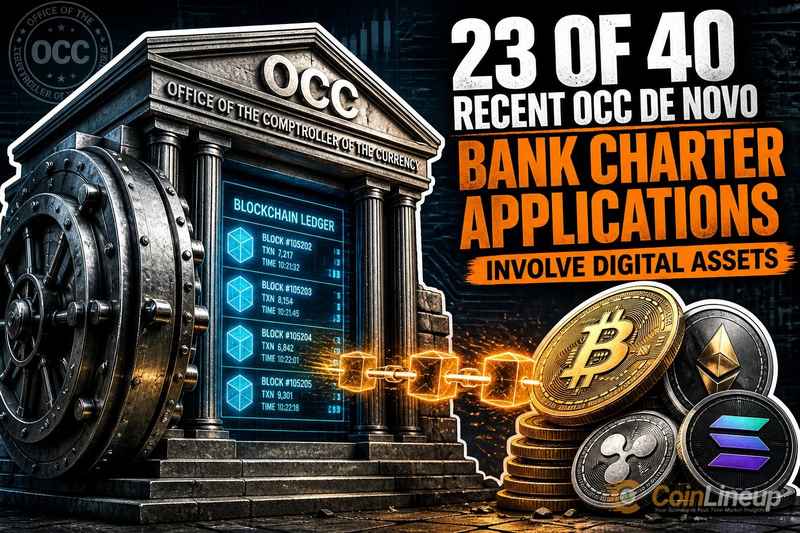
More than half of the newest applications to establish a brand-new U.S. bank now involve digital assets. Of the 40 recent de novo bank-charter applications filed with the Office of the Comptroller of the Currency (OCC), 23 involve digital-asset firms — roughly 57% of the pipeline — a striking signal that crypto companies increasingly want a place inside the regulated banking system.
Why the OCC application mix matters
The Office of the Comptroller of the Currency is the U.S. regulator that charters and supervises national banks. A "de novo" charter application is a request to build a new bank from scratch rather than buy an existing one.
New-bank formation itself has been rare in the United States since the 2008 financial crisis, with only a small number of de novo charters approved nationwide in the years that followed. Against that backdrop, a 40-application pipeline of any kind is unusual — and the digital-asset share makes it more so.
The reported split — 23 of 40 applications touching digital assets, or roughly 57%, per an OCC news release — is a large share for a single industry in a single pipeline.
One important caveat: an application is a request, not an approval. The figures show what the application mix signals, not which banks will actually open their doors.
What this says about crypto firms pursuing regulated banking access
A national bank charter can give a company a direct route to regulated deposits, payments, custody, and settlement — infrastructure that many crypto firms have long relied on outside partners to provide.
Digital-asset companies have faced repeated pressure over banking access, counterparty risk, and regulatory credibility. That pressure has a concrete history: in 2023, Silvergate wound down voluntarily and New York regulators closed Signature Bank, two of the sector's main banking partners, while the Federal Reserve denied Wyoming-based Custodia Bank both membership and a master account. The exits left crypto firms with fewer dedicated banking partners.
Recent reporting has described how policy shifts are shaping this new wave of charter interest, as covered in a Banking Dive report on OCC leadership remarks.
Digital-asset involvement can mean many things in this context: custody, payments, stablecoin operations, or broader financial plumbing. On the custody side there is limited precedent — Anchorage Digital received a national trust charter from the OCC in 2021, though trust charters cover custody and fiduciary activities rather than the full deposit-taking powers of a national bank. Stablecoin issuers, meanwhile, now work under a federal rulebook after the GENIUS Act, signed into law in July 2025, required payment-stablecoin issuers to be regulated entities. Some observers question how "bank-like" these firms really are — a tension explored in a CryptoSlate analysis of crypto banks.
The bigger picture: applying for a charter signals a move from the edge of finance toward the traditional banking framework. That is a harder, slower path than staying purely crypto-native, which is why the volume stands out.
The trend also fits a wider pattern of governments defining crypto's place in the financial system, from Nigeria's proposed capital floor for offshore platforms to new state-level crypto tax rules in the United States.
What to watch as these applications move forward
Application volume alone does not determine approval rates or launch dates; a crowded pipeline can still produce few new banks.
The signals that will matter next are concrete: approvals, denials, any conditions attached to a charter, and formal OCC guidance on digital-asset banking. Those outcomes will reveal how the regulator actually responds, not just how firms are positioning.
The distinction matters. Application momentum shows industry intent; regulatory acceptance shows whether that intent becomes real, supervised banks.
For individual holders, the pipeline changes nothing about existing holdings today, but it points toward a possible future in which more crypto activity runs through federally regulated banks. The OCC's approval decisions — not the application count — will show whether that future arrives.
The same regulatory momentum is visible elsewhere, including questions in Congress about crypto and ETFs.
Disclaimer: This article is for informational purposes only and does not constitute financial or investment advice. Cryptocurrency and digital-asset markets carry significant risk. Always do your own research before making decisions.

