More Than Half of Tracked Crypto Tokens Have Failed, CoinGecko Data Shows
Key Takeaways
- •CoinGecko data shows 53.2% of tokens tracked between mid-2021 and the end of 2025 are no longer actively trading, with cumulative failures reaching about 13.4 million.
- •Failures spiked in 2025 to roughly 11.56 million tokens, about six times the combined total of the previous four years and an average of around 31,700 per day.
- •The spread of launchpads such as pump.fun lowered the cost and skill needed to create tokens, fueling a wave of short memecoin launches that drove failure counts higher.
- •The fourth quarter of 2025 saw 7.7 million token failures, beginning with the October 10 liquidation of $19 billion in leveraged positions, which CoinGecko called the largest single-day deleveraging event in crypto history.
- •A study of 845 exchanges by University of Vaasa researcher Niranjan Sapkota found 43.3% had defaulted, while surviving platforms tended to be older, list more coins, and hold higher ratings.
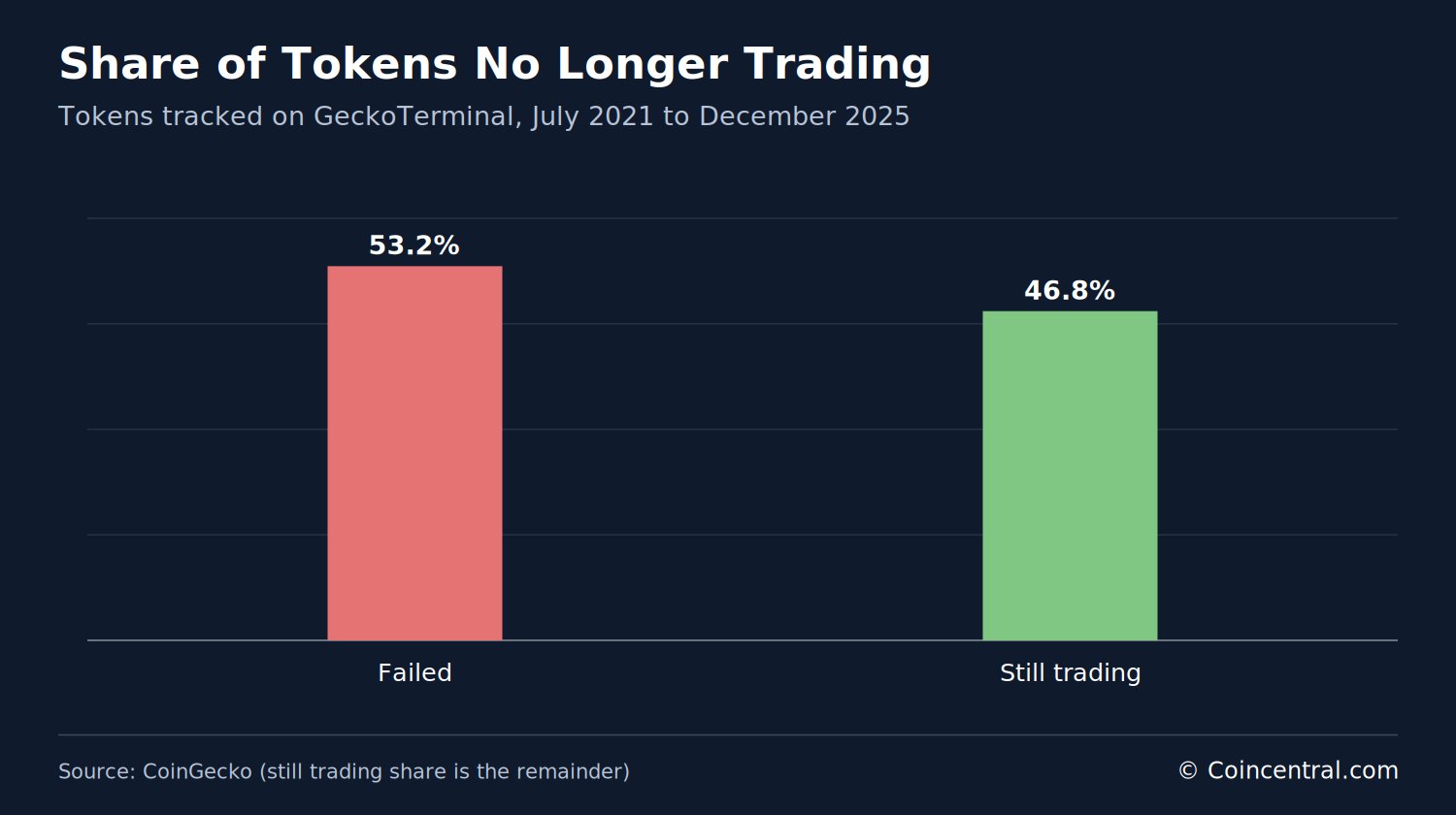
Crypto has a failure problem, and the data now puts numbers on it. CoinGecko found that 53.2% of the tokens it tracked between mid-2021 and the end of 2025 are no longer trading, and most of those failures were counted in a single year.
The findings draw on four sources. Three cover token failures, including CoinGecko's own dataset. The fourth is an academic study of 845 crypto exchanges. Together, they show how often projects fail, when failures happen, and what failed projects have in common.
A quick note on method: CoinGecko counted tokens on GeckoTerminal, its platform for tracking on-chain decentralized-exchange trading, that had at least one trade and later went silent. All token figures below come from that data unless the text says otherwise.
Key Crypto Failure Rate Statistics
The headline number is 53.2%, the share of tracked tokens that are no longer actively traded. CoinGecko calls these tokens dead or failed. Its yearly counts add up to 13,407,627 failed tokens, of which 86.3% were counted in 2025.
The sources do not agree on every total. Bitcoin World reported that 53.2% of 20.2 million tokens is about 10.7 million failures. CoinGecko's yearly counts give about 13.4 million, which matches the figure CoinDesk reported. The sources also describe the 20.2 million figure in different ways. For that reason, this article uses CoinGecko's yearly failure counts and does not use 20.2 million to work out totals.
Crypto Token Failures by Year
The yearly data shows how fast failures grew. In 2021, only 2,584 tokens failed. By 2023, the count was 245,049. The jump came after that: 1,382,010 tokens failed in 2024, and in 2025 the count reached 11,564,909, the highest yearly total in the data.
Measured against the five-year total, failures from 2021 to 2023 made up only 3.4%. The 2024 figure was 10.3%, and the 2025 figure was 86.3%.
A note on labels: CoinGecko's table names its first column "year of launch," but its method note says tokens are grouped by the year they last had an active trade. This article reads the counts as failures by year.
The rise was not steady. From 2022 to 2023 the count grew by about 15%, from 2023 to 2024 by about 464%, and from 2024 to 2025 by about 737%. CoinDesk reported the same pattern, noting that 2,584 projects failed in 2021, more than 1.3 million failed in 2024, and the count then rose sharply in 2025. At the 2025 rate, about 31,700 tokens stopped trading each day.
Put another way, 2025 produced about 11.56 million failures, while 2021 through 2024 together produced about 1.84 million. The2025 count is roughly six times the total of the four years before it.
Why Token Launches Grew So Fast
Failures grew because launches grew. CoinGecko reports that 428,383 projects were listed on GeckoTerminal in 2021. By 2025, the number of projects had grown to nearly 20.2 million.
CoinGecko analyst Shaun Paul Lee linked the rise to launchpads such as pump.fun. These platforms lowered the cost and skill needed to create a token, and the result was a wave of low-effort memecoins and experimental projects. Many of these tokens did not last. CoinDesk reported that many never made it past a handful of trades before they went silent, and Lee said many had little or no development behind them.
The timing lines up with the launch of pump.fun in 2024. Before that, CoinGecko says, yearly failures numbered in the low six digits. In 2024 there were over 3.0 million new projects, the second-highest launch count in the data, and 1,382,010 failures.
Bitcoin World's table lists about 7.5 million launches for 2024, while CoinGecko lists over 3.0 million. This article uses the CoinGecko figure because it comes from the dataset itself. The 2024 failure count equals about 46% of that year's launches. That is a rough comparison, since failures in any year can include tokens launched earlier, but it shows that launches and failures rose together.
CoinGecko also notes a limit in its data: only pump.fun tokens that had graduated were included, so the count does not cover every token launched on that platform. On pump.fun, a token graduates when it moves beyond the launchpad's initial phase onto a public decentralized exchange. CoinDesk adds that the data counted only projects with at least one active trade before they went silent, and says this shows how open access to token creation can lead to market saturation. Bitcoin World made a similar point about easy token creation, saying the low barrier to entry supports new ideas but also fills the market with fragile tokens.
The October 2025 Liquidations and Q4 Failures
The fourth quarter of 2025 was the worst period in the data. CoinGecko counted 7.7 million token failures in those three months.
The quarter began with a market shock. On October 10, 2025, $19 billion in leveraged crypto positions were wiped out in 24 hours. CoinGecko calls it the largest single-day deleveraging in crypto history, and Lee described it as a liquidation cascade.
The Q4 count of 7.7 million is more than five times the 1.38 million failures recorded in all of 2024. Taking 7.7 million from the 2025 total leaves about 3.9 million failures for the first nine months, meaning roughly two-thirds of the year's failures were counted in the last three months. This split is our own calculation from CoinGecko's figures.
There is also an unexplained gap. CoinGecko states that Q4 made up 34.9% of all recorded failures, which does not match the 13.4 million total, where 7.7 million would be about 57%. The sources do not explain the discrepancy, so the 7.7 million count is the safer figure to use.
Bitcoin World says many failed tokens relied on similar liquidity pools and automated market maker designs, so that when prices fell, liquidity dried up and token values dropped toward zero. This explanation comes from commentary in that article and not from the CoinGecko dataset. CoinGecko ties the sharp drop in token survival to wider market stress during 2025, which hit the memecoin sector in particular. Bitcoin World adds that regulatory scrutiny has also pushed exchanges to delist some tokens.
Crypto Exchange Default Statistics
Tokens are not the only part of crypto that fails. A 2025 study by Niranjan Sapkota of the University of Vaasa looked at 845 exchanges worldwide, with data up to February 2023. Of those, 366 had defaulted and 479 were still running, a default share of 43.3%. The author notes that the split is close to even, which is unlike traditional markets.
To build the sample, the author collected 2,077 exchange entries from three sites. After removing duplicates, 845 unique exchanges remained, each with full variable data. The data came from CoinMarketCap, Cryptowisser and CoinGecko. The study also cites Cryptowisser data showing that about 60% of exchanges have defaulted since the Mt. Gox collapse in 2014.
A snapshot from CoinMarketCap shows the same gap. Of 609 exchanges listed on April 10, 2023, only 237 had generated at least $1 of trading in the prior 24 hours.
The study lists several well-known cases. BTC-E closed in 2017 after money laundering allegations from US authorities. QuadrigaCX went bankrupt in 2019 after $190 million became inaccessible. Thodex froze in 2021, and FTX collapsed in 2022 with an $8 billion shortfall. The study also notes that lesser-known exchanges often default or disappear without much coverage.
The study contrasts this with traditional markets, where exchange failures are rare. Those exchanges are highly regulated and do not hold client funds in the way centralized crypto exchanges do.
Location data was mixed. Singapore had the most defaulted exchanges at 41, but also 55 running ones, and Hong Kong had 29 defaults. By region, Asia had the most running exchanges at 129, and Europe had the most defaults at 60. The United Kingdom, the United States and Australia each had an equal number of running and defaulted exchanges.
Reasons for failure varied. Between 2014 and 2023, business problems, regulatory challenges and scams contributed about equally. After 2018, most exchanges simply disappeared without a stated reason.
What Failed Exchanges Had in Common
Ratings in the study come from CoinGecko on a scale of 0 to 3. They cover product quality, infrastructure, user accounts and security, and a rating of 0 was the most common score in both groups.
The study compared running and defaulted exchanges on 14 factors. Running exchanges listed more coins, had higher ratings and were older, while defaulted exchanges were rarely certified. The author tested these gaps: the in coins listed, age, ratings, certification and affiliate programs were too large to be chance, while the difference in the share of decentralized exchanges was not.
Fees showed a smaller gap. Defaulted exchanges charged a lower average taker fee, at 0.35% against 0.62%, and a lower maker fee, at 0.27% against 0.52%. These gaps were not large enough to rule out chance.
The regression models added more detail. After other factors were held steady, exchanges that listed more coins had lower odds of default, exchanges that allowed US customers had about 52% higher odds of default, and higher withdrawal fees were also linked to default.
One result runs against what many readers would expect: exchanges based in countries with higher transparency scores were more likely to default. The author says this should not be read as a failure of regulation. Countries with strong systems may simply have more crypto activity, and more scams, and regulation alone may not keep an exchange stable.
Affiliate programs and higher ratings were linked to lower odds of default in the models, but both links were weak, reaching only the 10% level, so the author advises caution. The models also found that decentralized exchanges had lower odds of default than centralized ones, at about 27.5% of the odds. The author adds a caution here too: the simple comparison of shares showed no clear gap, so the result depends on the model.
Earlier research points in the same direction. A study of 144 exchanges found that cybersecurity grades, a public developer team, exchange age and the number of coins traded were linked to closure. Another study, of 822 exchanges, found that those trading only crypto and not fiat currency faced about 60% greater odds of shutting down, while trading more coins was linked to a lower chance of failure.
How Well Can Failure Be Predicted?
The study also tested whether open data can tell running exchanges from defaulted ones. Standard models did well: the logit model classified 81.18% of exchanges correctly, and the probit model reached 81.42%.
Even the simple models missed some failures. The logit model found 272 of the 366 defaulted exchanges, or 74.3%, and missed 94. It correctly identified 414 of the 479 running exchanges, or 86.4%.
The author then tried machine learning. Random forest scored 98.8% when 80% of the data was used for training, but at a 90% training split its accuracy fell to 81.9%. The author also combined five models into a stacked ensemble, whose accuracy ranged from 81.7% to 83.4% across the training splits and leaned mostly on gradient boosting. The swings in random forest results suggest caution, and the study treats XGBoost's reported 100% accuracy as a sign of overfitting on a sample of 845.
Five-fold cross-validation gave a steadier picture. Random forest scored 81.7%, the support vector machine 80.5% and gradient boosting 78.9%, results close to the plain logit and probit models. The takeaway is modest: open data can flag many failing exchanges, but the best-looking scores should not be taken at face value.
Failure Rates in Context and Data Limits
Failure is common in crypto and rare in listed stocks. The study cites research showing that fewer than 1% of NYSE-AMEX firms, and slightly more than 1% of NASDAQ firms, go bankrupt in a given year.
Earlier crypto research points the same way. A study cited in the paper found that about 60% of cryptocurrencies defaulted between 2014 and 2018 because of scams, hacks and business failures, and another study of over 2,500 coins found that newer ones were more likely to fail.
These comparisons need care. The crypto figures cover several years, while the stock figure is a yearly rate, so the time frames differ. Bitcoin World compares the current period to the early days of the internet, when many companies failed before a few strong ones remained. That is a view from analysts and not a finding from the data. Failed tokens also stay visible on public ledgers, while private startup failures usually do not.
Each dataset has limits. CoinGecko counts only tokens that had at least one trade and, for pump.fun, only tokens that graduated. The exchange study relies on open-source data, ends in February 2023 and lacks trading volume for closed exchanges. It also warns of possible reverse causality, meaning that some traits may follow failure rather than cause it, and its models are linear, which may add bias. Readers should treat the links as patterns and not proof of cause.
Conclusion
The data points to a market where most new tokens do not last. CoinGecko counts 13.4 million failures since mid-2021, and 86.3% of them were recorded in 2025. The rise followed the spread of launchpads and the October 10 liquidations.
Bitcoin World says investors should look beyond price charts when judging a token, pointing to a project's technology, team, token design and community as the areas to check.
Exchanges show a similar pattern on a smaller scale. In the Sapkota sample, 43.3% had defaulted, and survivors tended to be older, better rated and certified. The totals differ between sources, so the exact numbers may change as new data arrives.
Sources
- Dead Coins: Over 50% of Cryptocurrencies Have Failed (CoinGecko, Shaun Paul Lee)
- More than half of all crypto tokens have failed, and most died in 2025 (CoinDesk, Helene Braun)
- Cryptocurrency Failure Rate: Shocking 53.2% of Projects Launched Since 2021 Have Ceased Trading (Bitcoin World)
- The crypto collapse chronicles: Decoding cryptocurrency exchange defaults, Niranjan Sapkota, Journal of International Financial Markets, Institutions & Money
- Source: Crypto Failure Rate Statistics: What the Data Says About Failure Rates (CoinCentral)

