How Long Do Staked Crypto ETFs Take to Unlock?
Key Takeaways
- •Ethereum validator exits have variable timing, and the checked data showed no exit-queue wait but a 7.9-day sweep delay.
- •Cosmos Hub delegators generally face a 21-day ATOM unbonding period, while ADA delegation does not restrict spending.
- •The iShares Staked Ethereum Trust filing describes staking 70% to 95% of its Ether and keeping some assets unstaked for redemptions.
- •A proposed Solana ETF expects unstaking to take two days under normal conditions but still plans to maintain an unstaked SOL reserve.
- •Unstaked reserves can help funds satisfy redemptions without waiting for validator withdrawals or relying solely on cash settlement.
In the primary market, authorized participants create or redeem large blocks of ETF shares with the trust. The key question is not simply how much yield a fund earns, but whether it holds enough unstaked assets and has sufficient settlement flexibility when redemption demand increases.
Key takeaways
- Ethereum validator exits use a variable queue.
- Cosmos Hub requires 21 days to unbond ATOM.
- Delegated ADA has no delegation lockup.
- A proposed Solana ETF expects unstaking to take two days.
- Fund reserves can bridge the gap between staking and redemptions.
Staking does not create a standard liquidity rule
The time required to access staked assets depends on the blockchain. Each network establishes its own validator and delegation rules, as explained in this guide to proof of stake and proof of work. A fund holding staked ETH faces different constraints from one delegating ADA or ATOM.
That difference affects how a sponsor manages its portfolio. Where a protocol has a long or variable exit process, a fund may need a larger unstaked reserve, cash-settlement provisions, or other arrangements to avoid exiting validators during a period of heavy redemptions.
Ethereum has a queue, not a fixed withdrawal period
Ethereum does not establish a fixed number of days for a validator to complete its exit. A validator first waits in an exit queue that changes with network demand. It then completes the protocol’s withdrawal-eligibility delay before being collected in a validator sweep. The Ethereum Foundation’s withdrawal guide explains that the timing is variable.
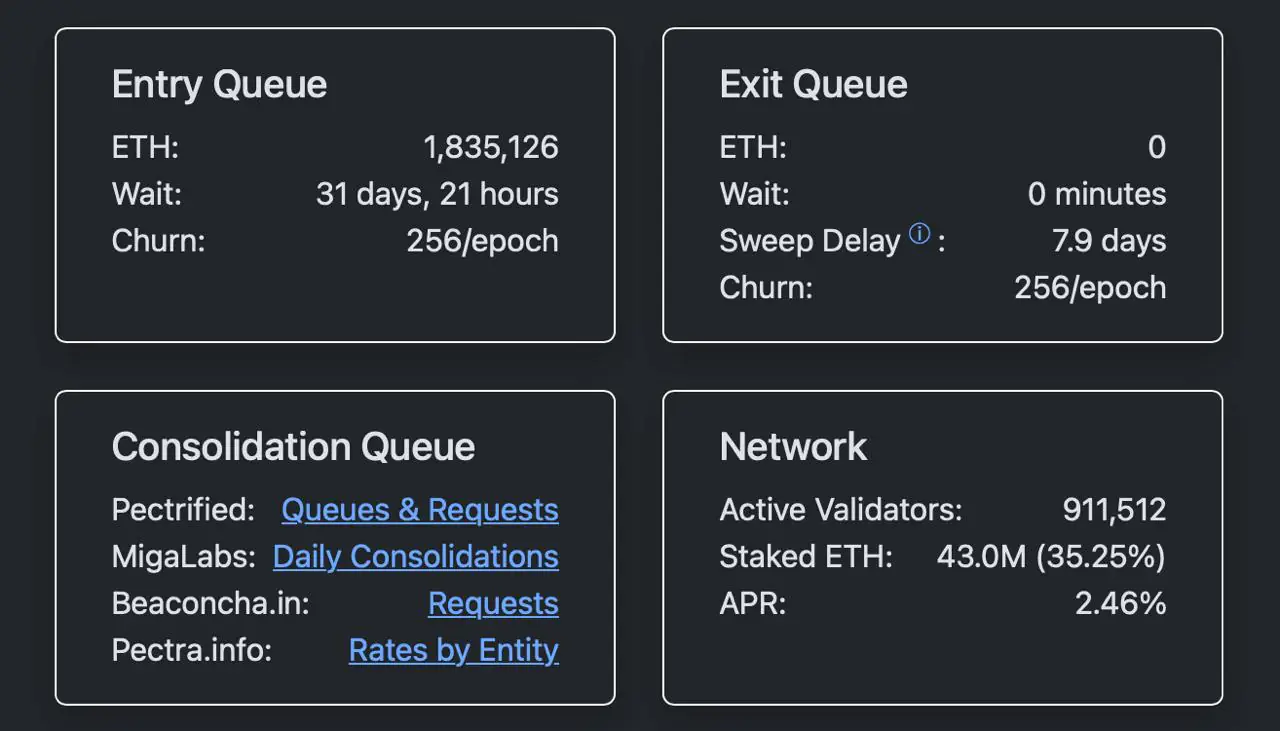
Ethereum’s exit rules now apply to a significant portion of the asset’s supply, not only to a small group of professional validators. More than 39 million ETH had already been staked, while ValidatorQueue displayed 43.0 million ETH, or 35.25% of total supply, in staking when checked. These figures do not indicate that the staked ETH is about to be sold. They do mean that a fund cannot treat every ETH it owns as immediately available for redemption once a substantial portion has been committed to validators.
The question of rewards is separate from, but connected to, fund design. Debate over how Ethereum’s reward dynamics may change as staking expands does not alter withdrawal mechanics. It can, however, affect the return a sponsor weighs against the cost of keeping part of the portfolio unstaked for liquidity. A related report is available at this Coindoo article.
How to read Ethereum’s live exit data
Investors and fund analysts can check ValidatorQueue.com for live estimates of Ethereum’s entry queue, exit queue, and validator sweep. The dashboard is useful because the wait in the exit queue and the later sweep delay are separate parts of the withdrawal process.
Ethereum does not provide a fixed timetable for a validator to withdraw completely. A validator may first face an exit queue that changes with network demand, then complete the protocol’s withdrawal steps before its balance is included in a validator sweep. The Ethereum Foundation’s withdrawal guide treats the timing as variable rather than as a standing number of days.
When checked, the exit queue showed no wait, but the sweep delay was estimated at 7.9 days. A validator could therefore begin its exit immediately while its ETH still had to pass through the later withdrawal process. The entry queue tracks validators waiting to begin staking and does not show how long an existing validator would take to leave.
These readings do not determine an ETF’s settlement time by themselves. The trust’s custody process, the size of a redemption, and its unstaked ETH reserve also determine whether it can meet a request without waiting for validator withdrawals.
More than one-third of Ethereum’s supply is now committed to staking. The network had already passed 39 million ETH in staking, while the dashboard displayed 43.0 million ETH, or 35.25% of supply, when checked. Funds and custodians holding staked ETH must therefore treat the exit process as a liquidity constraint when determining how much ETH to keep outside validators.
Staking rewards affect the other side of that decision. Changes in Ethereum’s reward dynamics as staking grows may affect the return forgone by holding ETH unstaked for redemptions. Proposals to allow validators to receive rewards sooner, such as those discussed in this report, concern reward timing rather than faster access to staked principal.
Four chains, four different liquidity models
The distinction is material. Cosmos Hub documentation states that unbonding ATOM takes three weeks, or 21 days. Delegators can redelegate to another validator without waiting through that period, but they cannot immediately transfer or sell tokens that are in the unbonding process.
Cardano takes a different approach. Its official developer documentation says that delegation is non-custodial: ADA remains in the holder’s wallet and stays spendable. A fund delegating ADA would still need custody and settlement procedures, but delegation would not prevent it from transferring ADA to meet a redemption.
Reserves bridge the gap between staking and redemptions
Ethereum funds cannot eliminate the exit queue, so the practical question is how much ETH they keep outside it. The latest iShares Staked Ethereum Trust ETF filing describes a normal policy of staking 70% to 95% of its Ether while maintaining an unstaked “liquidity sleeve” for anticipated redemptions.
That policy is more informative than a staking yield considered in isolation. A larger staked share can increase reward generation, but it also reduces the size of the unstaked reserve. If that reserve is insufficient, the fund may need to wait for validator exits, settle in cash where its documents permit it, or use another disclosed liquidity arrangement.
Unstaked assets are not idle by accident. They allow a fund to meet ordinary redemption demand without having to unwind validators when conditions are least favorable.
Solana’s shorter estimate does not remove the ETF challenge
The proposed Morgan Stanley Solana trust treats an unstaked SOL reserve as necessary even though its prospectus expects a relatively short exit process under normal conditions. The prospectus says the trust would retain some SOL outside staking for foreseeable redemptions rather than rely solely on unstaking.
The proposal sits alongside Morgan Stanley’s broader plan for staking-based Ethereum and Solana ETFs, as described in this report. A shorter expected timeline may reduce the size of the liquidity buffer a trust needs, but it does not make that buffer unnecessary.
This article is for informational purposes only and does not constitute investment, legal, or financial advice. Staking terms, withdrawal queues, and ETF policies may change.
