Crypto ETF Market Holds $124.77 Billion in AUM: 2026 Flows, Rankings, and Fees
Key Takeaways
- •Bitcoin ETFs account for $97.18 billion of the $124. billion total crypto ETF AUM, while Ethereum ETFs hold $23.59 billion and the balance sits in Solana and XRP products.
- •BlackRock's iShares Bitcoin Trust (IBIT) is the largest crypto ETF with $68.67 billion in assets, more than four times Fidelity's second-place FBTC at $15.66 billion.
- •Crypto ETFs recorded a combined net outflow of $650.6 million on October 7, 2026, with BlackRock's IBIT and ETHA together responsible for roughly $323.8 million of that total.
- •Despite the early-October selling, crypto ETFs attracted $2.35 billion in net inflows over the past 30 days and $9.19 billion during the July-September 2026 quarter.
- •Grayscale's high-fee legacy funds, GBTC at 1.50% and ETHE at 2.50%, have seen $28.11 billion in net outflows since the spot ETF era began, while its lower-fee mini trusts have captured part of that migration.
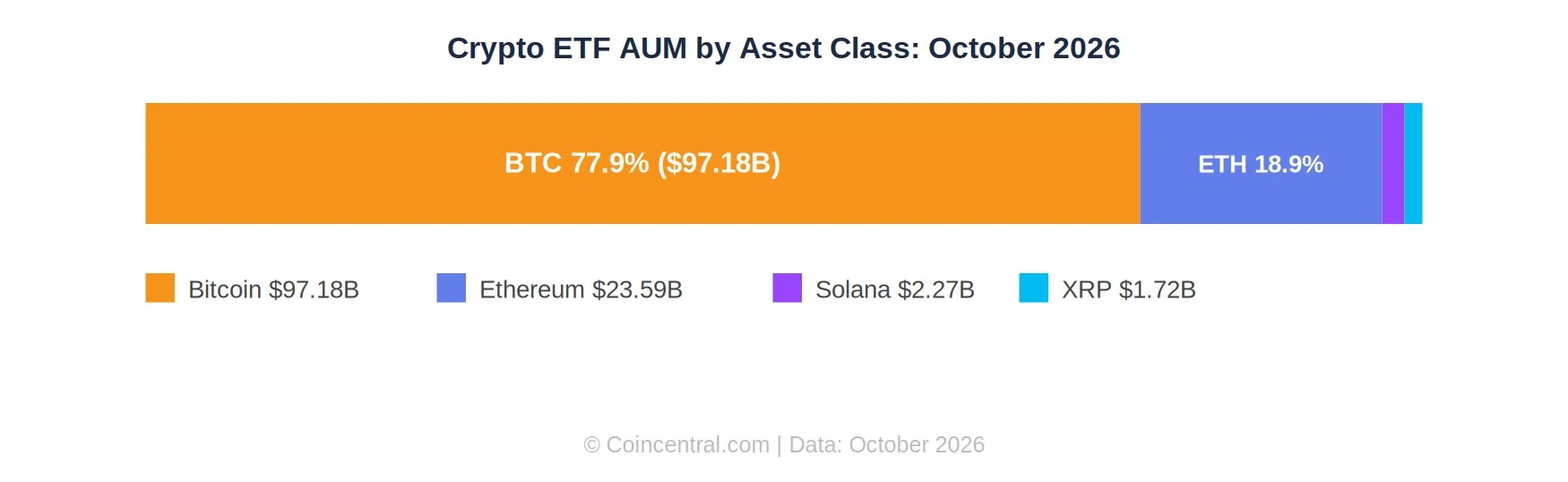
The global crypto ETF market held $124.77 billion in total assets under management (AUM) as of October 7, 2026, spread across 32 active funds run by 11 issuers, with products listed in both the United States and Hong Kong. Bitcoin funds dominate the total: BTC-focused products hold $97.18 billion in AUM, while Ethereum funds hold $23.59 billion. Solana and XRP ETFs make up the remainder.
The dataset, compiled from figures dated October 7 and October 8, 2026, covers fund flows, AUM rankings, institutional activity, and expense ratios across the entire crypto ETF universe.
The Crypto ETF Market at a Glance
The category has grown from near zero in early 2024, when US spot Bitcoin ETFs launched, to more than $100 billion in AUM within two years — a pace that places it among the largest ETF categories globally. By October 2026, total AUM across all tracked products reached $124.77 billion.
ETFs now hold approximately 8.80% of the combined market capitalization of the crypto assets they track. In absolute terms, fund structures hold 1.28 million Bitcoin, equal to 6.1% of the capped 21 million BTC supply, along with 5.9 million Ethereum. Because Bitcoin's total supply is capped, that 6.1% share is measured against a fixed denominator, making it a direct gauge of how much of the asset now sits in regulated fund structures.
Bitcoin products account for 77.9% of total crypto ETF AUM and Ethereum products for 18.9%. Solana ETFs hold $2.27 billion and XRP ETFs hold $1.72 billion.
The universe spans 32 active funds managed by 11 issuers, with three additional Hong Kong-listed funds still being compiled. Spot vehicles hold the bulk of assets, while futures-based funds account for a smaller share. Across the 35 tracked funds, combined 24-hour trading volume runs at roughly $143 million, showing ongoing daily market activity even during periods of net outflows.
Bitcoin ETF Rankings: Who Holds the Most
BlackRock's iShares Bitcoin Trust (IBIT) is the largest crypto ETF in the world by a wide margin, holding $68.67 billion in assets — more than four times the next-largest Bitcoin fund. Fidelity's Wise Origin Bitcoin Fund (FBTC) ranks second at $15.66 billion, leaving a $53 billion gap that reflects how quickly IBIT accumulated assets after its launch in January 2024.
Grayscale's Bitcoin Trust ETF (GBTC) is third with $10.56 billion. The fund has lost AUM steadily since spot Bitcoin ETFs debuted, weighed down by a 1.50% expense ratio — the highest among spot Bitcoin products — which has pushed investors toward lower-cost alternatives. Grayscale responded by launching its Bitcoin Mini Trust (ticker: BTC) at a 0.15% fee. That fund now holds $5.42 billion, capturing some of the outflow from GBTC and giving existing Grayscale investors a cheaper route to stay within the firm's lineup.
Further down the table, the Bitwise Bitcoin ETF (BITB) holds $3.24 billion and charges 0.20%. The ARK 21Shares Bitcoin ETF (ARKB) holds $2.87 billion at 0.21%. VanEck's HODL holds $1.26 billion and currently charges 0.00%, a figure that reflects a fee waiver rather than a permanent rate.
Over the past 30 days, IBIT attracted $1.47 billion in net inflows and FBTC added $357.92 million. ARKB shed $224.28 million in the same period, and BITB lost $60.43 million. Smaller funds such as EZBC, BTCO, and BRRR saw flat or minimal flows.
The top seven Bitcoin ETFs together hold more than $110 billion in combined AUM. IBIT alone represents over 61% of all BTC ETF assets, making it one of the fastest-growing ETFs in the history of the US market across all asset classes.
HODL fee is currently waived. Standard rate is 0.20%.
Ethereum ETFs: A Smaller but Active Market
The Ethereum ETF market launched later than Bitcoin's and remains smaller, with total ETH ETF AUM of $23.59 billion as of October 2026 against $97.18 billion for Bitcoin funds.
BlackRock leads the Ethereum segment with its iShares Ethereum Trust ETF (ETHA), which holds $8.61 billion in assets — equal to 36.5% of the entire ETH ETF market on its own — in the form of 3.53 million ETH.
Grayscale operates two Ethereum products. The Ethereum Staking Mini ETF (ticker: ETH) holds $2.20 billion at a 0.15% fee, while the older Grayscale Ethereum Staking ETF (ETHE) holds $1.83 billion at 2.50% — the highest fee in the entire crypto ETF space. Fidelity's Ethereum Fund (FETH) holds $1.37 billion at 0.25%, Bitwise's Ethereum ETF (ETHW) holds approximately $279 million, and VanEck's Ethereum ETF (ETHV) holds around $120 million.
ETHA on its own holds more AUM than the next five Ethereum ETFs combined, a concentration that mirrors the Bitcoin side of the market, where one large provider likewise dominates.
Measured against total market capitalization, Ethereum ETF AUM represents about 7.61% of ETH, slightly below Bitcoin's ETF market cap share of 9.02%. Both figures have risen steadily through 2026 as institutional demand has increased.
Smaller ETH ETF providers include Franklin Templeton (EZET, $53 million), Invesco (QETH, $27 million), and ProShares' futures-based EETH ($68 million). These funds serve investors seeking options beyond the top two issuers or preferring futures-based exposure.
Daily Flows: October 7, 2026
Crypto ETFs recorded a combined net outflow of $650.6 million on October 7, 2026, across all tracked funds and asset classes in a single trading day.
Bitcoin ETFs saw the largest outflow, losing $484.9 million. Ethereum ETFs shed $160.9 million and Solana ETFs reported outflows of $4.8 million, while XRP and Hyperliquid ETFs saw zero net flows.
IBIT recorded the largest single-fund outflow at -$207.7 million, followed by BlackRock's ETHA at -$116.1 million. Together, the two BlackRock funds accounted for roughly $323.8 million of the day's $650.6 million net total — close to half — a direct illustration of how the concentration at the top of the rankings carries into daily flow data: when one or two dominant funds move, the aggregate print moves with them. The next day, October 8, GBTC reported a separate $150 million single-day outflow.
Some funds were flat during the period. Several smaller products reported zero net flows, meaning no share creation or redemption activity — a common occurrence for smaller funds with limited institutional trading volume.
The five-day rolling total as of October 7 stood at -$674.57 million, and the one-week total -$729.84 million, confirming that the first week of October 2026 was broadly a period of net selling across crypto ETFs.
For all its scale, the $650.6 million outflow represents less than 0.6% of total crypto ETF AUM. Large single-day outflows can be driven by a small number of institutional redemptions and do not always reflect a broad shift in investor sentiment over time.
How Flows Have Trended Over Time
While October 7 showed heavy outflows, the monthly and quarterly pictures tell a different story. Over the past 30 days, crypto ETFs attracted $2.35 billion in net inflows, placing the single bad day inside a broader period of positive demand.
The last full quarter, July through September 2026, brought in $9.19 billion in net inflows — one of the strongest quarterly figures on record for the crypto ETF market.
The strongest single month on record was July 2025, when crypto ETFs pulled in11.45 billion amid strong crypto price moves and rising institutional involvement across multiple asset classes. The weakest month was June 2026, with net outflows of $4.98 billion, when broad weakness in crypto prices led to widespread redemptions across Bitcoin and Ethereum funds.
The five-day rolling outflow of $674.57 million and the weekly total of $729.84 million confirm that the start of October 2026 was a soft period, but the 30-day and 90-day data remain in net positive territory. The divergence between short-term and long-term flow trends is a common feature of the crypto ETF market: weeks of outflows can occur inside months that still end net positive, and daily flow numbers are most reliably read against the wider trend. By these measures, the longer-term demand picture heading into the fourth quarter of 2026 remained positive. The quarter therefore opens with two conflicting frames — a negative first week against positive 30-day and 90-day windows — and the daily prints through the rest of October will show which one the quarter's final numbers fit.
The Biggest Issuers: Institutional Rankings
BlackRock has taken the top position among ETF issuers by a wide margin. Its two products, IBIT and ETHA, have attracted a combined $78.68 billion in cumulative net inflows since launch.
Fidelity is second with $13.42 billion in total net inflows across its Bitcoin and Ethereum funds. Bitwise is third with $4.41 billion, followed by ARK 21Shares at $1.20 billion and VanEck at $1.01 billion.
Grayscale is the outlier among major issuers. Its products have seen $28.11 billion more leave than enter since the spot ETF era began, an outflow tied directly to the high fees on GBTC at 1.50% and ETHE at 2.50%. Grayscale manages seven crypto ETFs in total, more than any other single issuer, and its AUM remains large because its funds have been in operation longer and because rising crypto prices have lifted the value of assets still held inside them. Net flows, however, have trended negative on a consistent basis since early 2024, reflecting the years-long migration of investors to lower-cost alternatives once those became available.
Fidelity's four crypto ETFs include both Bitcoin and Ethereum spot products. Along with BlackRock, Fidelity has been one of the two main destinations for new money entering the crypto ETF market over the past two years.
Expense Ratios: What Investors Are Paying
Fees vary widely across crypto ETFs. The most expensive products are Grayscale's ETHE at 2.50% and GBTC at 1.50% — legacy products that were converted from trust format to ETF structure without reducing their fee levels. That leaves legacy products charging steep multiples of the going rate for equivalent spot exposure — GBTC at ten times the 0.15% mini fee, ETHE at more than sixteen times it — the widest pricing gap in the dataset and the variable that maps most directly onto the flow patterns described above.
The cheapest spot Bitcoin ETF by stated rate is Grayscale's Bitcoin Mini Trust at 0.15%. VanEck's HODL currently charges 0.00%, though that reflects a fee waiver rather than a permanent rate; whether a promotional waiver carries an end date is a material detail behind the stated figure.
Most major spot Bitcoin ETFs from BlackRock and Fidelity charge 0.25%. ARK 21Shares' ARKB charges 0.21%, Bitwise's BITB 0.20%, and Franklin Templeton's EZBC 0.19%.
Spot Ethereum ETFs fall in a similar range. BlackRock's ETHA and Fidelity's FETH both charge 0.25%, Bitwise's ETHW and VanEck's ETHV both charge 0.20%, and Franklin's EZET charges 0.19%.
The average expense ratio across all 174 US-listed crypto ETFs is 0.83%, a figure pulled higher by older, high-fee products. New spot ETFs are generally priced between 0.15% and 0.25%.
Futures-based ETFs tend to cost more. ProShares' BITO charges 0.95%, and part of that cost comes from contract rolling mechanics: as a futures contract expires, it must be replaced with a new one, often at a higher price, creating a drag on performance that goes beyond the stated annual fee.
Spot ETFs vs Futures ETFs
Most AUM and most daily trading volume sit in spot ETFs, which directly hold the underlying crypto asset. Futures ETFs hold derivative contracts and must roll those contracts forward as they expire, adding costs beyond the stated fee.
BITO, the ProShares Bitcoin futures ETF, is the largest futures fund with $1.71 billion — a small fraction of IBIT's $68.67 billion. The gap shows how strongly investor preference has shifted toward spot products since they became available in the US in January 2024.
Futures ETFs are subject to a cost known as roll yield, or negative roll. When a futures contract expires, it is replaced with a newer contract, often at a higher price, eating into returns beyond what the expense ratio alone would suggest. That is one reason futures-based performance can lag the spot asset price over time. Spot ETFs do not have this problem: they hold the actual asset and track its price directly, which at similar fee levels makes them the lower total-cost vehicle for long-term holding.
Hong Kong-Listed Crypto ETFs
Three Bitcoin ETFs are listed in Hong Kong: ChinaAMC, Harvest, and Bosera HashKey. Full AUM and flow data for these funds is still being compiled, and the numbers are not directly comparable to US-listed funds at this stage.
Hong Kong's crypto ETF market is a fraction of the size of the US market. Daily volumes for Hong Kong-listed Bitcoin ETFs run in the low millions, compared with the billions traded on US exchanges during active periods. Ethereum ETFs are also available in Hong Kong, and combined AUM for all Hong Kong crypto ETFs sits in the hundreds of millions of dollars. The market is growing but trails the US by a wide margin in both total assets and daily liquidity.
The Hong Kong market serves Asia-Pacific investors who want regulated crypto ETF access within their region. Over time it may grow, but it is likely to continue lagging the US given the difference in the size of institutional capital allocated to crypto.
Sources
- The Block — Spot Bitcoin ETF Flows Data
- Artemis — Spot Bitcoin ETF AUM Data
- Yahoo Finance — ETF Volume Data
- Coinglass — Crypto ETF Flow Tracker
- ETFdb.com — Cryptocurrency ETF List and Ratios
- BlackRock — iShares Bitcoin Trust (IBIT) Fund Page
- Fidelity — Wise Origin Bitcoin Fund (FBTC)
- Grayscale — Fund Overview

