Custody: Four Questions to Answer Before Funding an Account
Key Takeaways
- •On custodial exchanges, customer balances are entries in a private database that make users unsecured creditors, so operator insolvency places their claims in a queue often governed by the law of a foreign jurisdiction.
- •Mt. Gox reported losing roughly 850,000 BTC in 2014 and creditors waited about a decade for repayment, while FTX's November 2022 collapse led to creditor distributions beginning only in 2025.
- •Proof-of-reserves attestations show a snapshot of on-chain holdings but do not demonstrate solvency without liability data, and US FDIC deposit insurance and SIPC brokerage coverage do not extend to crypto balances.
- •Hybrid venues such as EVEDEX match orders off-chain while settling positions and holding collateral on-chain, which addresses custody risk but leaves parameter risk and matching-engine opacity unresolved.
- •The EU's Markets in Crypto-Assets framework, applying to licensed crypto-asset service providers from the end of December 2024, makes safeguarding and segregating client assets a regulatory obligation, while the Financial Stability Board lists segregation and custody disclosure among its core recommendations.
Almost everyone evaluates a trading platform in the same order: fees first, then available markets, then leverage, then the interface. Custody, if it is considered at all, usually comes last and is treated as a vague security feature rather than as a question with a precise answer.
That order is backwards, and the sector has produced enough evidence to say so plainly. The Bank of England devoted an entire issue of its Financial Stability in Focus series to cryptoassets and decentralised finance, and one recurring theme is that operational and counterparty exposures in this market are often opaque to the people carrying them. Fees are a percentage of your trades. Custody is a claim on the entire balance.
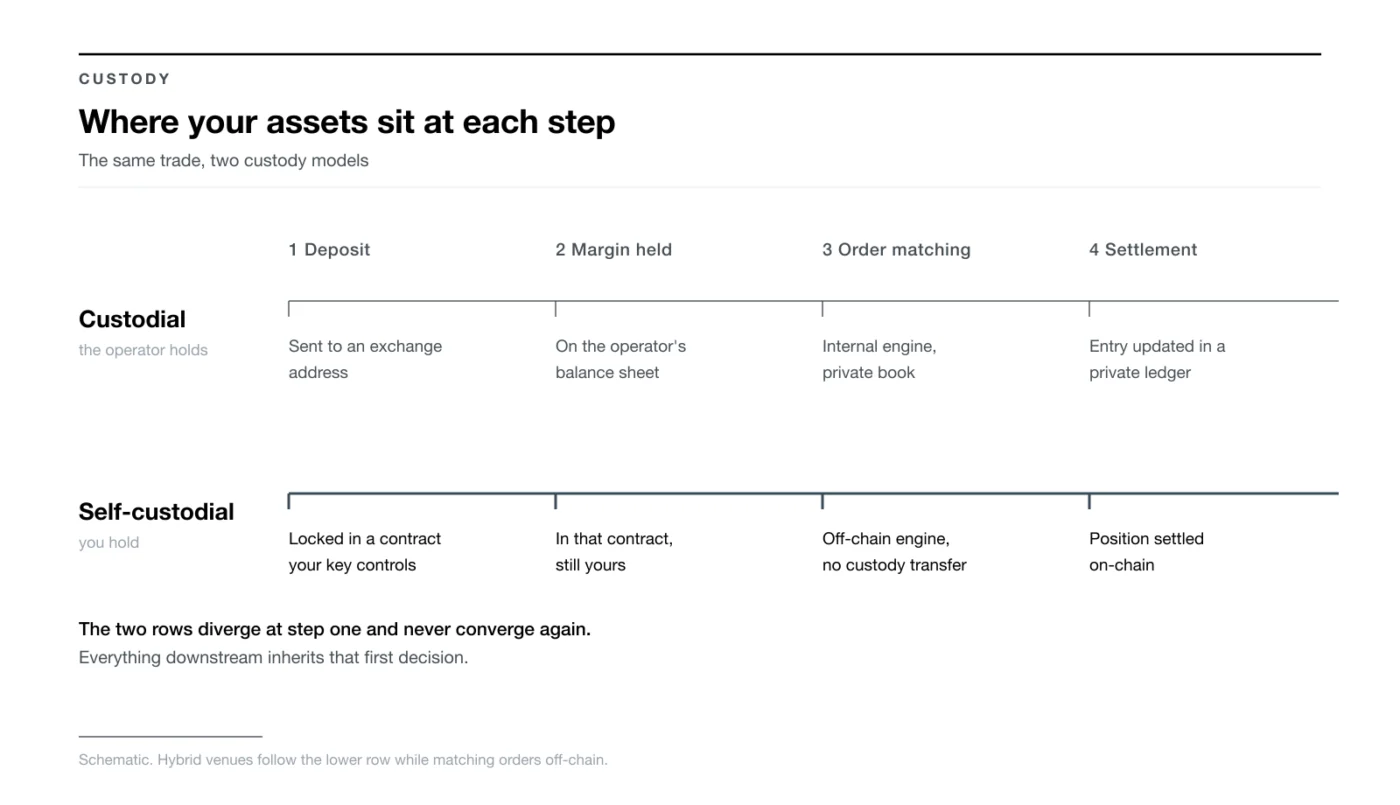
The distinction is straightforward once it is stated clearly. On a custodial platform, you deposit assets, the platform records a number next to your name, and you become an unsecured creditor of that business. On a self-custodial platform, assets sit in a smart contract or wallet you control, and the platform’s role is limited to matching and settlement. Venues built on the second model, including EVEDEX, keep collateral in contracts the user can exit rather than on a company balance sheet, which changes what an operator failure means for the user.
1. What “your balance” means on a custodial venue
On a custodial venue, “your balance” is an entry in a private database. That entry is enforceable only to the extent that the business is solvent, honest, and legally reachable from where you live.
Under normal conditions, this can be perfectly workable and comes with real benefits: password recovery, customer support, error correction, sometimes insurance, and, in properly regulated markets, a segregation regime that separates client assets from company funds.
Under abnormal conditions, the picture changes. If the operator becomes insolvent, customer claims typically join a queue governed by the insolvency law of the jurisdiction of incorporation, which is often not the jurisdiction where the customer lives. Withdrawal suspensions usually come first, and by definition users cannot act during one.
The uncomfortable historical pattern is that customers of failed crypto platforms generally learned there was a problem only after the withdrawal button stopped working, not before.
The pattern has names and dates. Mt. Gox reported the loss of roughly 850,000 BTC in 2014, and its creditors waited about a decade under a Japanese rehabilitation process before repayments began. When FTX failed in November 2022, customer claims moved into a US bankruptcy process, and distributions to creditors only started in 2025. The industry’s partial response — proof-of-reserves attestations, which a number of exchanges began publishing after the FTX collapse — shows a snapshot of on-chain holdings, but a snapshot without liabilities does not demonstrate solvency, and it says nothing about who controls the keys between attestations. The backstops familiar from traditional finance do not fill the gap either: in the United States, FDIC deposit insurance and SIPC brokerage coverage do not extend to crypto balances.
2. What self-custody guarantees, and what it does not
Self-custody guarantees exactly one thing: no third party can prevent you from moving your assets, because no third party holds the key. That is a real and substantial property, and it removes the single largest category of loss in this industry’s history.
It also removes several other things, and being honest about those limits is what separates a useful comparison from a sales pitch.
There is no recovery if you lose the key; the balance is lost permanently. There is no reversal for a mistaken transaction, no dispute process, and no support desk with authority over the ledger. The assets are also only as safe as the contract holding them, which means smart contract risk replaces counterparty risk rather than eliminating risk altogether. A well-audited contract with years of live operation is a different proposition from a new one, and most users have no simple way to tell them apart.
Some of that single-key risk can be engineered around: multisignature wallets split control across several keys, Shamir backup schemes split a seed phrase into shares that must be recombined, and social-recovery wallets replace one key with a set of pre-approved accounts. Each reduces the chance that one permanent mistake loses everything, and each adds setup complexity plus new assumptions about the devices or people holding the other pieces. The risk has been redistributed, not removed.
The two models diverge at the first step and do not converge again.
3. The middle ground that now carries much of the volume
Hybrid designs exist because neither pure model was satisfactory for active trading.
Fully on-chain order books have historically struggled with latency and cost. Fully custodial exchanges can deliver excellent execution while asking users to accept the creditor position in return. The compromise now carrying a large share of derivatives volume is to match orders off-chain, where matching is fast and cheap, while settling positions and holding collateral on-chain, where the user retains control.
It is important to be precise about what this does and does not solve. It addresses custody risk. It does not make the matching engine transparent, it does not remove the operator’s ability to change parameters, and it does not mean the venue is decentralized in any governance sense. Those are separate claims and should be scrutinized separately.
4. Stress behaves differently in each model
This is where the theoretical difference becomes practical.
A Bank for International Settlements bulletin on DeFi lending noted that because borrowers are anonymous, overcollateralisation is pervasive, which generates procyclicality: falling prices trigger liquidations, which push prices lower, which trigger more liquidations. On-chain systems liquidate mechanically and publicly, and they do so quickly.
Custodial platforms have discretion. They can halt trading, widen bands, pause withdrawals, or socialize losses. Sometimes that discretion protects users, and sometimes it protects the platform. Users generally find out which one it is only when the discretion is exercised.
Neither model is straightforwardly safer. They fail differently, and understanding the failure mode is the real issue.
A quick side-by-side of the three models
| Custodial | Hybrid | Self-custodial | |
|---|---|---|---|
| Where assets sit | The operator’s books, recorded in a private database | An on-chain contract, with matching off-chain | A wallet or contract you control |
| Your position | Unsecured creditor of the operator | Control of collateral retained, but the operator still runs matching | No intermediary holds the key |
| If the operator fails | Withdrawal suspension, then an insolvency queue | Custody risk addressed; parameter risk is not | Not exposed, but smart-contract risk remains |
| If something goes wrong | Password recovery, support, sometimes insurance, at the operator’s discretion | Liquidation is mechanical and on-chain | No key recovery, no reversal, no dispute desk |
| Under stress | Halts, widened bands, socialized losses, at the venue’s discretion | Mechanical, public, fast | Mechanical, public, fast |
Five questions to answer before you fund anything
Where do the assets physically sit? A contract address you can inspect, or a balance sheet you cannot.
Who is the legal entity, and where is it registered? That determines your recourse, and it is usually in the footer.
Can you withdraw unilaterally? If the answer requires the platform’s cooperation, that is a dependency, whatever the marketing says.
What is the published policy for extreme volatility? Auto-deleveraging, insurance fund, socialized loss. All three exist, and each has different consequences. Auto-deleveraging force-closes profitable positions to offset unrecovered losses; an insurance fund is a pool the venue itself maintains to absorb them; a socialized-loss policy spreads any shortfall across users’ balances. Which mechanism a venue uses determines who pays when the market gaps.
Have you tested a withdrawal at size? Not a token amount. A real one, on a calm day, before you need it to work on a bad one.
Regulators are converging on this view. The Financial Stability Board’s global framework for crypto-asset activities lists client asset segregation and clear disclosure of custody arrangements among its core recommendations, precisely because so much past damage came from these arrangements being unclear until it was too late to matter. The EU has already gone further: its Markets in Crypto-Assets framework, which began applying to licensed crypto-asset service providers at the end of December 2024, makes safeguarding and segregating client assets a direct regulatory obligation rather than a recommendation.
Custody is not the most exciting part of choosing a trading venue. It is the part that determines whether the other parts ever mattered.
This article is general information about market structure and is not investment or legal advice.
The post Custody: Four Questions to Settle Before You Fund an Account appeared first on Blockonomi.
