Crypto Card Volume Climbs 33% to $4.31B in Q3 as Stablecoin Payments Expand
Key Takeaways
- •Total crypto card volume rose 33% quarter over quarter to $4.31B in Q3, up from $3.24B in Q2.
- •TRON led all blockchains with 23.2% of quarterly card payment volume, and TRON, Base, and BNB Chain together processed nearly half of card-based stablecoin payments.
- •In September, USDC card payments exceeded $439M, more than three times the card usage of USDT, reflecting USDC's displacement of USDT in regulated payment channels.
- •September's total stablecoin payment volume surpassed $54B, showing that card spending remains a small share of overall stablecoin payment activity.
- •Payments, exchange, and brokerage companies accounted for 71.6% of crypto VC funding in Q3, with $2.26B raised across 127 rounds and payment projects securing $1B over the past two quarters.
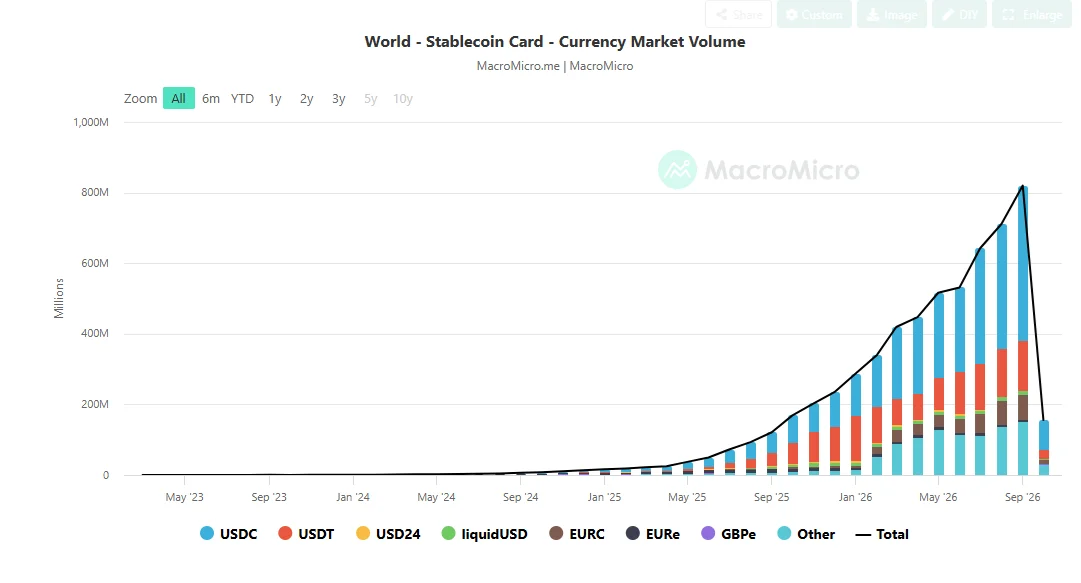
Crypto card payments expanded again in the third quarter, underscoring a steady adoption trend. The increase followed the addition of new assets and growing usage of the two major stablecoins, USDT and USDC.
Total crypto card volume rose 33% quarter over quarter, reaching $4.31B in Q3, up from $3.24B in Q2, according to world stablecoin card volume data. Part of the growth came from Tether's payment network Plasma, which increased its volume by 350%. Stablecoin payments and stablecoin card usage have been expanding since 2024, continuing to grow through broader crypto setbacks and a brief bear market.
TRON, one of the main liquidity venues for USDT, led all chains with 23.2% of quarterly payment volume. Nearly half of card-based stablecoin payments took place on TRON, Base, and BNB Chain combined. Ethereum remains the legacy venue for stablecoin payments, while Solana is broadening adoption with a growing number of user addresses.
Crypto payment cards let users spend stablecoin balances at merchants through ordinary card payments, and what began as a novelty product has since developed into a consumer staple. Henri Stern, who leads Privy, Stripe's crypto and stablecoins unit, recently announced that the platform will expand its stablecoin tools to boost global adoption, per an announcement on X. Growth also came from adoption through Revolut, which expanded its selection with a native euro-based stablecoin, EURR.
USDC drives crypto card expansion
Stablecoin usage shifted following mandatory MiCAR adoption in the EU, as well as under US regulation through the Genius Act, which is still being rolled out in practice. That distinction reaches the checkout, since card spending puts stablecoins directly in front of merchants and consumers. Over the past two years, the regulated stablecoin USDC has started displacing USDT, a shift that is even more clearly visible in card payments. USDT transfers, supply, and ownership remain higher for internal crypto transactions and peer-to-peer payments, but card volumes have grown alongside the adoption of a regulated asset.
USDC retains a circulating supply of around $75B, of which $6.75B is minted on the Solana chain, where adoption for trading and DeFi has been faster. In September, USDC card payments reached a volume of more than $439M, over three times the card usage of USDT.
Payments are becoming an increasingly prominent use case for stablecoins. Adjusted volumes reported more than $54B in stablecoin payments for September, a figure against which the quarter's $4.31B in card volume shows card spending still represents a small slice of overall stablecoin payment activity. Other major use cases include DeFi, DEX routing, and general activity within crypto protocols. USDC is filling the gap left by USDT, which has been divested by brokerages, exchanges, and other financial service providers.
Payment apps boost crypto fundraising
Payments as a use case expanded in 2026, following a period of adapting to the new regulations. That shift was reflected in funding activity, based on Cryptorank's tracking of VC investments. In Q3, payments, exchange, and brokerage companies accounted for 71.6% of VC funding. In total, companies raised $2.26B during the quarter across 127 rounds. Payments and fintech displaced earlier waves of investment in consumer-directed crypto, such as memes and NFTs.
Funding activity declined over the past quarter, with more capital flowing to already established payment ecosystems like Crypto.com. For the past two quarters, payment projects have raised $1B, becoming the second-biggest category in crypto VC funding. Prediction markets ranked first with $2B in funding, though payments may continue to grow based on recent growth in transaction counts and value transfers. Near-term markers for the trend include the continued practical rollout of the Genius Act and the next quarterly readings of the same card volume dataset.
Source: Cryptopolitan

