Crypto ATM Market Statistics 2026: Global Count, Revenue and Regional Share
Key Takeaways
- •The worldwide count of active crypto ATMs fell from 38,928 on March 29 to 27,945 on July 8, 2026, a loss of 10,983 machines.
- •The United States accounted for roughly 93% of the global reduction, dropping from 30,247 to 20,005 machines.
- •Bitcoin Depot, operator of 23.8% of tracked kiosks, filed for Chapter 11 on May 18, 2026, and began winding down a network of about 9,700 machines.
- •The FBI's Internet Crime Complaint Center logged 13,460 crypto kiosk complaints in 2025 with adjusted losses of about $389 million, with complaints rising 23% and losses rising 58% from 2024.
- •Four US states — Indiana, Tennessee, Minnesota and Vermont — enacted crypto ATM bans by June 16, 2026, while Delaware and New Jersey have prohibition bills still in committee.
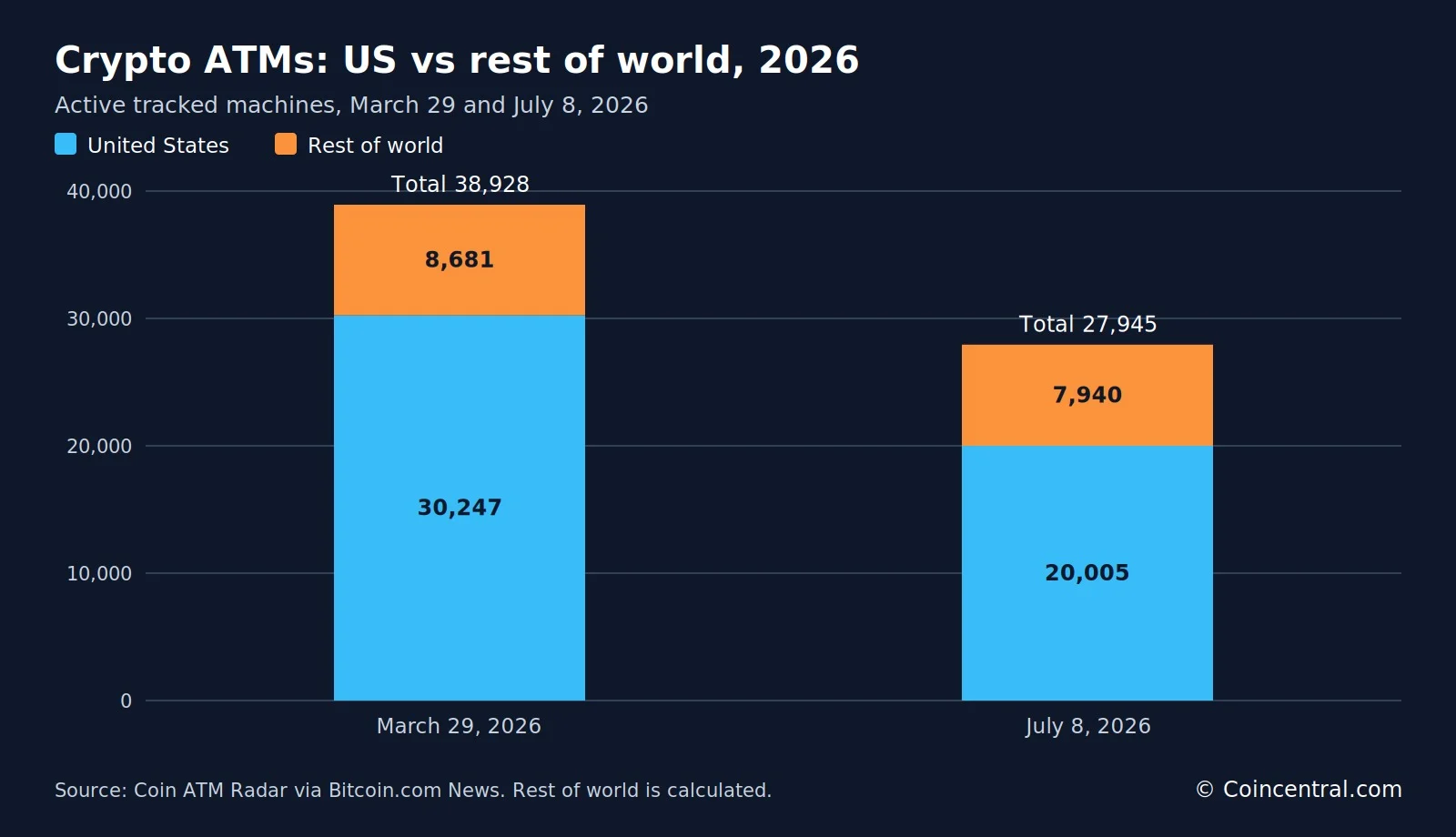
The global crypto ATM network contracted sharply in 2026. Coin ATM Radar counted 27,945 active machines worldwide on July 8, down from 38,928 on March 29, with the United States accounting for nearly all of the decline.
This report covers installation counts, regional share, leading operators, revenue forecasts, fraud losses and state-level bans. The data is drawn from Coin ATM Radar, Fortune Business Insights, the FBI and company filings. Where sources disagree, the snapshot date is stated. For readers new to the sector: a crypto ATM is a physical kiosk where customers buy cryptocurrency with cash and, at a minority of machines, sell holdings back for cash.
Crypto ATM Market Statistics: The Headline Numbers
Six figures sum up the 2026 data, painting a picture of a smaller network, a major operator in bankruptcy and rising fraud losses.
Coin ATM Radar tracked 38,928 machines worldwide on March 29. By July 8 the count had fallen to 27,945, a drop of 10,983. The US count went from 30,247 to 20,005, a loss of 10,242, while machines outside the US fell from 8,681 to 7,940, a decline of 741. Both national and regional figures are derived from the global and US totals in the same data set.
The US therefore lost roughly 93% of the machines removed between the two dates. Finbold, using first-half data, puts the US share of the global reduction at about 96%.
The US share of tracked machines stood at 77.7% on March 29 and about 71.6% on July 8, based on the same data. Finbold reported a similar of 71.5% for June 2026.
The drop is striking against the earlier trend: Coin ATM Radar's monthly reports show the network moving by 2.2% or less in every month before May. The figures count active tracked machines, so any kiosk that stops operating drops out of the total. The data does not indicate whether removed machines were scrapped, relocated or switched off.
How Many Crypto ATMs Are There in 2026?
Coin ATM Radar tracked 27,945 active machines on July 8, 2026. The network stood at 38,708 on May 1, meaning 10,763 kiosks went offline in 68 days.
According to Bitcoin.com News, the largest single monthly change in the Coin ATM Radar series came on June 1, at roughly 10,230 machines. US installations fell from 30,247 to 20,005 over the same window.
Finbold, which used the same data provider for its first-half report, put the global total at 28,322 on June 30, down from 39,158 at the end of 2025 — a fall of 27.7%. The two counts differ because they use different snapshot dates and definitions, but both show a drop of more than 10,000 machines. The gap between the snapshots is small: Coin ATM Radar's July 8 count sits just 377 machines below Finbold's June 30 figure. Measured against the end of 2025, the loss ranges from 10,836 to 11,213 machines.
The trend before 2026 was growth. Fortune Business Insights, citing Coin ATM Radar, says the world had 9 crypto ATMs in 2013 and 500 in 2015. The count reached about 35,100 at the end of 2021 and about 37,700 at the end of 2024. The 2026 fall took the network back below its 2021 level.
The network was still expanding in 2025, rising from about 37,700 machines at the end of 2024 to 39,158 at the end of 2025 — a gain of roughly 1,458 machines, or 3.9%.
Monthly Crypto ATM Openings and Closures
Coin ATM Radar publishes a monthly summary of machines opened and closed. The series below runs from October 2025 to August 2026; June is not included in the data provided.
Closures outnumbered openings in eight of the ten months. The January report describes the change as a decrease, but the listed figures of 955 openings and 655 closures imply a net gain of 300; the table shows the numbers as published.
May stands apart. Some 10,768 machines closed against 553 openings, a net loss of 10,215, or 26.2% of the network. Bitcoin Depot filed for bankruptcy on May 18.
Excluding May, the other nine months saw 6,000 openings and 8,268 closures, with monthly losses ranging from 0.06% to 3.1%.
Openings also slowed. The highest monthly figure was 955 in January and the lowest was 259 in July. Across the ten months, openings averaged about 655 per month, while closures outside May averaged about 919. August closed 1,455 machines against 584 openings, a net loss of 871 machines, or 3.1% — the largest monthly drop outside May.
Bitcoin Price and the ATM Count
Bitcoin started October 2025 at $114,034. By the start of July 2026 it stood at $58,534, a fall of 48.7%.
Machine counts did not follow price in a clear pattern. The network lost 871 machines in August while the price rose 25%, and it gained 205 machines in February while the price fell 16.2%. Price moves of 10% or more occurred in five of the ten months listed: November (-17%), February (-16.2%), April (+11.8%), July (+10.6%) and August (+25%).
Kiosks earn fees on each sale, so trading volume matters as much as price. Fortune puts those fees at 5% to 20%. No volume figures appear in the sources, so the link between price and machine counts cannot be measured here.
Finbold attributed the first-half drop to operator caution during price swings and sector losses near $890 billion, and also pointed to the Bitcoin Depot bankruptcy. NewsBTC urged readers not to read the ATM decline as a sign of lower Bitcoin use, noting the change concerns physical machines rather than online activity.
Crypto ATM Market Share by Country and Region
The United States held 77.7% of tracked machines on March 29, 2026. Canada ranked second with 3,839 machines, a 9.9% share, and Europe was third with 1,727 machines, or 4.4%. Together, these three regions host 35,813 kiosks, or 92% of the global count; Asia, Oceania and other regions split the remaining 8%.
Fortune Business Insights, citing 2024 Coin ATM Radar data, provides detail on smaller markets. Spain led Europe with around 313 machines. Australia grew from 73 machines in 2022 to 1,107 in 2024, while New Zealand went from zero kiosks in 2023 to 157 by the end of 2024. In South America, Colombia had 46 machines, Panama 17, Argentina 13 and Brazil 9.
Finbold reports that Canada, Europe and Australia lost fewer machines than the US in the first half of 2026. The US nonetheless retains the largest share of any country. Fortune cites 30,100 US machines at the end of 2024 and an approximate 88% global share, though that figure does not match the 77.7% March 2026 reading — 30,100 of 37,700 machines would be about 80%. This article uses the Coin ATM Radar share.
Which Operators Lead the Crypto ATM Market?
Bitcoin Depot ran 9,246 machines in March 2026, a 23.8% share of tracked kiosks. Coinflip had 5,493 machines and Athena Bitcoin 4,045. The top ten operators held 30,450 machines, or 78.2%.
That concentration explains why one company's troubles could move the global count. Bitcoin Depot filed for Chapter 11 — the US bankruptcy process that allows a company to restructure its debts under court supervision — on May 18, 2026, and began winding down a network of about 9,700 kiosks; the operator figures above predate the filing. The six operators listed ran 26,051 machines, about 67% of tracked kiosks, while the other four operators in the top ten ran 4,399 machines between them.
Coin ATM Radar also found that 91.6% of March 2026 machines were set up for purchases only, meaning users could buy crypto with cash but not sell it back; two-way machines also accept crypto in exchange for cash. Ethereum was supported at 22,200 locations, Litecoin at 21,292 and Tether at 19,894.
Fortune's revenue split gives a different picture: one-way machines account for 80.94% of modelled 2026 revenue against 91.6% of machines by count. The gap suggests two-way machines earn more per unit.
What Bitcoin Depot's Accounts Showed Before the Filing
Bitcoin Depot reported 2025 revenue of USD 614.85 million, up 7% from 2024. Net income fell to USD 5.12 million from USD 7.81 million.
The fourth quarter was weaker. Revenue fell to USD 116.04 million from USD 136.83 million a year earlier, and the company posted a net loss of USD 24.86 million, which included an USD 18.5 million arbitration accrual.
For 2026, the company guided to a 30% to 40% decline in core-business revenue, citing state regulations and compliance standards. Its Chapter 11 filing puts first-quarter 2026 revenue down about USD 80.7 million, or 49.2%, from the same quarter of 2025. Finbold reported that the bankruptcy followed a security breach and regulatory challenges.
Gross profit rose about 30%, from USD 81.46 million to USD 105.65 million, but the gain did not reach the bottom line: net income fell about 34%, and fourth-quarter revenue was down about 15% from a year earlier.
Crypto ATM Market Size and Revenue Forecasts
Fortune Business Insights values the global crypto ATM market at USD 356.72 million for 2025, projects USD 549.98 million for 2026, and forecasts USD 18,127.56 million by 2034, a CAGR of 54.80%.
This measures vendor revenue from hardware, software and services — not the value of crypto sold through machines. That is why Bitcoin Depot's 2025 revenue of USD 614.85 million exceeds the modelled global market for the same year.
Fortune projects the US market at USD 438.68 million in 2026. One passage in the report states this in billions, but the figure only fits within the North America total of USD 486.06 million when read as millions.
The report also splits the 2026 market by segment. Hardware leads components at 66.34%, one-way machines lead types at 80.94%, Bitcoin leads coin types at 51.52% and restaurants and hospitality lead applications at 36.44%. Each share belongs to a separate split and cannot be added to the others.
The fastest forecast growth lies in two-way machines at 59.70% a year, Litecoin at 58.40% and commercial spaces at 57.90%. Fortune also puts kiosk fees at 5% to 20%, well above online exchange pricing, and has not restated the forecast against the smaller installed base.
Every region is forecast to grow between 54% and 63% in 2026, with Asia Pacific fastest at about 63% and North America slowest at about 54%. The forecast describes vendor revenue, while the 2026 data above describes machine counts — the two do not measure the same thing.
Crypto ATM Fraud Statistics: What the FBI Recorded in 2025
The FBI's Internet Crime Complaint Center logged 13,460 complaints involving crypto kiosks in 2025. Adjusted losses were USD 388,981,267, or about USD 28,900 per complaint. Complaints rose 23% and losses rose 58% from 2024.
People over 50 filed more than half of the complaints and reported losses above USD 302 million. The IC3 notes that some complaints may involve other payment types, so the total is not exclusively kiosk losses.
Florida filed more complaints than Texas — 1,213 against 1,179 — but Texas reported the larger loss total at USD 56.8 million. Losses per complaint differ by state: Texas averaged about USD 48,200 and Florida about USD 27,000. The eight states in the table account for USD 195.6 million, about half of the national total, and 5,575 complaints, roughly 41% of all filings.
The CFTC issued a consumer advisory in August 2026 citing the same FBI figures, warning that kiosk transfers are usually immediate and cannot be reversed.
The FBI numbers cover complaints that reached the agency in 2025, and they cover only the United States, which has held the largest share of tracked machines in every reading cited in this report. They are a count of reports, and the true number of kiosk scams may differ. The IC3 data also shows the age pattern clearly: people over 50 made up more than half of complaints, and their reported losses of over USD 302 million represented about 78% of the total.
Crypto ATM Regulation: The 2026 State Bans
Four states had enacted kiosk bans as of early July 2026. Indiana signed first, on March 9, with Tennessee, Minnesota and Vermont following by June 16. Delaware and New Jersey had prohibition bills in committee with no final vote at that point.
At city level, Spokane in Washington, plus Stillwater and St. Paul in Minnesota, restrict or bar the machines.
New Jersey also ranks fifth in the FBI table, with USD 17.9 million in losses; Delaware does not appear in the top eight. About 185 machines operated in Tennessee before its ban took effect, and Minnesota's law requires full removal by 2027. The bans use different tools, ranging from criminal penalties in Tennessee to voided registrations in Vermont. Tennessee also appears in the FBI table, with 348 complaints and USD 15.0 million in losses. The pending bills in Delaware and New Jersey, along with Minnesota's 2027 removal deadline, are the regulatory items to watch next.
What the 2026 Crypto ATM Data Shows
Three figures frame the year. Tracked machines fell from 38,928 on March 29 to 27,945 on July 8. The operator holding 23.8% of them filed for Chapter 11 in the middle of that window. The FBI also recorded USD 388,981,267 in 2025 kiosk losses, four states have enacted bans, and two more have bills waiting.
Two kinds of data tell different stories: machine counts point to a shrinking physical network, while the Fortune forecast points to fast revenue growth. They measure different things.
Finbold attributes about 96% of the first-half reduction to the US, which lost 10,380 machines, or 33.9%, and still held about 71.5% of active machines in June. The monthly series shows the decline continued after May, with 328 net closures in July and 871 in August. Later reports will show whether the pace keeps slowing or picks up again.
Sources
- Coin ATM Radar, global crypto ATM counts and monthly market dynamics
- Bitcoin.com News, Coin ATM Radar data on installations, operators and state bans (July 8, 2026)
- Finbold, Global Bitcoin ATMs drop 28% in H1 2026 (July 2, 2026)
- NewsBTC, US Accounts for 96% of Global Bitcoin ATM Reductions in First Half of 2026 (July 3, 2026)
- Fortune Business Insights, Crypto ATM Market Size, Share and Industry Analysis, 2026 to 2034
- FBI Internet Crime Complaint Center, cryptocurrency kiosk complaint data, PSA I-051526-PSA
- Bitcoin Depot Inc., Form 8-K Exhibit 99.1, filed March 16, 2026
- Commodity Futures Trading Commission, consumer advisory on crypto kiosks (August 2026)
- Duane Morris Government Strategies, Indiana kiosk ban signing (March 2026)

