Crude Oil Falls More Than 9% as U.S.-Iran Diplomacy Eases Supply Fears
Key Takeaways
- •Brent crude fell more than 9% over two trading sessions, and U.S. West Texas Intermediate dropped to its weakest level since mid-July.
- •President Donald Trump said he was temporarily suspending U.S. military operations against Iran to allow negotiations to continue.
- •Iran suspended planned retaliatory actions, while Iranian and Omani representatives continued talks on restoring safe passage through the Strait of Hormuz.
- •Maritime traffic through the Strait of Hormuz remains far below normal, with fewer than 10 commercial cargo vessels crossing per day over the weekend.
- •Analysts said oil prices are likely to remain volatile until a formal agreement is reached, because the current pause in tensions remains fragile.
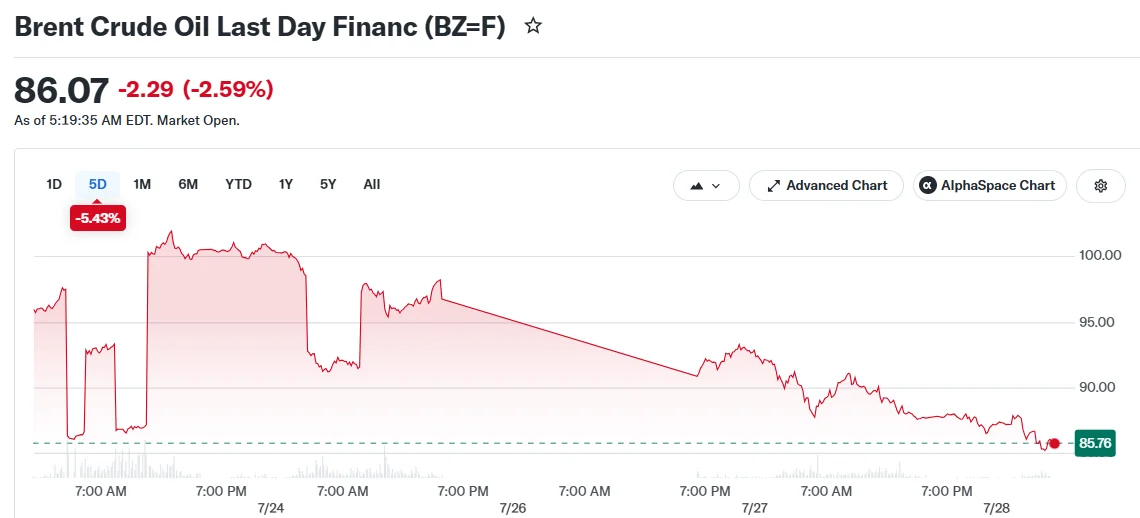
Crude oil prices fell sharply as optimism grew around possible diplomatic progress between Washington and Tehran, easing concerns about a prolonged disruption to Middle East supply.
Brent crude dropped more than 9% over two trading sessions, easing from levels above $100 per barrel last week to about $87.24 by Tuesday. U.S. West Texas Intermediate also posted steep losses, closing at $82.61 on Monday, its weakest level since mid-July.
The selloff gathered pace after President Donald Trump said over the weekend that he was temporarily suspending U.S. military operations against Iran to allow room for negotiations.
Speaking on Monday, Trump described the talks with Iran as “good talks” and said there was “a good chance that something could happen.” He also warned that “strong military action” would follow if diplomacy failed.
Iran and Oman are drafting the deal to reopen the Strait of Hormuz, and Tehran wants a peace agreement before the U.S. midterms. -Per the WSJ, the two countries huddled through the weekend into Monday on an arrangement for safe passage through the strait, the narrow fix… pic.twitter.com/NvP5N4Gx1C — Mario Nawfal (@MarioNawfal) July 28, 2026
Iran and Oman are drafting the deal to reopen the Strait of Hormuz, and Tehran wants a peace agreement before the U.S. midterms.
-Per the WSJ, the two countries huddled through the weekend into Monday on an arrangement for safe passage through the strait, the narrow fix… pic.twitter.com/NvP5N4Gx1C
— Mario Nawfal (@MarioNawfal) July 28, 2026
Tehran responded to Washington’s pause by suspending its own planned retaliatory actions. Intelligence reports also indicate that Chinese officials have been involved in quiet efforts to help restore communication between the two sides.
Strait of Hormuz traffic remains heavily restricted
Despite the improved tone in markets, physical oil flows through key maritime chokepoints remain far below normal, limiting how quickly prices can reflect diplomacy alone.
Maritime tracking data from Kpler showed that fewer than 10 commercial cargo vessels crossed the Strait of Hormuz each day over the weekend. Analysts estimate that current flows have fallen to roughly 15% of pre-conflict levels, down sharply from the usual throughput of about 20 million barrels a day.
“A political pause doesn’t put a single extra barrel on the water right here and now,” said Ole Hvalbye, market analyst at SEB Research.
Shipping through the Bab el-Mandeb strait also remains constrained after Houthi militia attacks on Saudi petroleum facilities along Red Sea routes, forcing shipping companies to take longer and more expensive alternative paths.
Iranian and Omani representatives are continuing negotiations aimed at restoring normal shipping through the Strait of Hormuz, a waterway that typically carries about one-fifth of global petroleum transport.
Analysts warn against overreading the ceasefire pause
Energy market specialists said prices are likely to remain volatile until a formal agreement is reached, rather than a temporary halt in fighting.
“The market seems to be forever seeking good news from an arena that really is not providing any,” said PVM analyst John Evans. He added that oil futures would fall further only if high prices weaken demand, not because of “questionable mini-ceasefires.”
IG senior market analyst Tony Sycamore said the latest decline reflects growing market confidence in a possible resolution, but stressed that the current pause remains highly fragile.
If negotiations break down, or if renewed attacks target Saudi export infrastructure, the geopolitical risk premium built into crude prices could quickly return.
In a separate development, Kazakhstan’s main petroleum export terminal at the Caspian Pipeline Consortium restarted loading after disruptions caused by Ukrainian drone strikes, easing some immediate supply pressure.

