Costa Rica's Crucitas Gold Project Puts Anti-Mining Policy to the Test
Key Takeaways
- •President Fernández placed Bill 24.717 on the Legislative Assembly's extraordinary-session agenda just four days after her May 8 inauguration, making the Crucitas reopening a flagship initiative of her new government.
- •The bill would authorize gold exploration and mining solely within the 84,800-hectare Cutris de San Carlos district while maintaining Costa Rica's nationwide prohibition on open-pit metal mining everywhere else.
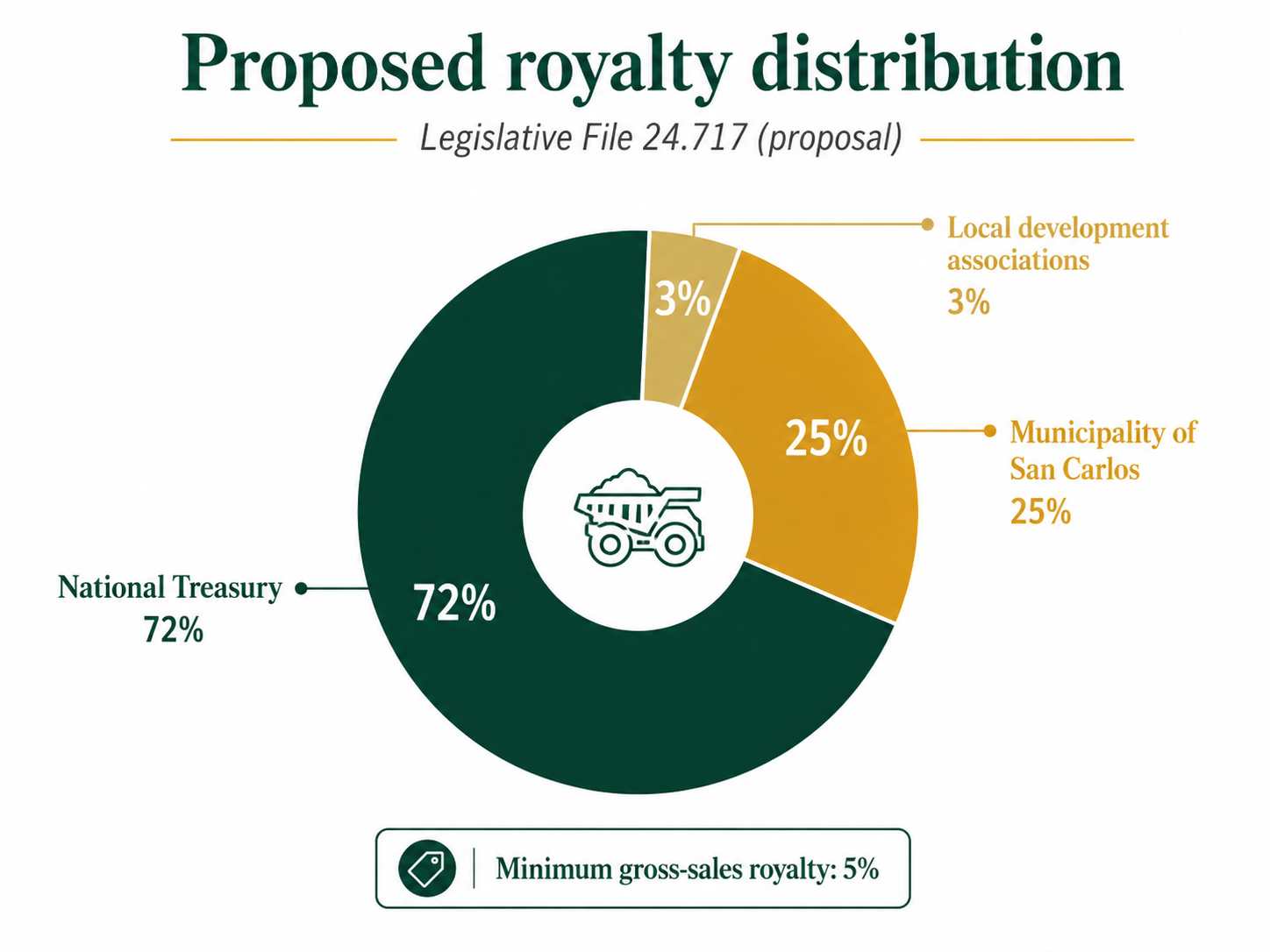
- •The proposed legislation establishes a minimum 5% royalty on gross mineral sales, with more than 70% of revenue directed to the central government and smaller allocations for municipalities and local development associations.
- •An international tribunal ruled in Costa Rica's favor against Infinito Gold in 2021, and the company abandoned its appeal in 2024, removing a major legal uncertainty that had hung over the Crucitas project.
- •President Fernández has indicated she may pursue a national referendum if the legislature rejects the bill, creating potential leverage over undecided lawmakers and a fallback path around legislative gridlock.
Costa Rican President Laura Fernández has made the proposed reopening of the Crucitas gold deposit a centerpiece of her new administration's agenda, putting one of Latin America's most robust anti-mining frameworks to the test and reigniting a national debate over whether mineral resource development can coexist with the country's conservation-focused identity.
Fernández, inaugurated on May 8 after securing a first-round victory in February's presidential election, acted swiftly to advance Bill 24.717 by placing it on the Legislative Assembly's extraordinary-session agenda just four days after taking office (Presidency of Costa Rica).
The legislation would authorize gold exploration and mining exclusively within the 84,800-hectare district of Cutris de San Carlos, where the Crucitas deposit is located, while maintaining Costa Rica's nationwide prohibition on open-pit metal mining everywhere else.
The initiative represents a striking policy shift for a nation that has built its international standing on conservation, ecotourism, and sustainable development. Costa Rica has constitutionally protected more than a quarter of its national territory through parks, reserves, and wildlife refuges, and ecotourism ranks among its leading sources of foreign exchange. Government officials contend that the existing ban has not halted mining activity at Crucitas. Instead, it has enabled illegal operators to expand their presence, frequently using mercury and cyanide without any environmental oversight.
Juan Ignacio Guzmán, CEO of GEM Mining Consulting, noted that the debate is increasingly focused on governance rather than mining per se. He pointed out that Costa Rica already sustains an active non-metallic mining sector that supplies aggregates, limestone, silica, and other industrial materials for construction and infrastructure.
Eduardo Zamanillo and Marta Rivera, analysts at Geopolitical Mining, argue that Crucitas exemplifies a wider phenomenon they term "anomic mining" — situations where formal mining regulations technically remain in force but no longer reflect what is actually occurring on the ground. In their assessment, the central question is not whether mining should coexist with conservation, but whether the state can manage mineral extraction more effectively than the illegal networks already operating in the region.
Legislative Framework and Concession Design
The proposed bill would allocate mining concessions through public auctions managed by the Directorate of Geology and Mines, which operates under the Ministry of Environment and Energy. Qualifying companies would need to demonstrate technical expertise, financial capacity, and a satisfactory environmental record before being eligible to bid.
The legislation also establishes a minimum 5% royalty on gross mineral sales. Under the proposed revenue-sharing structure, more than 70% of proceeds would flow to the central government, with municipalities and local development associations receiving smaller allocations.
Juan Carlos Guajardo, executive director of mining consultancy Plusmining, said the government's argument that regulated mining could reduce environmental harm is plausible but far from certain. Formal mining operations can operate under substantially higher environmental standards than illegal miners, employing engineered tailings facilities, water-management systems, chemical controls, and legally enforceable closure plans.
However, he cautioned that successfully displacing illegal mining demands broader measures, including territorial control, enforcement against criminal networks, gold traceability systems, and alternative economic opportunities for communities currently reliant on informal mining.
"The challenge is not simply replacing illegal mining with legal mining," Guajardo said. "The deeper question is whether Costa Rica can transform an environmental liability that contradicts its development model into an opportunity to generate economic value, restore damaged ecosystems and reinforce its sustainability credentials."
Political Battle and Legislative Hurdles
Despite the administration's determined push, the bill remains far from enactment. It has already cleared committee review and received an endorsement from the Special Committee of Alajuela in September 2025. It now stands before the legislative plenary, where opposition lawmakers have filed hundreds of delaying motions.
Opposition to the measure remains intense. Members of the left-wing Frente Amplio party and factions within the Partido Liberación Nacional contend that resuming open-pit mining would threaten sensitive ecosystems and erode decades of environmental policy achievements. Environmental organizations have similarly mobilized against the proposal.
The debate is further complicated by the legacy of Canadian miner Infinito Gold. The company's concession was annulled by Costa Rica's courts in 2010 — the same year legislators voted to ban new open-pit metal mining. Infinito subsequently pursued international arbitration against the state (Mining.com).
That dispute concluded in Costa Rica's favor when an international tribunal declined to award Infinito damages in 2021. The company abandoned its effort to annul the ruling in 2024, eliminating a major legal uncertainty surrounding the project. Officials now regard the outcome as an opportunity to reconsider development of the deposit under a new regulatory framework.
Zamanillo and Rivera said the Infinito dispute demonstrates that mining risk extends well beyond permits and contracts. A project can meet all legal requirements yet still become politically and socially untenable if public opinion, courts, or governments change direction. The case also underscored how international investment treaties, such as the Dominican Republic-Central America Free Trade Agreement (DR-CAFTA) under which Infinito filed its claim, can subject sovereign environmental decisions to binding arbitration before international tribunals.
Fernández has indicated she may pursue a national referendum if lawmakers reject the bill. The prospect of a public vote serves a dual purpose: a potential pathway around legislative gridlock and a source of leverage over undecided legislators. The administration believes its messaging on employment, local economic development, public security, and illegal mining will resonate with voters.
Investment Implications
For mining investors, the proposal's significance reaches well beyond the Crucitas deposit itself. Costa Rica has long been regarded as one of the least accessible jurisdictions for metallic mining in Latin America. The government's willingness to reconsider its longstanding prohibition signals that the country may be open to resource investment under tightly controlled conditions.
Guzmán noted that Crucitas is significant by Costa Rican standards but remains modest when compared with many of Latin America's largest undeveloped gold projects. Guajardo concurred, characterizing Crucitas as a mid-sized gold project rather than a world-class discovery on the scale of major Andean deposits.
Nevertheless, he said the project could draw serious industry interest if legal barriers are removed. Earlier studies found the deposit economically viable when gold prices were trading in the $1,000–$1,300 range, compared with today's approximately $4,000-per-ounce levels, suggesting the asset could become attractive once again under the right regulatory conditions.
Guajardo said major mining companies would likely apply a substantial political and ESG discount to any valuation of Crucitas, given its history of litigation, environmental controversy, reputational damage, and ongoing illegal mining activity. While junior and mid-tier producers might express interest, many larger operators would probably demand stronger legal and security assurances before committing.
Zamanillo and Rivera said passage of Bill 24.717 would likely be interpreted as a meaningful signal that Costa Rica is prepared to reopen the mining discussion. However, they warned that legislative approval by itself would not materially alter perceptions of regulatory risk.
Guzmán similarly believes the project's greatest challenge lies in governance, not geology.
"The key question is whether the government can secure the area, reduce illegal mining, enforce environmental standards and identify an operator capable of financing long-term compliance and remediation," he said.
Costa Rica's environmental sensitivity ensures that any future project would face intense scrutiny.
"Companies would not evaluate Crucitas like a conventional project in Peru, Ecuador or Chile," Guzmán said. "They would price in constitutional risk, litigation risk, security concerns, environmental liabilities and the possibility of future policy reversals."
Guajardo also raised questions about whether the proposed concession auction — which emphasizes royalty bids — would attract the most qualified operators. He cautioned that while politically appealing, systems focused primarily on maximizing royalties can favor aggressive bidders with optimistic projections over technically capable firms with strong environmental and social track records.
"In a project as sensitive as Crucitas, technical competence, environmental performance, financial strength, mine-closure capacity and understanding of Costa Rica's institutional realities should carry at least as much weight as the economic offer," he said.
Environmental and Regional Context
The broader debate mirrors a challenge confronting governments across the Americas as they seek to balance resource development, environmental protection, and economic growth. The Interpol-coordinated Operation Mercury in Peru's Madre de Dios region demonstrated that sustained military and police presence, combined with alternative livelihood programs, can reduce — though not eliminate — illegal gold mining, offering a cautionary reference point for Costa Rican policymakers weighing similar enforcement strategies.
Guzmán argued that legalizing mining alone is unlikely to eliminate illegal activity. Citing examples from Peru and Colombia, he noted that illegal operators frequently relocate unless governments simultaneously strengthen enforcement and improve gold traceability systems (Mining.com).
Guajardo of Plusmining believes the environmental threshold for public acceptance will be exceptionally high. He argued that a future concessionaire may need to help finance restoration of areas already damaged by illegal mining to establish credibility with the public.
"The company that eventually develops Crucitas may need to act not only as a mining operator, but also as an agent of environmental restoration, institutional rebuilding and public trust," Guajardo said.
Zamanillo and Rivera caution that Costa Rica's greatest reputational risk may stem not from formal mining itself, but from a failure to rein in an illegal mining economy that continues to damage forests, waterways, and local communities beyond regulatory oversight. They argue the government must draw a clear distinction between accountable, regulated mining and what they describe as anomic extraction if it hopes to safeguard the country's conservation credentials.
Whether Bill 24.717 succeeds or fails, Fernández has already reshaped the national conversation. The debate now extends well beyond a single gold project. It has become a test of whether Costa Rica can reassert environmental and institutional control over territory already affected by illegal mining while preserving the conservation-focused identity that underpins much of its international standing.
If the approach succeeds, Crucitas could serve as a model for how governments address environmentally destructive illegal extraction through formal regulation, enforcement, and remediation. If it falls short, critics argue it could reinforce the view that mining and conservation-led development remain fundamentally incompatible.
The outcome is likely to influence not only the future of Crucitas, but also how investors evaluate Costa Rica's long-term regulatory credibility and political risk profile.

