Everyday Expenses Outpace CPI as Final Demand PPI Rises Much Faster, Econbrowser Finds
Key Takeaways
- •The AIER Everyday Price Index confirms that frequently purchased goods and services have grown more expensive faster than the headline CPI since February 2026.
- •Consumer price indexes carry distinct policy roles: the CPI for wage earners and clerical workers has historically anchored Social Security cost-of-living adjustments, while the chained CPI has been used to index federal income tax brackets since 2018.
- •Measured real hourly earnings for production and nonsupervisory workers differ depending on which of the five cost-of-living gauges is used as the deflator.
- •The final demand Producer Price Index is rising much faster than the CPI, with fuels and related products driving the upward movement in producer prices.
- •The author anticipates that the PPI will lead the CPI, and subsequent monthly BLS releases of both indexes will show whether the gap between them widens or narrows.
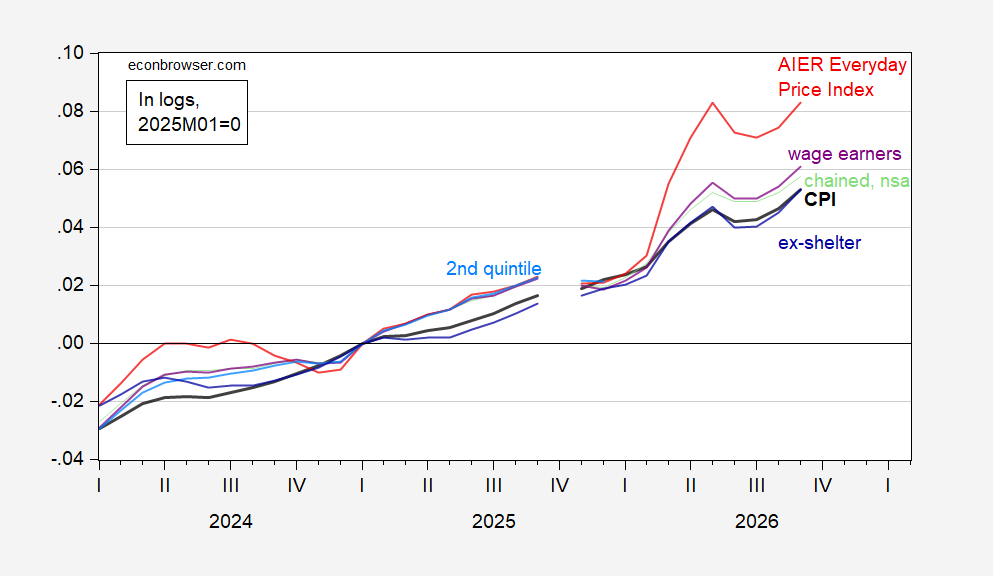
An analysis published on Econbrowser on October 15, 2026, examines a range of consumer price indicators and finds that the cost of everyday expenses has been rising faster than the headline Consumer Price Index (CPI) since February 2026, while prices at the producer level have been climbing considerably faster.
The post draws on data from the Bureau of Labor Statistics (BLS) and the American Institute for Economic Research (AIER), together with the author's own calculations, and presents three sets of comparisons covering cost-of-living gauges, inflation-adjusted wages, and producer prices.
Multiple Consumer Price Gauges
Figure 1: CPI – all urban (black), CPI wage earners and clerical workers (purple), chained CPI (light green), CPI ex-shelter (blue), AIER Everyday Price Index (red), all in logs, 2025M01=0. Source: BLS, AIER, and author's calculations.
The first figure tracks five consumer price measures on a logarithmic scale, indexed to January 2025: the CPI for all urban consumers; a companion CPI covering wage earners and clerical workers; the chained CPI, which adjusts for consumers substituting between items as relative prices shift; CPI excluding shelter; and AIER's Everyday Price Index (EPI).
According to the author, anyone who feels that everyday expenses have been rising faster than the CPI since February will find that impression confirmed by the EPI. The AIER index is designed to capture prices for goods and services that households purchase on a frequent, recurring basis, in contrast to less regular expenditures such as major appliances or vehicles.
The distinctions among these gauges are not merely academic: the wage-earners-and-clerical-workers index has historically served as the basis for Social Security cost-of-living adjustments, while the chained CPI has been used to index federal income tax brackets since 2018. CPI excluding shelter, meanwhile, strips out the category that accounts for roughly a third of the headline index, isolating the price path of non-housing items.
Real Wages Under Different Deflators
Figure 2: Average hourly earnings for production and nonsupervisory workers deflated by CPI – all urban (black), CPI wage earners and clerical workers (purple), chained CPI (light green), CPI ex-shelter (blue), AIER Everyday Price Index (red), all in 2025$. Source: BLS, AIER, and author's calculations.
The second figure shows average hourly earnings for production and nonsupervisory workers — a widely followed BLS series often used as a proxy for the pay of rank-and-file employees — deflated by each of the five price measures and expressed in 2025 dollars. The comparison illustrates how measured real hourly earnings differ depending on which cost-of-living gauge is applied. Because benefit formulas and contract escalators are often tied to specific indexes, the choice of deflator can affect how pay growth measures up against living costs.
Producer Prices Rising Much Faster Than CPI
Figure 3: CPI (blue), final demand PPI (red), both in logs, 2026M02=0. Source: BLS.
The third figure compares the CPI with the final demand Producer Price Index (PPI), both on a logarithmic scale indexed to February 2026. The author notes that final demand PPI is rising much faster than the CPI. The final demand PPI measures prices received by domestic producers for goods, services, and construction sold as final output, and is commonly watched as an upstream gauge of cost pressures in the economy.
With "fuels and related products" leading the upward movement in producer prices, the author writes, "I think we can be relatively assured that PPI will be leading CPI" (see this post). Subsequent monthly BLS releases of both indexes will show whether the gap between them widened or narrowed.

