Cosmax R&D Head: A Cosmetics ODM's Role Is 'Creating What's Not Out There Yet'
Key Takeaways
- •Cosmax develops products for roughly 5,000 beauty brands worldwide and works as an ODM rather than an OEM.
- •Woo Young-hwa said gel-type formulas, including products that change texture on contact with skin, are one of the company’s main development areas.
- •The company is also working on an ultra-thin, high-adherence gel for lip products that aims to last longer without drying the lips.
- •Cosmax sees growing potential for hybrid products that combine makeup and skincare benefits in items such as foundation, lipstick and primer.
- •Woo said AI is increasingly being used to analyze consumer reviews, trends and formulation data, while demand for Korean-made formulas is rising in North America, Indonesia and Thailand.
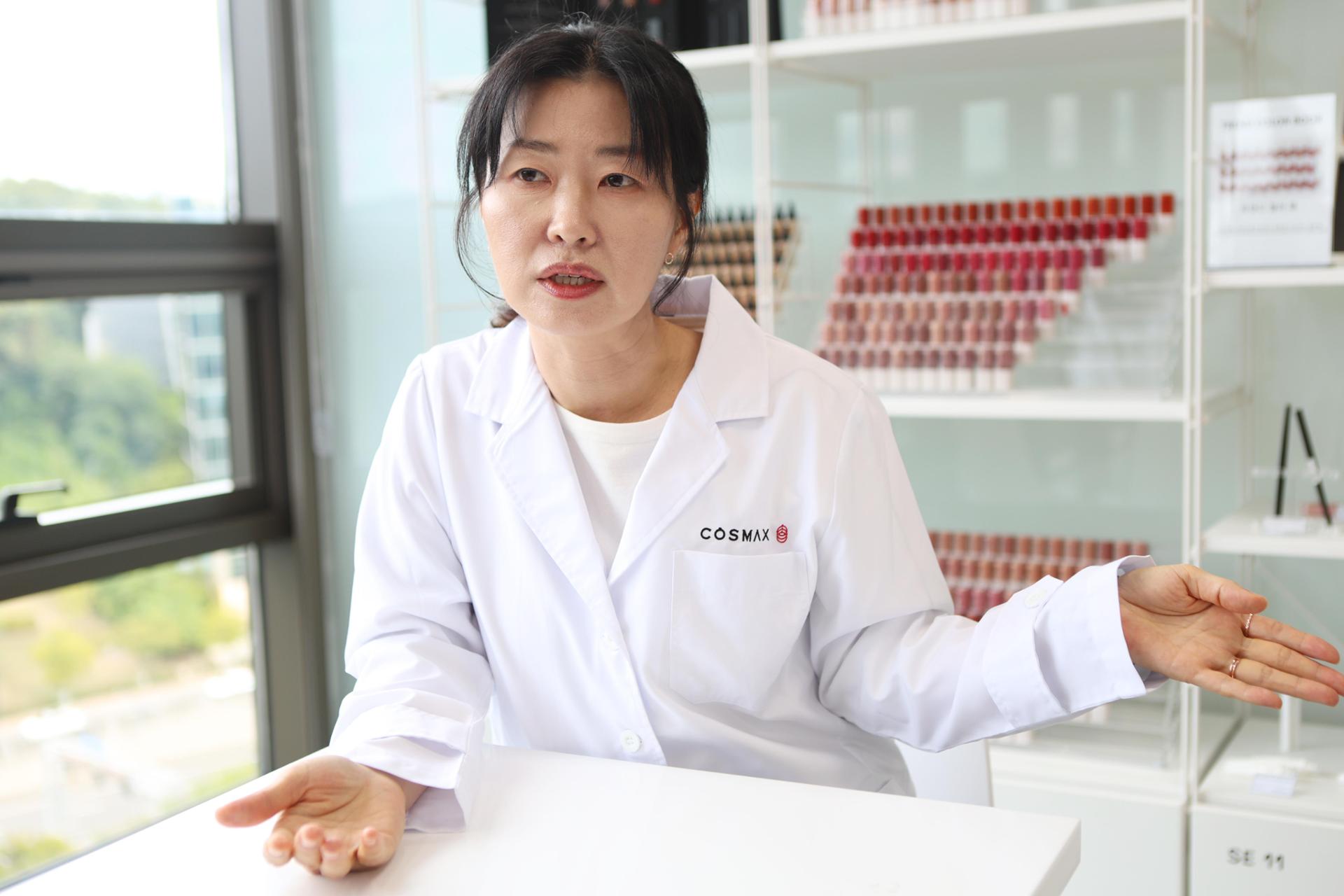
SEONGNAM, Gyeonggi Province — Cosmax, one of Korea’s largest beauty original development manufacturing (ODM) companies, develops products for some 5,000 beauty brands worldwide, a scale that obliges it to stay ahead of market trends. Working with clients that range from major European labels to emerging boutique brands, the company aims not simply to follow demand but to help shape the next beauty trend. Unlike an original equipment manufacturer (OEM), which produces goods to a client’s exact specifications, an ODM handles the research and formulation itself — meaning products developed in labs like Cosmax’s often reach shelves under a client’s brand name, with the supplier invisible to the shopper.
At its research center in Seongnam, Gyeonggi Province, the company is working on what it hopes will be the next market breakthroughs. While many basic consumer needs and desires are relatively obvious, the paths to providing those solutions can be creative and innovative. Woo Young-hwa, director of the Cosmax Makeup R&D Center, said in an interview with The Korea Times on Aug. 13 that three technologies currently under development could emerge as major trends in the global beauty industry.
Gel-type formulas are one of the technologies Cosmax sees as potentially reshaping product lines. After introducing a gelatinous lipstick this summer that leaves little residue after use, Woo is now focusing on developing formulas that change texture or form upon contact with the skin.
The second technique Woo highlighted is an ultra-thin, high-adherence gel that spreads evenly into a thin coat and works particularly well for lip products. This allows for lipstick that does not wear off or dry the lips while maintaining lasting pigmentation.
Woo’s third prospect is combining makeup and skincare into a single product. She believes it will not be long before consumers see foundation, lipstick and primer loaded with moisturizing and other skin-conditioning effects.
“In the past, makeup technology focused on maximizing a single feature, such as color payoff, longevity or texture,” Woo said in the interview at the company’s research center. “Today, products are expected to be lightweight and comfortable while lasting longer and offering benefits for the skin. Bringing all of these conflicting qualities together in a single formula has become a key challenge for the industry.”
These preemptive efforts to figure out what will trend ahead of a product launch are essential for an ODM like Cosmax. Since its establishment in 2014, the company has seen client demands evolve from simple production orders to requests for products that do not yet exist in the market. That shift mirrors the broader arc of Korea’s beauty suppliers, which have moved from behind-the-scenes production to the center of product innovation as K-beauty’s global expansion pressed brands to refresh lineups faster than in-house labs alone could manage. The same model has lowered the barrier to entry for smaller players, letting boutique brands field full product lines built on an ODM’s research rather than their own.
“An ODM’s job in the past was simple: developing the specific product they wanted. As time went by, we were asked to make what’s not out there yet, something unique. Now, our mission’s difficulty has gone up another notch to ‘find out what consumers will want,’” Woo said.
“Global brands are now shortening their product development cycles because they must gauge consumer responses online and turn them into products quickly. The future competitiveness of ODMs will go beyond how well they manufacture products. They will be required to anticipate the market ahead of their customers and proactively propose new products.”
To stay ahead of the trends, Cosmax analyzes vast amounts of data ranging from consumer reviews and market trends to ingredient performance, usability and production conditions. Woo said such analysis relied largely on researchers’ experience in the past but is increasingly being handled by artificial intelligence (AI). She added that data analysis is particularly important in makeup development, where preferences for skin tones and colors vary widely across clients, regions and ethnic groups.
“In Japan, we’re building a new ODM model in which AI analyzes written orders from clients, prescribes cosmetic formulas and collects feedback from consumers,” she said. “An ODM’s work will eventually be connected via a singular data cycle.”
“Makeup ODM doesn’t end in producing cosmetic contents. It also involves developing applicators, packaging and devices to help consumers use our formulas more easily. PYXOH, our device that made hair dying easy and satisfying, is one example.”
While client lists for ODMs strictly remain confidential, Woo hinted that Cosmax’s clients are rapidly rising across North America, Indonesia and Thailand — markets where demand for Korean-made formulas has grown alongside K-beauty’s overseas expansion.
Source: The Korea Times

