Bitcoin Bulls Defend Key Support as Corporate Strategies Diverge
Key Takeaways
- •Bitcoin maintained its support cluster near $64,200 on August 11, combining the 50-day SMA at approximately $63,330 and the 0.236 Fibonacci retracement around $63,650, though overhead resistance from falling longer-term moving averages persists.
- •Strategy has begun selling small portions of its Bitcoin treasury holdings, a shift from its long-standing accumulation approach that economist Peter Schiff cited as evidence of eroding institutional confidence.
- •Trump Media & Technology Group sold roughly $159.6 million in bitcoin-related equity securities and redirected the proceeds into direct Bitcoin holdings, accumulating approximately 14,139 BTC with a fair value of about $890.5 million by July 31.
- •Peter Schiff argued that Bitcoin's recent performance diverges inversely from gold's rally, labeling the cryptocurrency 'anti-gold' and predicting further metal strength would pressure BTC.
- •Updated FASB accounting rules effective for fiscal years beginning after December 15, 2024, require companies to measure certain crypto assets at fair value, giving corporate holders clearer visibility into realized gains and losses when adjusting positions.
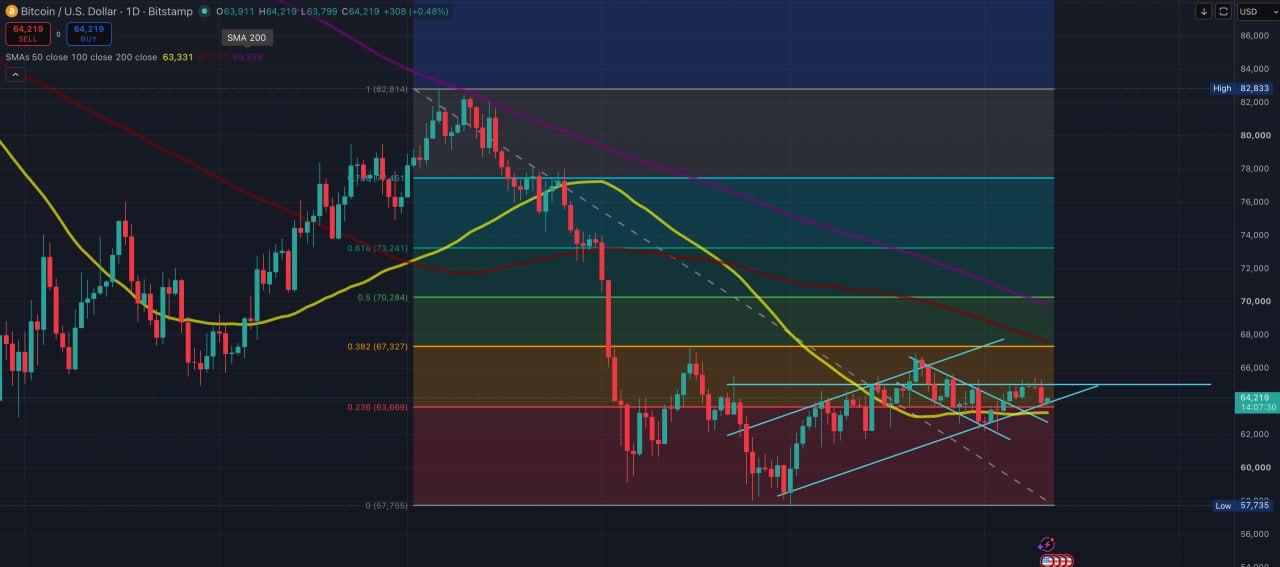
Bitcoin traded near $64,200 on August 11, holding above a support zone that has sustained its late-June recovery. The immediate challenge for buyers is the $65,000 level, where recent attempts to extend gains have stalled.
Beyond price action, the corporate Bitcoin landscape is growing more fragmented. Since the first major treasury allocations began in 2020, corporate Bitcoin holdings have expanded into a meaningful segment of market demand, making shifts in how these holders manage their positions relevant beyond any single company. Strategy has begun selling small portions of its treasury holdings, providing economist Peter Schiff with fresh ammunition for his argument that institutional confidence in Bitcoin is eroding. Trump Media & Technology Group, by contrast, has shifted part of its bitcoin-linked exposure directly into BTC.
Bitcoin's Support Cluster Holds Firm
The support zone combines several technical markers: the 50-day simple moving average near $63,330, the 0.236 Fibonacci retracement around $63,650, and the lower boundary of Bitcoin's short-term ascending channel.
Repeated tests have yet to produce a sustained breakdown, preserving the series of higher lows established since the late-June bottom. Technical headwinds persist above, however. The 50-day SMA continues to slope downward, while the falling 100-day and 200-day moving averages remain overhead.
A decisive break above $65,000 would pull Bitcoin out of its recent compression and bring the 0.382 Fibonacci retracement near $67,300 into focus. If the support cluster breaks first, both the ascending channel and the higher-low sequence would come under pressure.
Schiff Cites Strategy's Sales in Latest Bitcoin Critique
Peter Schiff has been interpreting Bitcoin's recent weakness through its relationship with gold. In an August 10 post, he argued that Bitcoin declined when gold initially broke out, recovered during gold's correction, and resumed falling once gold began rallying again. He labeled Bitcoin "anti-gold" and predicted that further strength in the metal would pressure BTC.
The comparison draws on a long-running debate: both Bitcoin and gold are frequently positioned by their respective proponents as alternative stores of value outside the traditional fiat system, which is why divergences between the two attract attention from investors in both camps. The recent divergence supports Schiff's narrative, though it does not confirm a lasting inverse correlation between the two assets.
In a separate post, Schiff pointed to Strategy's recent Bitcoin sales, claiming the company was shifting back toward dollars because lenders preferred fiat collateral.
Strategy's transactions have undeniably shifted the conversation. After years defined by accumulation, the company demonstrated that Bitcoin holdings can be liquidated when management identifies an alternative use for the capital. This is also occurring against the backdrop of updated accounting standards: under FASB rules that took effect for fiscal years beginning after December 15, 2024, companies measure certain crypto assets at fair value rather than the previous cost-less-impairment model, giving corporate holders greater visibility into realized gains and losses when they adjust positions. However, one company's treasury decisions are insufficient to signal a broader corporate retreat.
Trump Media Moves Toward Direct Bitcoin Holdings
Trump Media & Technology Group took nearly the opposite approach in July. According to its latest SEC filing, the company sold approximately $159.6 million in bitcoin-related equity securities and used the proceeds to purchase Bitcoin directly.
By July 31, Trump Media held roughly 14,139 BTC, including pledged coins, with a fair value of approximately $890.5 million based on a Bitcoin price of $62,982.
The key development is the change in exposure type. Trump Media did not simply add another bitcoin-linked security — it divested indirect exposure and redirected the proceeds into the underlying asset. While the full $159.6 million does not necessarily represent entirely new Bitcoin risk, the move signals a clear preference for direct holdings.
The political dimensions add to the significance. Trump Media operates Truth Social and remains closely associated with current U.S. President Donald Trump. Its treasury decisions are independent of White House policy. Even so, it is a notable market feature that a public company so closely tied to the sitting president holds more than 14,000 BTC at the same time that one of Bitcoin's most vocal critics is arguing corporate conviction is fading.
Corporate Bitcoin Strategies No Longer Move in Lockstep
Strategy and Trump Media illustrate how substantially the corporate Bitcoin landscape has evolved. Strategy is managing its massive treasury actively enough to sell small portions for other balance-sheet objectives. Trump Media has moved in the opposite direction with part of its portfolio, replacing bitcoin-related securities with Bitcoin itself.
Neither move serves as definitive proof that institutions are collectively accumulating or abandoning BTC. Instead, they reflect a market in which corporate holders are beginning to deploy Bitcoin in different ways based on their individual financing and treasury requirements. Whether other public companies with Bitcoin on their balance sheets follow either pattern, or chart distinct paths of their own, will help clarify whether these moves represent isolated treasury decisions or the early stages of a broader shift in how corporates manage digital-asset exposure.
This makes Schiff's sweeping conclusion difficult to sustain based on Strategy alone. Corporate Bitcoin exposure is no longer a straightforward accumulation narrative, but it is not vanishing either.
Bitcoin's chart occupies a similar position to that debate: support remains intact, but buyers have not yet done enough to resolve the question.
Disclaimer: This article is for informational purposes only and does not constitute financial or investment advice. Cryptocurrency markets are highly volatile, and readers should conduct their own research before making any investment decisions.

