CoreWeave Insiders Sell $3.3 Billion in Stock as Shares Rebound and Jefferies Stays Bullish
Key Takeaways
- •CoreWeave's three co-founders have sold approximately $3.3 billion in shares since the IPO, with insiders executing 48 sale transactions over the past three months and offloading more than 55 million shares in the last year.
- •The stock rebounded 5.94% to close at $69.69 on Oct. 15 after earlier losses, but a head-and-shoulders formation leaves it exposed to a possible decline toward a conditional $50 target if confirmed.
- •CoreWeave's revenue backlog exceeded $104 billion in the second quarter, driven by deals with Meta Platforms, Microsoft, Jane, and OpenAI, while analysts project revenue rising 150% to $12.8 billion this year.
- •The company plans to spend more than $39 billion on infrastructure this year, largely funded through borrowing, with its bonds yielding over 15% and Gartner warning of potential write-downs as GPUs depreciate.
- •Nvidia has continued buying while insiders sold, holding 47.2 million shares worth over $3.2 billion as the second-largest holder behind Magnetar Financial, and Jefferies raised its price target, calling the share decline a gift.
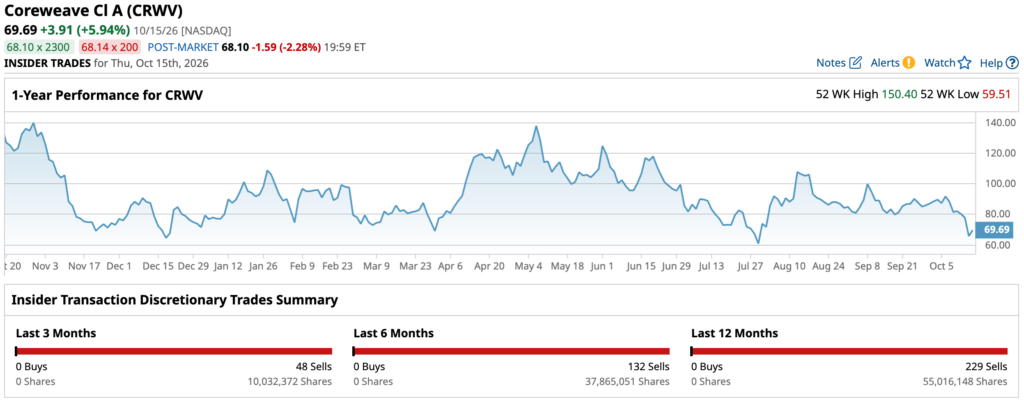
CoreWeave stock rebounded on Oct. 15 after suffering substantial losses earlier in the week, with shares closing at $69.69, up 5.94%, as investors assessed the company's financial outlook. The recovery coincided with a Bloomberg report showing that three of CoreWeave's co-founders have sold approximately $3.3 billion in shares since the company's initial public offering, drawing fresh attention to insider activity at the AI-focused cloud computing provider.
Analysts remain divided over CoreWeave's prospects. Some have maintained bullish recommendations, even as rising borrowing costs and substantial infrastructure spending continue to raise concerns. The stock has also formed a head-and-shoulders pattern — a chart formation traditionally viewed as a potential bearish reversal signal — that technical observers are watching closely.
Insider Sales of $3.3 Billion Under Scrutiny
CoreWeave insiders, including the company's Chief Executive Officer (CEO), Chief Financial Officer (CFO), and Chief Development Officer (CDO), have continued to sell shares. Barchart data shows that insiders executed 48 sale transactions over the past three months and 229 transactions over the past 12 months, selling a total of more than 55 million shares in the last year.
According to Bloomberg, insiders have dumped shares worth over $3.3 billion — a substantial amount for a company valued at more than $38 billion. Because transactions by directors and officers at U.S.-listed companies are disclosed through regulatory filings, the pace and scale of the selling are directly visible to the market.
Insider sales are usually seen as a highly bearish signal, since these individuals have more information about their company than the broader market, and heavy selling can suggest they expect the company to face major challenges ahead. Such sales are not always a red flag, however. In some instances, insiders sell shares as part of routine portfolio management, to fund large purchases, or to make investments in other companies.
Most notably in this case, the insider selling has continued even as Nvidia has been buying CoreWeave's shares — a sign that Jensen Huang expects the business to thrive. Nvidia now holds 47.2 million CoreWeave shares worth more than $3.2 billion, making it the second-largest holder after Magnetar Financial, a firm with more than $17 billion in assets. CoreWeave's other holders include BlackRock, Goldman Sachs, and Vanguard.
Analysts at Jefferies, meanwhile, have turned bullish on the company. They believe the ongoing sell-off is justified and have raised their price target, describing the recent decline in the shares as "a gift."
Business Growth Continues, but Headwinds Are Rising
The insider transactions are taking place at a time when CoreWeave — a provider of cloud infrastructure for artificial intelligence workloads — has continued to expand, making it one of the fastest-growing companies in the United States. Recent results showed that CoreWeave's revenue backlog — contracted business that has yet to be recognized as revenue — jumped to more than $104 billion in the second quarter as it secured deals with companies including Meta Platforms, Microsoft, Jane, and OpenAI.
Top analysts expect the company's revenue growth to continue in the foreseeable future. Revenue is estimated to have jumped 159% in the last quarter to $3.54 billion. For the full year, analysts see revenue rising 150% to $12.8 billion, before reaching $26.354 billion next year — a figure that will likely come in higher than expected.
The challenge, however, is that CoreWeave's business model is under substantial strain from high capital expenditures. The company now expects to spend more than $ billion this year, with most of that funded through borrowing. There are signs that investors are worried about this debt: CoreWeave's bonds are yielding over 15%, a level well above what highly rated corporate borrowers typically pay, which means the company will need to pay more in interest — a situation that could worsen if yields continue to rise. At the same time, Gartner, the technology research firm, has warned that CoreWeave may need to take a large write-down in the coming years as GPUs depreciate.
Those projections, alongside the company's spending plans, highlight both the scale of CoreWeave's growth and the capital commitments it entails.
What Comes Next for CoreWeave Stock?
CoreWeave shares face competing developments after Thursday's rebound. Bloomberg's insider-sale report has increased scrutiny of executive stock transactions, while analysts remain divided over the company's valuation. The $104 billion revenue backlog supports expectations for substantial future business activity, although CoreWeave's investment requirements and borrowing costs remain significant.
Investors will assess whether contracted revenue can translate into stronger cash flow as new computing capacity becomes operational. Additional insider filings could also provide information about changes in executive ownership.
Technically, the proposed head-and-shoulders formation requires confirmation. A sustained breakdown could expose lower price levels, including the conditional $50 target. Conversely, a recovery toward $88.80 could weaken the bearish scenario if the reported moving-average level remains relevant.
The central question is whether CoreWeave can convert its contracted AI demand into sufficient cash generation to finance its continued expansion.
This article is for informational purposes only and does not constitute financial or investment advice.

