CoreWeave Stock Extends Slide as Elon Musk Predicts Widespread Neocloud Failures
Key Takeaways
- •Elon Musk warned on X that credit market tightening could cause widespread neocloud failures, expecting more than 200 companies to fail with only a handful surviving.
- •CoreWeave closed at $54.24 on Oct. 23, roughly 71% below its record high, and its bonds maturing in 2031 yield 15% compared with a 5% ten-year Treasury yield.
- •Analysts expect CoreWeave revenue to jump 150% to $12.8 billion this year and reach $26.4 billion next year, but annual capital expenditures are projected to approach $40 billion, requiring new debt or equity financing.
- •SpaceX and Meta Platforms are emerging as significant neocloud competitors, with SpaceX holding large orders from Google, Anthropic, and Reflection AI, while Meta seeks to sell its excess capacity.
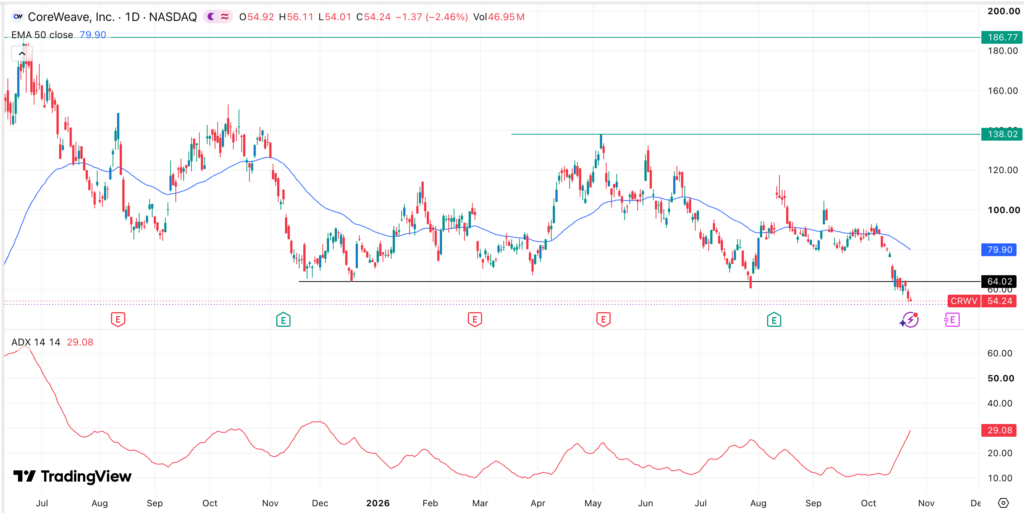
- •Technically, the stock has broken below the $64 support level and formed a head-and-shoulders pattern, with downside targets of $50 and the all-time low of $33.20 unless it moves back above $64.
CoreWeave shares have extended their sell-off after Elon Musk warned that tightening conditions in the credit market could trigger widespread failures among "neocloud" providers — the fast-growing companies that rent out cloud computing capacity for artificial intelligence (AI) workloads.
The AI infrastructure firm closed at $54.24 on Oct. 23, roughly 71% below its record high. The latest leg down followed rising corporate borrowing costs and growing concerns about AI infrastructure investments. Research firm Gartner, in a separate projection, forecast widespread consolidation among neocloud operators before 2030 — a signal that warnings of a sector shakeout are not confined to a single commentator.
Musk Warns of Widespread Neocloud Failures
Musk, the world's richest person, has turned his attention to neocloud companies such as CoreWeave, Nebius, and IREN. In a post on X, he said there will be "widespread neocloud failures" due to the credit market.
According to Musk, the debt market has largely shut off access to financing for companies without substantial revenue outside AI data centers. He expects more than 200 neocloud companies to fail, with only a handful of them surviving.
A wave of failures across the industry would deal a heavy blow to CoreWeave, the biggest player in the sector. The company does hold one advantage over many rivals: its customer base is comparatively diverse, spanning the largest AI labs as well as financial services firms such as Jane Street. In a market where financing terms increasingly hinge on revenue quality, that mix lowers CoreWeave's dependence on any single contract. That contrasts with companies like Nebius and IREN, which rely on a handful of clients.
Even so, signs of stress in the credit market have accelerated. Yields on CoreWeave bonds have continued to climb, with those maturing in 2031 yielding 15% — a striking figure given that the ten-year Treasury yield has jumped to 5%. For a company that must keep raising capital to fund data center build-outs, the gap between its borrowing costs and benchmark rates has become a direct gauge of how expensive new financing will be.
Rapid Growth at a Heavy Cost
On paper, CoreWe's expansion remains among the strongest in the industry. Yahoo Finance data shows analysts expect revenue to jump by 150% to $12.8 billion this year, up from $5.13 billion last year. Revenue is then projected to reach $26.4 billion next year, representing 105% annual growth, as the company continues fulfilling its commitments to customers.
The central challenge is that this growth is coming at a cost. CoreWeave's annual capital expenditure is expected to approach $40 billion this year, meaning the company will need to raise cash — either through debt or equity — to finance its build-out. That financing is set to become significantly more expensive now that its bond yields are soaring and fears of the AI bubble are significant.
Competition is another mounting risk as more companies enter the neocloud industry. The most significant entrants are SpaceX and Meta Platforms. SpaceX has already taken large orders from Google, Anthropic, and Reflection AI, while Meta Platforms — itself a top client for many neocloud companies — is seeking to sell its excess capacity to other customers. Meta's shift from a source of demand for neocloud capacity into a potential supplier shows how quickly the sector's balance can change. Smaller rivals include Nscale, Lambda, RIOT Platforms, The RUM Group, and MARA Holdings.
There is also a risk that CoreWeave will need to depreciate its chips faster than expected. The company's modeling suggests the chips have a useful life of six years, while analysts believe the figure is less than four years. The distinction matters because depreciation flows directly into reported earnings: a shorter useful life would accelerate the write-down of the company's largest assets and weigh on the profitability that its headline revenue growth is meant to deliver.
Technical Picture Points to Further Downside
Technical analysis suggests CRWV stock carries more downside risk in the near term. The shares have plunged below the important support level of $64, which marked their lowest levels in November and December last year.
CoreWeave has also formed a head-and-shoulders pattern, a common bearish reversal sign in technical analysis. The stock has slumped below its 50-day moving average, while the ADX indicator has risen, suggesting the downward trend is accelerating.
On that basis, the stock will likely continue falling in the foreseeable future. The initial target is $50, followed by the all-time low of $33.20. A move back above $64 would invalidate the bearish outlook.
For readers following the sector, the near-term markers are already embedded in the data: the trajectory of CoreWeave's bond yields as a measure of financing conditions, whether new entrants turn order books into operating capacity, and whether the company's six-year chip-life assumption holds up against analyst estimates.
This article provides information, not financial advice. Stock investments carry risks, including volatility and potential losses. Readers should conduct independent research before making investment decisions.

