JPMorgan Upgrades CoreWeave to Overweight With $125 Target Despite Technical Risks
Key Takeaways
- •JPMorgan expects favorable GPU pricing and CoreWeave’s neocloud position to support the stock’s potential recovery.
- •CoreWeave reported 112% second-quarter revenue growth and a net revenue backlog exceeding $104 billion.
- •The company plans to spend $35 billion to $39 billion this year as memory, GPU, and server costs rise.
- •CoreWeave ended the latest quarter with more than $29 billion in debt, while outstanding shares increased to 457 million from 317 million at its IPO.
- •The stock is trading near $67.98 support after falling below its 50-day EMA, with a break below that level potentially signaling a move toward $50.
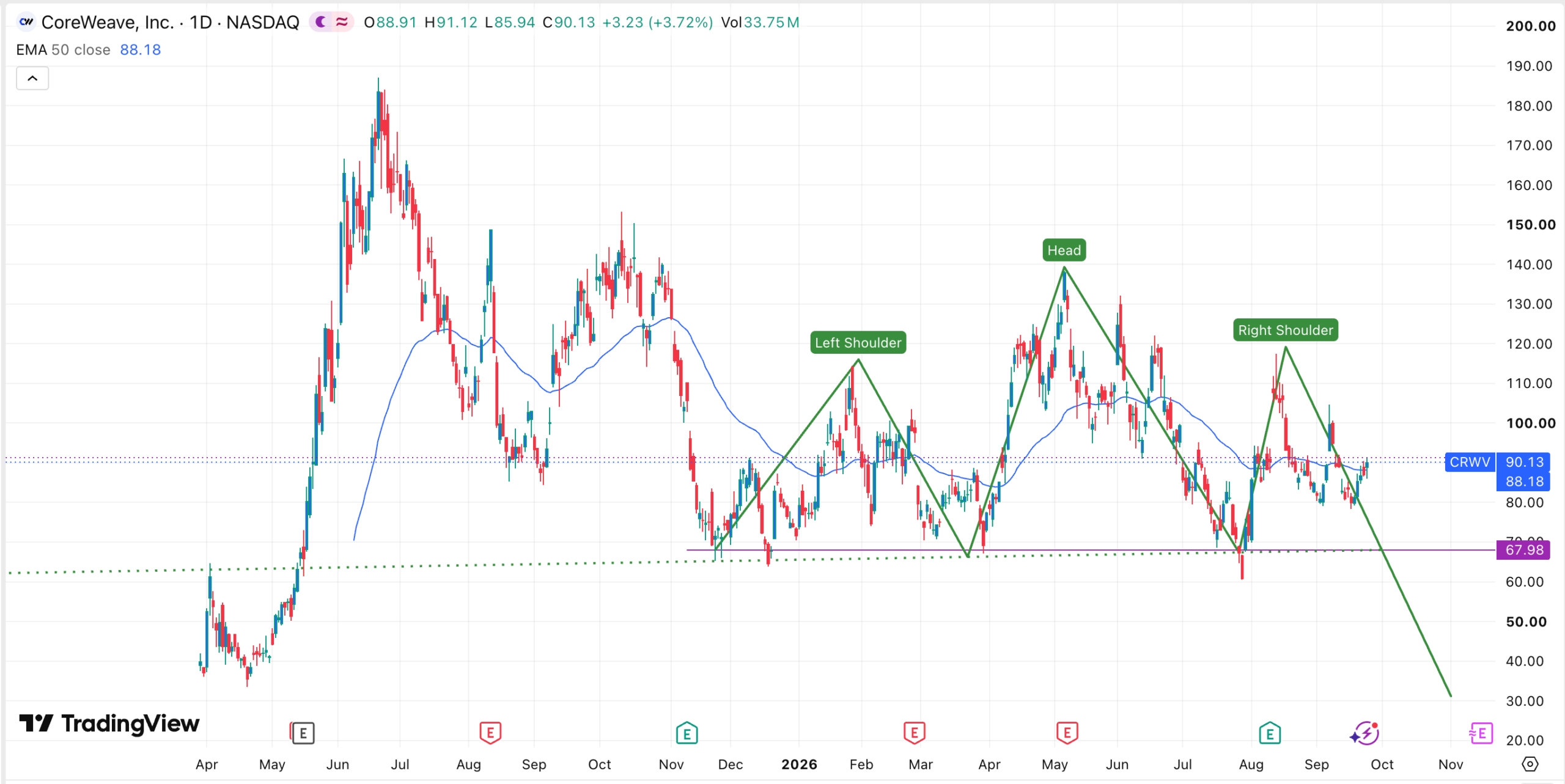
CoreWeave (CRWV) closed at $90.13 on Sept. 24 after JPMorgan upgraded the AI infrastructure company. The bank lifted its rating from Neutral to Overweight and raised its December 2027 price target to $125 — a level about 38.7% above the latest closing price.
The upgrade arrived after months of volatile trading. CRWV reached a 2026 high of around $138.25 in May before retreating sharply during the summer. Shares have remained under pressure in recent months even as analysts have turned more constructive, citing CoreWeave's strong market share; the company, meanwhile, has continued to post rapid revenue growth and stronger compute pricing.
JPMorgan Cites Pricing Tailwinds and Neocloud Lead
CRWV has pulled back over the past few months, but JPMorgan's analysts believe the shares may rebound in the near term. In a research note, the bank boosted its rating from neutral to overweight and lifted its price target from $120 to $125, implying roughly 42% upside from the current level.
JPMorgan pointed to numerous catalysts that could lift the stock over time. One is pricing, which the bank expects to remain favorable; recent data show AI companies are willing to spend substantial sums leasing GPUs. The analysts also believe CoreWeave has taken pole position in the neocloud industry — the emerging class of GPU-focused providers that lease raw computing power to AI developers, distinct from general-purpose cloud platforms — outpacing top rivals such as Nebius and IREN.
The company has already signed large deals with Microsoft, OpenAI, and Anthropic. In its last earnings statement, CoreWeave said its business carried a net revenue backlog of more than $106 billion — a measure of contracted future revenue that has become a key gauge of demand visibility across the AI infrastructure sector.
JPMorgan joins a group of major firms that have raised their CoreWeave forecasts. UBS initiated coverage with a buy rating and a $120 target, while Rosenblatt hiked its target to $250. Truist Securities and Goldman Sachs hold targets of $165 and $139, respectively. Despite this optimism, the company maintains a high short interest — a sign that many investors still expect the stock to retreat over time. That standoff between some of the Street's most aggressive targets and a persistent bearish bet underscores how divided the market remains on the AI infrastructure trade.
Strong Growth Is Coming at a Cost
CoreWeave's most recent results showed revenue growth accelerating this year as the artificial intelligence boom gains momentum. Revenue surged 112% in the second quarter, well above the company's guidance and analyst expectations.
The revenue backlog continued to grow, driven by customers across different sectors. While technology companies remain the biggest clients, CoreWeave has also attracted customers outside the industry, including Jane Street, the high-frequency trading (HFT) giant. These orders have pushed its revenue backlog to more than $104 billion.
The risk, however, is that this growth is coming at a cost. CoreWeave plans to spend between $35 billion and $39 billion this year, a higher figure than it previously predicted, with the surge driven in part by ongoing memory, GPU, and server costs. The numbers highlight the capital intensity of the neocloud model, in which providers must commit billions to data centers and hardware before the contracts behind their backlogs convert into revenue.
As a result, CoreWeave has grown its debt load substantially. It ended the last quarter with more than $29 billion in debt, far above its level a year earlier. Shareholder dilution has continued as well, with total outstanding shares rising sharply to 457 million from317 million at the time of its IPO last year. How management balances that funding need against its contracted backlog is set to remain a central question in the company's upcoming earnings reports.
The company is also contending with a highly competitive industry, with players such as Nscale and SpaceX gaining some market share.
Technical Picture Flags Further Downside
CoreWeave also faces substantial technical risks. The stock has formed a head-and-shoulders pattern, a common bearish reversal signal in technical analysis. It is now hovering slightly above the important support level of $67.98 — the low that marked its floors in November and December last year and again in March and July of this year.
The stock has also slipped below its 50-day Exponential Moving Average (EMA). As a result, there is a risk of a strong bearish breakout, potentially toward $50. That scenario would be confirmed if the stock moves below the neckline at $67.98.
Between the fundamental crosscurrents and the technical setup, the markers to watch from here are whether the $67.98 level continues to hold, and whether JPMorgan's pricing outlook and CoreWeave's spending plans play out as described when the company next reports results.
This article is for informational purposes only and does not constitute financial or investment advice. Analyst targets and technical projections may not materialize.
This report was originally published by The Market Periodical.

