CoreWeave Investor Defends AI "Neocloud" Debt Pile as Bond Yields Spike and Bubble Fears Build
Key Takeaways
- •CoreWeave's stock dropped 15.46% on Wednesday and a further 5.62% in post-market trading after Chamath Palihapitiya shared a chart showing the company's bond yields reaching 15%, though the shares recovered somewhat on Thursday.
- •CoreWeave's Q2 disclosures show $35.6 billion in total debt and $16.3 billion in operating lease liabilities, alongside a $1.4 billion net loss on $4.6 billion of first-half revenue.
- •The company holds $103.7 billion in noncancelable remaining performance obligations, with 41% scheduled for payment through 2028, which investor Evan Schlossman argues effectively backstops its borrowing.
- •Microsoft and OpenAI are CoreWeave's major customers, and its top three customers accounted for 72% of Q2 revenue under take-or-pay contracts that require payment even if services go unused.
- •Gartner estimates that 80% of neocloud providers will cease independent operations by 2030 because their revenues will not cover their expenses.
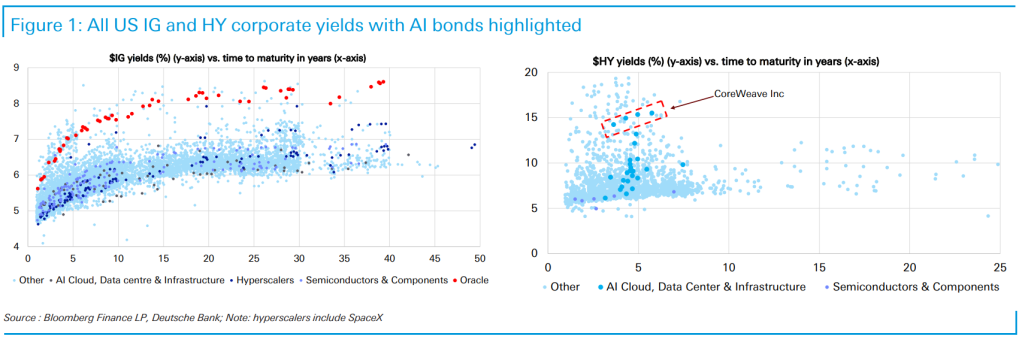
Shares of CoreWeave, the debt-financed AI "neocloud" provider — one of a new class of specialized cloud companies that rent out the GPU computing capacity on which AI models are built and run — dropped 15.46% on Wednesday and slid a further 5.62% in post-market trading after venture capitalist Chamath Palihapitiya posted on X a chart showing the yield on the company's bonds touching 15% — an indicator that investors were demanding a steep premium to hold its debt. "Is the AI build-out creating a private credit bubble?" Palihapitiya asked. (The stock recovered a little on Thursday.)
The sell-off coincided with a Financial Times interview in which CoreWeave cofounder and finance lead Brannin McBee said he wants to borrow even more money — from insurance companies. The insurance sector's access to capital "is unlimited," he told the paper. "Like, that's all the money in the world that sits in the insurance tranche."
CoreWeave's vast debt pile has stirred controversy before. In 2025, a Fortune analysis of the company's financials concluded that it had the potential to be "ground-zero for a future AI financial meltdown."
Debt owed by AI service companies has also dominated recent headlines. Oracle issued a "force majeure" citation to Blue Owl, the developer of a massive data center in New Mexico, over worries that the site won't be finished in 2028, when it is scheduled to come online — an indication that customers might have the legal ability to walk away from their commitments if conditions turn against them. And Gartner estimates that 80% of neocloud providers will cease independent operations by 2030 because their revenues won't cover their outgoings.
But the critics are wrong, according to Evan Schlossman, principal at Neostellar Capital Corp., a publicly traded venture fund that gives retail investors exposure to pre-IPO startup equity. (Neostellar bought a $25 million stake in CoreWeave in 2024 and sold 40% of it for a gain of $15 million in Q2 2025, per its investor disclosures.)
CoreWeave has certainly taken on enormous debt and lease commitments. According to its Q2 earnings release, the company carried operating lease liabilities of $16.3 billion and total debt of $35.6 billion. It generated $4.6 billion in revenue in the first six months of the year, but operating expenses exceeded sales, leaving a net loss of $1.4 billion for the first half.
Put simply: how does a company that makes no money repay $52 billion in combined debt and lease commitments?
'Take or pay'
The short answer is that the company holds $103.7 billion of "remaining performance obligations" (RPOs), 41% of which is scheduled to be paid to CoreWeave through 2028, according to its Q2 disclosure. That means CoreWeave is good for the money, Schlossman told Fortune.
RPOs are agreements to provide services that a company knows it will be paid for in the future — the revenue simply hasn't been delivered yet. Companies are only permitted to disclose them when the agreements are noncancelable. They are "take-or-pay" contracts with "extremely high-credit-worthy customers," Schlossman said.
A take-or-pay contract binds a customer to pay for the service even if they never use it. CoreWeave's major customers are Microsoft and OpenAI, and its top three customers — the third is undisclosed — generated 72% of its revenue in Q2, the company said.
It is highly unlikely that Microsoft would go bankrupt and leave CoreWeave holding unpaid bills, Schlossman said. In fact, under the agreement between the two companies, one of the few ways Microsoft can exit the contracts is if an Oracle-style "force majeure" event prevents CoreWeave from delivering its services.
That is why CoreWeave can rack up so much debt. Lenders can see that its credit is being backstopped by noncancelable RPOs from companies with a "tier-one balance sheet that is underwriting this," Schlossman said.
"We are confident in our backlog, which more than supports all of our debt obligations," CoreWeave told Fortune. "98% of our revenue is from committed, take-or-pay contracts. We structure the majority of our financing so that cash flows from customer contracts repay the associated debt and generate additional free cash flow."
'If there is something that goes wrong, I think you're going to see that it's going to matter significantly who owes you money'
While OpenAI's balance sheet isn't as rock solid as Microsoft's, its RPO commitments to CoreWeave are themselves backed by RPOs that OpenAI holds from other companies of Microsoft's quality, Schlossman said: "A lot of these contracts are backstopped by other companies."
"I understand how they're going to get paid back on this; how much they're going to make; and what are the specific risks associated with this," he said.
Besides, even if OpenAI were to suddenly disappear, the contracts it holds for compute power are worth more now than when they were signed — implying that CoreWeave could sell that capacity to other customers.
Schlossman does admit that not every piece of the AI ecosystem will pass a stress test. Smaller companies backed by venture capital whose customers are also early seed-round, venture-backed firms may not survive a market downturn. "If there is something that goes wrong, I think you're going to see that it's going to matter significantly owes you money, as it does in most businesses," he said.
'Microsoft is ruthless, and will eat CoreWeave for lunch'
CoreWeave's critics are unlikely to be satisfied by that argument. Francine McKenna, an accountant and investigative journalist who has taught at the Wharton School and Cambridge and who now writes The Dig, a respected Substack about accounting, does not believe Microsoft will deliver on CoreWeave's RPOs if demand for compute softens.
"If CoreWeave is counting on Microsoft to honor its contracts and bail them out of extreme debt and losses I have a bridge in Brooklyn I'd like to sell them," she told Fortune. "Microsoft is ruthless and will eat CoreWeave for lunch and throw bones to its dogs if it makes sense for them."
Microsoft declined comment.
The disagreement leaves a set of observable markers to follow: where CoreWeave's bond yields head after touching 15%, whether McBee's push to borrow from insurance companies takes shape, how the Oracle-Blue Owl force majeure standoff is resolved, and whether Microsoft and other customers honor take-or-pay commitments across the life of CoreWeave's $103.7 billion backlog — the question on which Schlossman's and McKenna's opposing cases ultimately rest.
This story was originally featured on Fortune.com.

