CoreWeave Stock at Risk of Bearish Breakout as Ray Dalio Warns the AI May Burst
Key Takeaways
- •Ray Dalio, founder of Bridgewater Associates, warned this week that the AI bubble could burst at any time, citing rising interest rates and bond yields as a top risk.
- •The US ten-year Treasury yield jumped to 5.3%, its highest level since 2002, while CoreWeave's junk-rated 2032 bonds yield more than 11%.
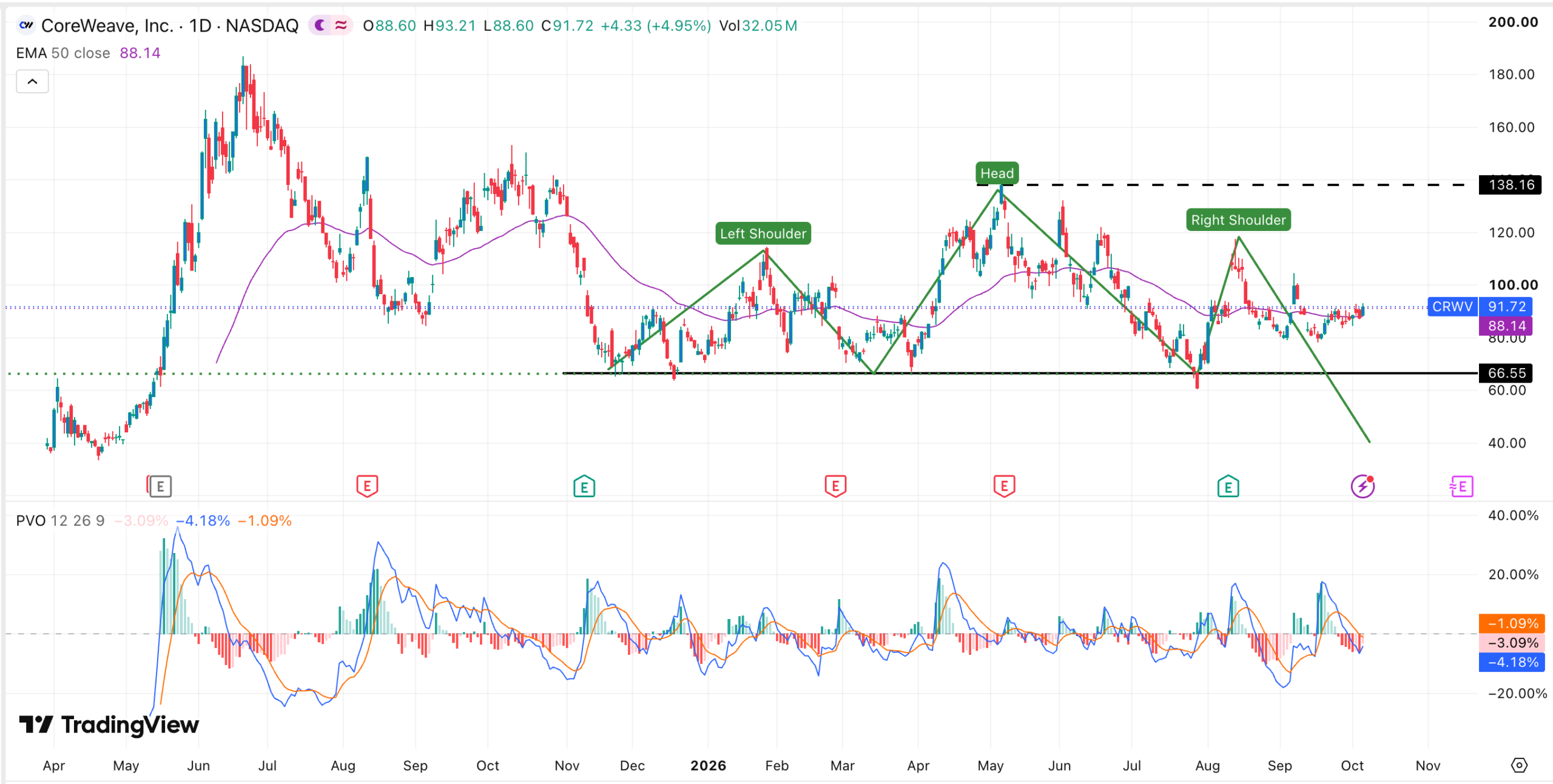
- •CoreWeave stock traded at $91.72 on Tuesday, almost 50% below its all-time high, as a head-and-shoulders pattern formed with the $66.55 neckline as the key support level to watch.
- •CoreWeave's depreciation and amortization rose to more than $1.39 billion in the second quarter, reflecting a dispute between the company's five-to-six-year GPU useful-life estimate and analysts' two-to-three-year view.
- •Despite the risks, CoreWeave holds a $104 billion backlog showing continued customer commitment to computing capacity, while its stock carries a 12% short interest.
Key Points
- CoreWeave (CRWV) has formed a head-and-shoulders chart pattern.
- Ray Dalio, founder of Bridgewater Associates, has warned that the AI bubble may burst soon.
- Such a burst could hit CoreWeave and other neocloud operators hardest because of their substantial debt.
CoreWeave at Risk as Dalio Warns of an AI Bubble
CoreWeave stock has moved essentially sideways for nearly two months, even as the company reported strong revenue and backlog growth. CRWV, which generates its revenue by renting GPU computing capacity to AI companies, was trading at $91.72 on Tuesday, down almost 50% from its all-time high. The shares now face the risk of a strong bearish breakout as Ray Dalio warns of an AI bubble and a risky head-and-shoulders chart pattern takes shape.
In a statement this week, Dalio, who founded Bridgewater Associates, one of the world's largest hedge funds, warned that the burst could happen at any time. He argued that gaps in the AI industry persist and identified rising interest rates and bond yields as one of the top risks. In the United States, the ten-year yield jumped to 5.3%, its highest level since 2002, and shorter-term bonds are showing the same pressure.
The move matters for CoreWeave because the company uses the bond market to finance its large infrastructure projects. A closer look at its bonds shows they sit in the junk segment of the market, below investment grade, with its 2032 bonds yielding more than 11%.
Dalio has also highlighted the gap between revenue and spending among the largest AI companies. A recent Financial Times report estimated that OpenAI plans to burn $280 billion through 2030, while Anthropic plans to spend billions of dollars on its data center rollout. The risk is that these companies — all CoreWeave clients — face growing competition from open-weight models, released with publicly downloadable parameters that companies can run on their own infrastructure, built by firms such as Moonshot, Alibaba, and DeepSeek. Just this week, Reflection AI launched Beam, open-weight model.
If the bubble bursts as Dalio predicts, neocloud operators like CoreWeave would be among the most affected because of their substantial debt.
CoreWeave Faces a Depreciation Challenge
Depreciation is the other major risk hanging over the company. CoreWeave's business is built on borrowing substantial amounts of money to buy GPUs, which it predicts will have a useful life of five to six years — by which point they will have repaid themselves. The company also believes it will be able to sell these GPUs and recognize a good return over time.
Some analysts, however, believe the useful life is closer to two to three years — a gap that matters because useful-life estimates determine how quickly each GPU's cost is expensed against the revenue it generates. That concern is already showing up in the company's results. Its latest financials showed depreciation and amortization jumped to more than $1.39 billion in the second quarter and $2.52 billion in the first half of the year. Those are large numbers considering quarterly revenue stood at $2.5 billion and half-year revenue at $4.6 billion.
These risks likely explain why the stock carries a high short interest of 12%, a sign that many investors still expect it to drop.
CoreWeave's Outlook Depends on AI Spending Staying Strong
CoreWeave remains one of the clearest public-market exposures to AI infrastructure investment. Its $104 billion backlog shows that customers continue to commit substantial capital to computing capacity. At the same time, the model requires CoreWeave to fund large infrastructure projects before earning revenue over time, meaning rising bond yields create more direct risk for CRWV than for cash-rich technology companies.
Dalio's AI bubble warning does not mean CoreWeave stock will collapse. His argument instead highlights the vulnerability of debt-heavy AI infrastructure if financing conditions continue to tighten.
For now, the $66.55 neckline — the support line beneath the head-and-shoulders formation and the level chartists watch to confirm a breakdown — remains the main chart level to monitor on the setup. A confirmed break below it would strengthen the bearish case, while a recovery above recent range resistance would weaken it.
This article is for informational purposes only and does not constitute financial or investment advice. Technical patterns, debt yields, and market conditions may change as new information emerges.

