Credit Markets Turn to CoreWeave as Default-Insurance Pricing Flags AI Hyperscaler Debt Risk
Key Takeaways
- •CoreWeave's five-year bond has fallen 16% since July, lifting its yield to 15% from 10%, a level associated with companies in financial distress.
- •Credit-default swap pricing analyzed by The Economist implies the probability of CoreWeave failing to service its debts over the next five years has risen above 60%.
- •Investors increasingly worry that companies at the center of the AI boom cannot generate sufficient cash flows to service their large and increasingly opaque debts.
- •Credit-market stress has spilled into equities, with the tech-heavy NASDAQ index falling back to where it stood in mid-May.
- •The industry faces a $5.5 trillion question by 2030: whether borrowing can outstrip cash flow enough to fund planned AI infrastructure spending, given that data centers, chips, and power require upfront investment while returns accrue over years.
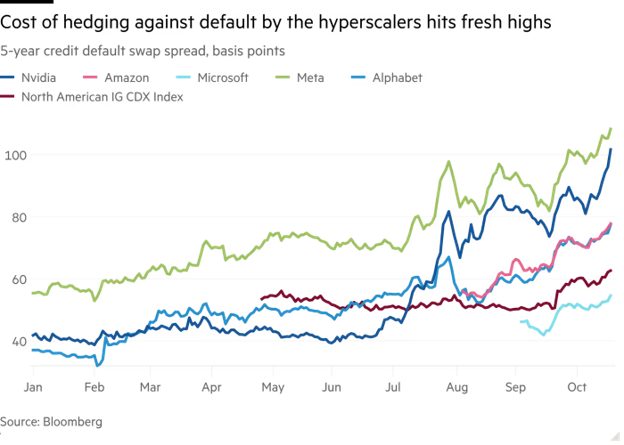
Credit markets have turned their attention to CoreWeave, and the worries now extend across the companies at the heart of the artificial intelligence boom. Default-insurance pricing for the data-center operator signals elevated perceived risk, and equity investors have begun to wobble as well. Debt-funded spending on AI infrastructure has become one of the most closely watched themes in global credit markets.
According to The Economist, credit markets are coming for CoreWeave. The price of a five-year bond issued by the "neocloud," which rents out data-center capacity for artificial-intelligence models, has fallen by 16% since July. The bond's yield is now 15% — a level associated with companies in financial distress — up from 10% in July. Bond prices and yields move in opposite directions, so the sell-off means investors now demand a far higher return to hold the debt — the kind of compensation markets typically require when perceived default risk climbs. The price of credit-default swaps offering insurance against a CoreWeave default implies that the probability of the company being unable to service its debts over the next five years has risen above 60%, according to the publication's analysis. Credit-default swaps are derivative contracts that function as insurance against a borrower failing to repay its obligations.
A separate Economist report published in September flagged that neoclouds like CoreWeave are getting much bigger and riskier.
Investors increasingly worry that the companies at the center of the AI boom will be unable to generate the cash flows necessary to service their vast debts. Credit-market signals carry particular weight in episodes like this because lenders stand ahead of shareholders in a company's capital structure, making debt pricing one of the most sensitive gauges of perceived solvency risk. Those concerns have spilled over from credit markets to cause a wobble in the stock market as well: having fallen sharply, the tech-heavy NASDAQ index is now back to where it was in mid-May. Investors are pricing in a debt stock that is getting bigger, more opaque — and increasingly risky.
Econbrowser highlighted Financial Times coverage published the previous day that examined the large players in the AI boom, while urging readers to consider the smaller players also involved in the boom.
The commentary distilled the debate into what it called the $5.5 trillion (by 2030) question: can borrowing really outstrip cash flow by as much as required to hit the industry's planned capital-expenditure spending on AI infrastructure? That is a question of timing as much as scale: spending on the physical backbone of AI — data centers, chips, and power — is typically committed up front, while the returns it is meant to generate accrue over years.

