Copper Supply Squeeze Eases as LME Inventories Surge More Than 50% in Three Days
Key Takeaways
- •On-warrant LME copper stocks rose by 63,000 tonnes from Monday to Wednesday, with gains seen across Asia, the U.S. and Europe.
- •The cash-to-three-month spread fell to about $176 per tonne on Wednesday after reaching nearly $550 per tonne on Monday, its highest level in more than five years.
- •The inventory build followed a heavy drawdown in June and July, after stocks had already fallen by about 100,000 tonnes in July and 75,000 tonnes in June.
- •Benchmark analyst Albert Mackenzie said the deliveries eased fears of extreme near-term tightness, but LME inventories will remain closely watched for price signals.
- •U.S. tariff uncertainty has been drawing copper to New York, creating regional imbalances that may continue to affect global market volatility.
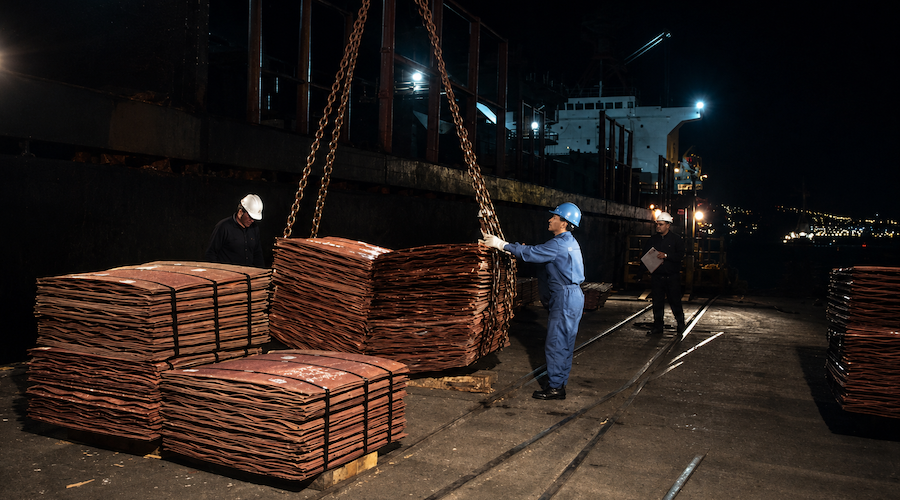
London Metal Exchange on-warrant copper inventories jumped by more than 50% in three days, easing fears of an acute supply squeeze and sharply narrowing a key spread in the copper market.
On-warrant copper stocks rose by 63,000 tonnes between Monday and Wednesday, with increases recorded across Asia, the U.S. and Europe, according to Benchmark Mineral Intelligence. Total LME stocks gained 28,000 tonnes as metal flowed onto the exchange and a significant amount of previously cancelled inventory — metal that had been earmarked for removal from warehouses — was re-warranted.
Copper's breadth of use — in wiring, plumbing, construction, power grids, electric vehicles and renewable-energy installations — makes LME stock levels one of the most widely watched readouts of physical availability, so a three-day swing of this size draws attention well beyond metals trading desks.
"The deliveries alleviate the fears of extreme nearby tightness for now, and LME inventories will be closely watched for signals on price movements," Benchmark copper analyst Albert Mackenzie said.
The rapid influx, the analyst noted, demonstrates how quickly high prices for immediately available metal can pull copper back onto the exchange. It also highlights the unusual trading conditions created by uncertainty over U.S. tariffs — expectations of import levies have kept New York's Comex futures at a premium to LME prices, drawing large volumes of copper into the United States and making supplies elsewhere appear tighter.
Backwardation drove the squeeze
The deliveries came after falling LME inventories had driven copper into a steep backwardation, a market structure in which metal for immediate delivery commands a premium over later-dated contracts. On-warrant stocks fell by about 100,000 tonnes in July, after a decline of 75,000 tonnes in June.
At points on Monday, the LME cash-to-three-month backwardation widened to nearly $550 per tonne, its highest level in more than five years. More than $400 per tonne of that premium was concentrated between the August and September contracts.
Those premiums gave holders of physical copper a strong financial incentive to deliver metal into LME warehouses. Market sources told Benchmark they believed one large trading company was behind the deliveries, while sources in China said some of the metal may also have come from Chinese market participants.
The resulting increase in available inventory rapidly eased the squeeze. The cash-to-three-month spread fell 60% to about $176 per tonne on Wednesday, from $436 per tonne at Monday's close. Three-month copper traded at $13,885 per tonne on Wednesday, down nearly $300 per tonne since Monday.
Tariff distortions persist
The inventory swing comes as U.S. tariff uncertainty continues to reshape global copper flows, creating regional imbalances that can exaggerate perceptions of physical scarcity.
"Lots of the current odd dynamics have come as huge amounts of copper heads to the U.S. due to the high arbitrage caused by tariff uncertainty, making the global market feel tighter than it really is," Mackenzie said. "As long as there is uncertainty on tariffs, situations like this could arise again."
The latest deliveries have relieved the immediate pressure, but the speed at which inventories fell in June and July has left traders watching warehouse movements — reported daily by the LME — for signs that tightness is returning, along with any clarification of U.S. tariff policy. Mackenzie warned that continued tariff uncertainty could keep diverting metal towards the U.S., leaving the global market vulnerable to further bouts of volatility.

