Copper Retreats from Record Highs as US-Iran Tensions Offset Strong Earnings Season
Key Takeaways
- •September Comex copper traded down 2.4% at $6.34 per pound, pressured by geopolitical risk despite firm underlying market conditions.
- •Teck Resources, Freeport-McMoRan and Southern Copper reported strong quarterly earnings, supported by higher copper prices and production gains.
- •Panama is considering options to partner with First Quantum Minerals on a potential restart of the Cobre Panama mine, with a decision expected before year-end.
- •LME copper inventories fell to 284,175 tonnes, while Shanghai Futures Exchange deliverable stocks have dropped 82% since early May.
- •Comex warehouses hold more than 630,000 tonnes of copper after eight straight quarters of builds, largely tied to expectations of possible US import duties.
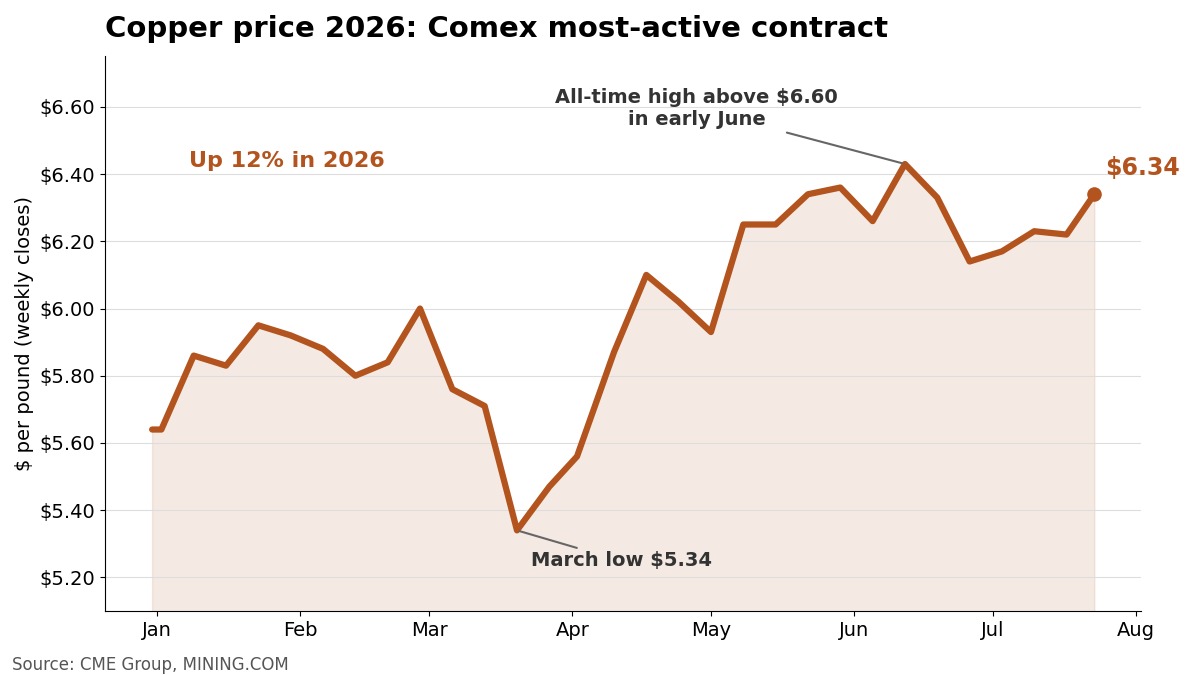
Copper prices declined alongside the broader metals complex on Thursday, as escalating US-Iran conflict anxieties unsettled markets and dampened investor appetite despite a wave of encouraging developments for the red metal, including robust quarterly earnings from Teck Resources and Freeport-McMoRan, as well as renewed momentum toward restarting the idled Cobre Panama mine.
The move highlighted the tension between near-term macro risk and a still-supportive copper backdrop. While stronger producer earnings, tight exchange inventories outside the United States, and Chinese import demand point to firm underlying conditions, geopolitical stress can quickly reduce risk appetite across industrial metals.
Comex copper for September delivery dropped as much as 2.5% to $6.33 per pound and was trading at $6.34, down 2.4%, as of 11:45 a.m. in New York. The US benchmark now sits roughly 5% below the record high established in early June, though it remains up more than 12% year to date, driven by tight supplies, anticipated US copper tariffs, and robust Chinese demand.
Earnings Season Highlights
Teck Resources reported that second-quarter adjusted EBITDA tripled year over year to C$2.19 billion ($1.6 billion), up from C$722 million, as revenue surged 78% to C$3.61 billion. Copper production increased 25% to 135,900 tonnes, with realized prices averaging $6.05 per pound compared to $4.32 a year earlier. The Quebrada Blanca mine in Chile delivered its third consecutive quarter of stable output at 55,800 tonnes, and full-year guidance remained unchanged. Teck's shares rose as much as 5.2% in Toronto.
"We see a clear path to the combined Anglo-Teck being a go-to copper major over the next 12 months," Jefferies analysts led by Christopher LaFemina wrote in a note. The proposed merger with Anglo American has received regulatory clearance in Canada, Chile, and Japan, with China remaining the key outstanding approval. Closing is still anticipated within 12 to 18 months of the September announcement.
Freeport-McMoRan exceeded expectations with second-quarter adjusted net income of $1.1 billion, or $0.74 per share, on revenue of $7 billion. Copper sales reached 710 million pounds (approximately 322,000 tonnes), surpassing the company's April guidance due to shipment timing, at an average realized price of $6.17 per pound. The company also reported steady progress ramping up the Grasberg Block Cave mine following last year's deadly mudslide, though a full restart has been pushed to early 2028.
Freeport projects 2026 copper sales of 3.1 billion pounds (approximately 1.4 million tonnes) at unit net cash costs of $1.90 per pound. Its shares declined 2.2% in line with the copper price. Anglo American gained nearly 4% in New York after releasing its own first-half results, which included a reduction in copper unit cost guidance.
Southern Copper also reported strong results, posting record adjusted EBITDA of $2.86 billion and net income of $1.67 billion for the quarter. The company outlined a trajectory to surpass one million tonnes of annual output by 2029, with its Tia Maria project in Peru approaching the halfway point of construction. Management raised 2026 production guidance to 917,000 tonnes and projects a slight global deficit this year, noting that exchange inventories currently cover only about 15 days of worldwide demand. Southern Copper's stock fell 3.8% on Thursday, tracking the metal lower.
Chile Recovery and Panama Negotiations
Chile is recovering from a winter storm that claimed 13 lives and triggered a state of catastrophe declaration in the Coquimbo and Atacama regions. No rainfall is forecast for the hardest-hit areas over the next five days. The principal copper-producing districts further north emerged largely unscathed, and central-region ports are gradually resuming normal operations, though some terminal restrictions persist.
Antofagasta deployed heavy equipment to clear roads near its Los Pelambres operation. Lundin Mining's Caserones mine has been suspended since July 18, with full-year guidance maintained. Teck reported that its Carmen de Andacollo operation has been partially suspended since July 17.
In Panama, Reuters reported that the government is considering the establishment of a state-owned mining enterprise to partner with First Quantum Minerals on restarting the Cobre Panama mine, which has been shuttered since late 2023. Proposed structures would grant First Quantum a 60% to 65% stake with the state retaining the balance, or alternatively lease the operation to the Canadian miner in exchange for royalties and tax revenues. A decision on the mine's long-term future is anticipated before year-end. First Quantum, which has paused its $20 billion arbitration claim and commenced processing stockpiled ore at the site, closed down 0.7% in Toronto on Wednesday.
The Panama discussions remain a key operational watch point for supply because any restart would depend not only on commercial terms but also on the government's chosen ownership or leasing structure. For now, the mine's continued closure keeps attention on existing producers' guidance and on near-term disruptions in Chile.
Declining Global Stockpiles
The price pullback unfolds against a backdrop of rapidly diminishing exchange inventories outside the United States. Copper inventories in LME-registered warehouses fell by an additional 6,750 tonnes in Thursday's daily report to 284,175 tonnes — the lowest level since March and down approximately 20% from late June. Further metal is booked for departure, with more than half of the remaining stock on cancelled warrants awaiting delivery earlier this week.
Deliverable stocks in warehouses monitored by the Shanghai Futures Exchange have plummeted 82% since early May. The Yangshan premium that importers pay to bring copper into China stood at $103 a tonne, remaining near its highest level in over a year. Much of that metal has instead flowed into the United States, where Comex warehouses now hold a record 630,000-plus tonnes following eight consecutive quarters of builds — a stockpile accumulated largely on expectations of a potential duty on refined copper imports, a decision that remains pending at the White House.
That split between shrinking LME and Shanghai inventories and record Comex stocks has made regional warehouse data especially important for traders assessing available supply. The pending US tariff decision remains a central policy variable because the recent buildup in Comex warehouses has been tied largely to expectations of a possible duty on refined copper imports.
(With files from Bloomberg and Reuters)

