Microsoft Copilot AI Outlines Aggressive Ethereum Scenario Eyeing $18,000–$40,000 by January 2027
Key Takeaways
- •Microsoft's Copilot AI mapped an aggressive scenario in which Ethereum could climb to $18,000–$28,000, with a stretch target of $40,000 or more, by January 1, 2027.
- •The projection assumes Ethereum becomes the main settlement layer for AI infrastructure and autonomous agent marketplaces, a catalyst the model acknowledges is currently a long shot.
- •Ethereum continues to consolidate in a wide range around the low-to-mid $2,000s, with sustained acceptance above the $2,800–$3,200 region flagged as a shift in intermediate momentum.
- •Whale rotations from Bitcoin into ETH and BitMine's push toward holding roughly 5% of total supply are cited as constructive accumulation signals, alongside periods of sharply rising active addresses.
- •Testing is underway for the Glamsterdam upgrade, which aims to significantly increase block capacity, while Vitalik Buterin has separately proposed a December 2028 timeline for quantum-resistant defenses, ahead of the current 2029 roadmap.
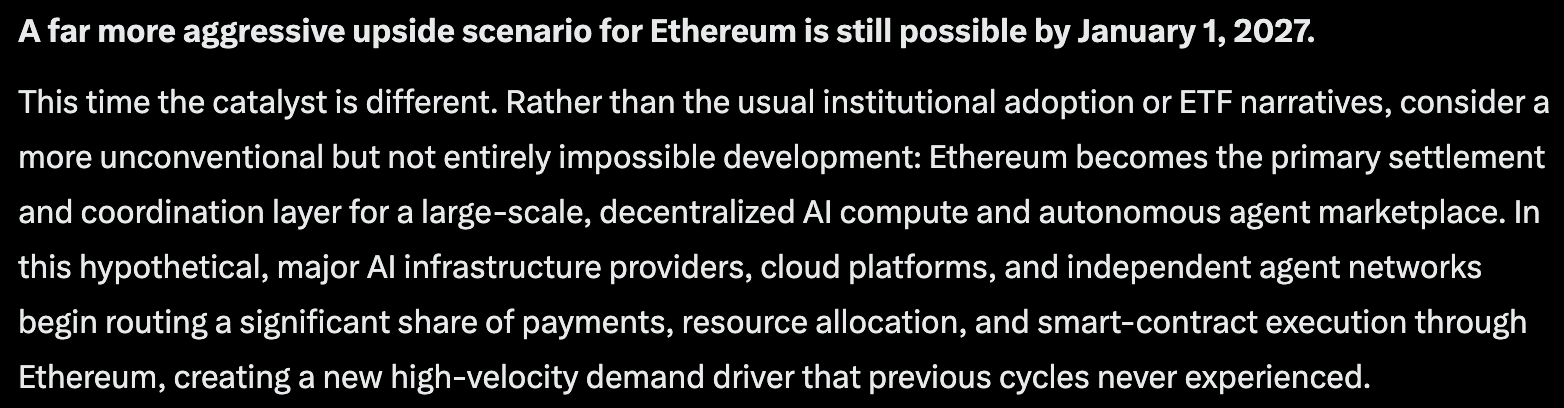
Microsoft's Copilot AI has mapped out an aggressive upside scenario for Ethereum (ETH) that it still considers possible by January 1, 2027. According to the outlook, an unconventional — though not impossible — development could send ETH to unprecedented heights during the fourth quarter of 2026. The projection frames the coming quarter as the window in which such a move could take hold.
As with any chatbot-generated outlook, the numbers reflect the premises the model was asked to explore rather than new market data, making the scenario's underlying assumptions as worth tracking as its headline targets.
The scenario centers on Ethereum emerging as the main settlement and coordination layer for a large-scale, decentralized marketplace built around AI computing and autonomous agents. Under that thesis, major AI infrastructure providers, cloud platforms, and independent agent networks would begin directing a significant share of payments, resource allocations, and smart contract executions through Ethereum. The shift would create a new, high-velocity demand driver that previous market cycles have never witnessed. The logic rests on a simple infrastructural point: machine-to-machine transactions at high frequency would need programmable payment rails — the role smart-contract platforms such as Ethereum are designed to fill.
The projection was generated via Microsoft's Copilot AI (copilot.microsoft.com) and is presented as a speculative scenario rather than a base-case forecast.
Technical Backdrop: Is a $2,500 Reclaim Key to Any Major Move?
Ethereum continues to trade in multi-month consolidation after the broader market pullback. The price has oscillated in a relatively wide range, repeatedly testing support in the low-to-mid $2,000s while struggling to sustain moves above intermediate resistance.
On higher timeframes, the structure remains constructive as long as the longer-term demand zones hold. A decisive breakout and sustained acceptance above the $2,800–$3,200 region would mark a clear shift in intermediate momentum. In a high-conviction expansion phase, measured-move projections and multi-cycle extensions from the current base would point to substantially higher targets than most market participants currently expect.
Glamsterdam Upgrade and BitMine Accumulation
Recent weeks have produced several developments described as constructive signals for Ethereum. Large holders continue to accumulate, with notable whale activity including multi-million-dollar rotations from Bitcoin into ETH. Corporate buyers such as BitMine are pushing closer to a self-imposed target of holding roughly 5% of the total supply.
On-chain metrics have also shown periods of renewed activity, including sharp rises in active addresses that suggest improving network usage. Protocol development remains active, with testing underway for the next major upgrade, Glamsterdam, which aims to significantly increase block capacity and improve efficiency. Glamsterdam is the latest step in Ethereum's long-running cadence of scheduled network upgrades, which typically pass through public testing before mainnet activation.
At the same time, a substantial portion of the ETH supply remains staked — locked under the network's proof-of-stake design — supporting the network while reducing liquid circulating supply. Although short-term ETF flows have been mixed, persistent large-scale accumulation, ongoing technical upgrades, and sustained staking participation continue to build a longer-term foundation that supporters view as constructive for Ethereum's broader recovery potential.
Separately, Ethereum co-founder Vitalik Buterin has proposed a December 2028 timeline for quantum-resistant defenses, potentially ahead of the current 2029 roadmap. The goal is to prepare the network for future quantum computing threats, although the timeline remains a proposal rather than an approved plan.
Ethereum co-founder Vitalik Buterin proposes a December 2028 timeline for quantum-resistant defenses, potentially ahead of the current 2029 roadmap. The goal is to prepare Ethereum for future quantum computing threats. However, the timeline is still a proposal, not an approved… pic.twitter.com/Mh7n2AUnGF
— Crypto Promo (@CryptoVPromo) November 4, 2026
https://x.com/CryptoVPromo/status/2117783896695697755?ref_src=twsrc%5Etfw
External Factors That Could Amplify a Move
Several developments outside Ethereum itself could increase the odds of a strong recovery. Globally, meaningful de-escalation in major geopolitical conflicts would reduce risk aversion and free up capital for growth assets. Economically, a clearer path toward monetary easing — or sustained liquidity support from major central banks — would favor high-beta assets.
Within crypto, continued growth in real-world asset tokenization, rising institutional allocation to smart-contract platforms, stronger Ethereum ETF inflows, and a broader rotation from Bitcoin into higher-beta layer-1 assets would all create a more supportive environment for ETH. ETF flows are reported daily, making them one of the most visible gauges of institutional demand.
Macro diplomacy is one such variable. A post on X pointed to potential progress in US–Iran talks:
US–IRAN: REPORTS SIGNAL POTENTIAL DIPLOMATIC BREAKTHROUGH Washington has reportedly approved a draft memorandum of understanding presented to Iran by Qatari mediators, according to Al-Araby Al-Jadeed, citing sources close to the mediation team. Discussions are reportedly…
— *Walter Bloomberg (@DeItaone) November 3, 2026
https://x.com/DeItaone/status/2117614084036165635?ref_src=twsrc%5Etfw
The Final Prediction
Under this aggressive scenario, Ethereum could reach $18,000–$28,000, with a stretch target toward $40,000+ by January 1, 2027. The outlook is characterized as highly speculative — an over-the-top scenario rather than a base-case forecast. The catalyst would require a fundamental shift in how AI infrastructure and autonomous systems determine value, which the model itself acknowledges is currently a long shot. The targets also sit far above the range ETH has occupied in recent months, underscoring how heavily the scenario depends on its assumed catalyst materializing. The projection is anchored to checkable markers — a fourth-quarter 2026 window, the January 1, 2027 deadline, and a $2,800–$3,200 breakout threshold — so each premise behind it can be tracked in real time as the timeline unfolds.
Source: 99Bitcoins

